
Director Beth de Araújo has called her first feature film of 2022 “Soft & Quiet”. In it she tells about a group of neo-Nazi women who start a fight with two Asian-American women in a liquor store, follow them home and torture them – all of this consistently from the perspective of the perpetrators, in real time and without a single cut. Such a cinema is often referred to as a “punch in the stomach”. But why? And for whom? Due to the gimmicky staging, the caricature-like drawing of the racists and the simultaneous reduction of the victims to a pure function as bearers of suffering, the calculatedly scandalous concept was left with little more than a sadistic simulation game without a goal or a larger idea.
“Josephine” – Beth de Araújo’s second film, which won two major prizes at the Sundance Film Festival – also begins with a striking setting: in the opening scene, the camera takes the point of view of the eight-year-old title protagonist (debutante Mason Reeves). “I’m scared,” she says from the darkness of the garage. “Fear doesn’t help,” replies her father (Channing Tatum), who is waiting for her outside with the football. After this start, the subjective gives way to a classic observer position, but the perspective and themes are established.
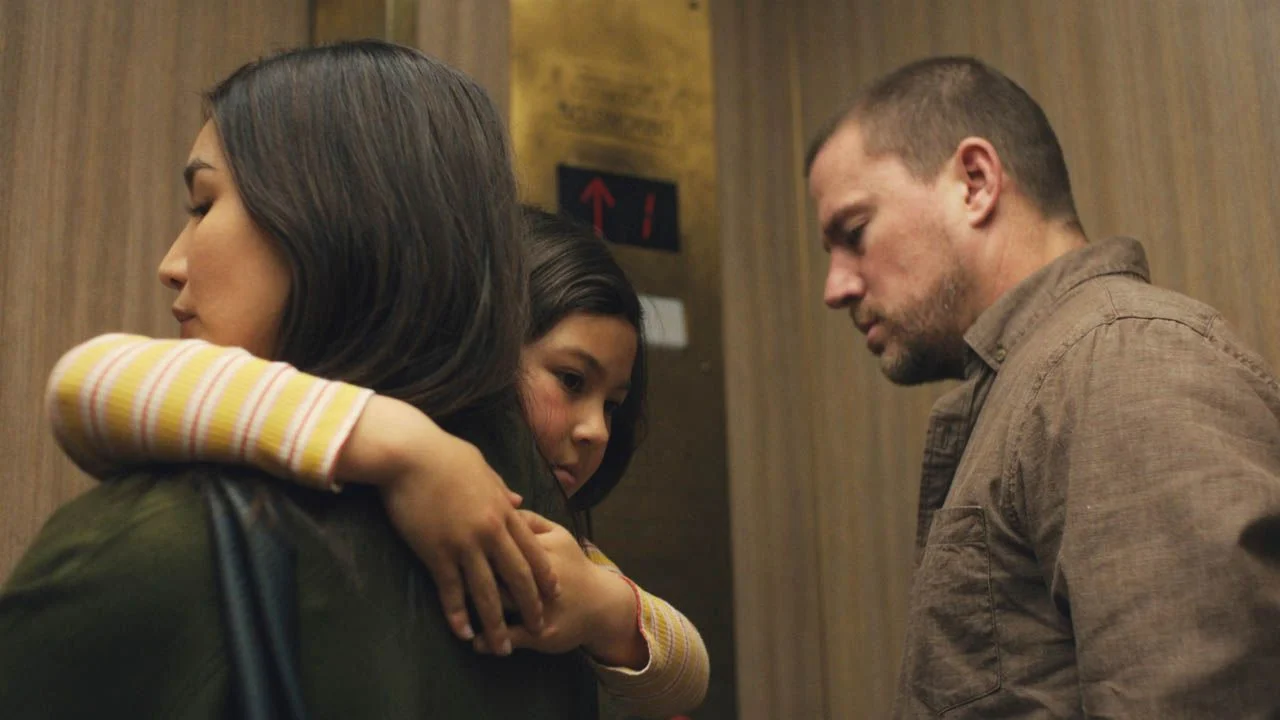
Claire (Gemma Chan) and Damien (Channing Tatum) deal with the trauma of their daughter Josephine (Mason Reeves) in completely different ways.
Like every Sunday morning, Damien takes his daughter to the park to play sports, but this time everything will be different. Josephine runs away from her father in the game and, from her hiding place in a secluded bush, sees a woman entering a public toilet. A man follows her, we hear screams, he drags her out and rapes her. Although we see the terrible attack from Josephine's perspective and therefore from a certain distance, the often nervously swaying camera of Greta Zozula, who was already responsible for the images in “Soft & Quiet”, hardly spares the audience a brutal detail.
Cope or prevent?
In the following, “Josephine” deals with what happens afterwards: What effect does it have when the very first contact with sexuality is linked to violence? How do you cope with something you don't even have words for? Is the pursuit of complete safety ultimately an illusion, analogous to the lack of a seatbelt in a police car, which is presented as a symbol early on – and what does this result in? In any case, father Damien and mother Claire (Gemma Chan) have very different answers to these questions: While she wants to consult psychological counsel, he appeals to Josephine's physical ability to defend herself in the event of an attack. Thinking about the psyche and the body, trauma processing and prevention together is something that neither the overwhelmed parents nor the film can do.
Most things in “Josephine” only happen because Beth de Araújo wants them to. Unlike “Soft & Quiet”, the film, which at least superficially strives for an empathetic approach, develops less from the experiences of the young protagonist than from constantly building artificial dilemmas and escalations around the psychological shock at the center in order to intensify the suffering: There is actually no reason why Josephine's parents do not deviate a millimeter from their supposedly contradictory attitudes and put additional strain on their child through incessant arguments, but that is just how their characters are written. One simply has to believe that no one can bring themselves to make a supportive gesture immediately after the crime has taken place.
Extremely manipulative
The way the film leads to the court hearing, which is placed as the finale, is also extremely crude. While Josephine is initially given the choice of whether she is willing to testify, later an all too obvious reason has to be constructed to force her to relive the traumatic experience as part of a cross-examination – and to actually sit physically opposite the perpetrator after he had previously appeared to her (a rather simple image) as a manifestation of her fear in places she believed to be safe, such as her childhood room.
Finally, the camera is constantly on her when the defense attorney casts doubt on her perception in an exaggerated and malicious manner: Even if there was violence involved, who is to say that the act observed was not consensual sex? “Some like it hard.” At least you can't blame Beth de Araújo for not staying true to herself: “Josephine” is feel-bad cinema that doesn't use any transparent manipulation tactics or woodcut-like script tricks until the irritatingly pathetic end.
Conclusion: “Josephine” tells the story of childhood trauma in a one-dimensional and manipulative way – and fails to develop a perspective that goes beyond pure suffering.
We saw “Josephine” at the Berlinale 2026, where the film celebrated its world premiere in the official competition.