
With the chamber drama comedy “My Hours with Leo”, in which Emma Thompson, as a retired teacher, treats herself to a date with the much younger sex worker title character, Australian director Sophie Hyde landed her biggest cinema hit to date in 2022. In the meantime, she has used this success not only to win art house superstars Olivia Colman (Oscar for “The Favourite”) and John Lithgow (“Conclave”) for her next film, but also to tell her most personal story to date with “Jimpa”: Sophie Hyde’s real father Jim Hyde left the family after coming out and then became a high-profile activist for gay rights and AIDS awareness until he died in 2018.
So he no longer saw how Aud Mason-Hyde (born 2005), the non-binary child of Sophie Hyde and her regular editor Bryan Mason, lived through her formative teenage years. In “Jimpa,” the filmmaker imagines what the interactions between her father and her child might have looked like – and shows, twelve years after her debut “52 Tuesdays,” about a mother who wants gender reassignment, how much queer stories are close to her heart. But especially in the case of “Jimpa”, you notice too much how much thought Sophie Hyde put into all the topics discussed – because the result often seems more intellectual and academic than engaging and touching.
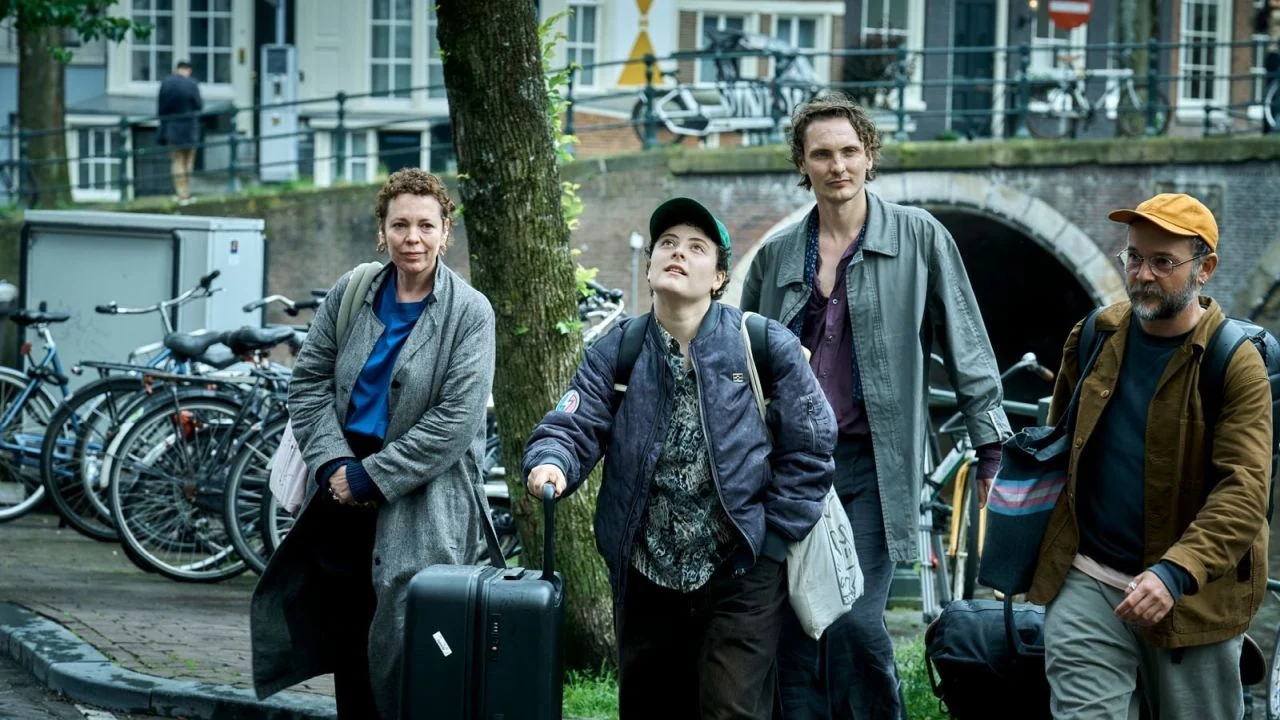
Frances (Aud Mason-Hyde) would like to stay with her grandfather in Amsterdam for a while, but her parents aren’t particularly keen on the idea.
In contrast to her real father, who remained in Australia even after leaving the family, the fictional Jim (John Lithgow) ended up in Amsterdam – one of the queer places of longing. That’s probably why her non-binary teenage child Frances (actually playing herself: Aud Mason-Hyde) tells her surprised parents shortly before their flight together in Adelaide that she would like to stay in Europe with her grandfather, known as “Jimpa”, for a few months.
While father Harry (Daniel Henshall) doesn’t take the request seriously, mother Hannah (Olivia Colman) is much more concerned. She asks herself whether her father, with his queer life experience, can actually give her child something that she is not capable of despite all the closeness and care – because Frances is the only non-binary person at the school. At the same time, Hannah also knows that her professor father is not the most reliable – especially since Jim is really struggling with the fact that, despite all his life’s achievements, the next generation is in danger of losing his academic rank…
Dumbledore, of all people, as a queer activist
There is a certain irony in the fact that John Lithgow can be seen in a pro-trans film in the cinema right now, while he embodies the Hogwarts headmaster Dumbledore in the first season of “Harry Potter”, which airs in December – after all, the streaming series is based on the novels by author JK Rowling, who is considered by many to be an anti-trans activist. But the two-time Oscar-nominated actor has always been open to queer roles, see “Garp and how he saw the world” or “Love Is Strange” – and in “Jimpa” he also shines as an aged pioneer who, larger than life, attracts everyone’s attention in his community, but at the same time also lets a vulnerable insecurity shine through: the AIDS battle has largely been fought – and the next LGBTQIA + fights will probably be the ones that follow Generations are at the front.
Olivia Colman also impresses as the director’s alter ego when she tries to pitch “a drama without conflicts” to her producers right at the beginning – and in real life, too, Hannah seems to prefer to avoid confrontations. But as appealing as the concept sounds at first, it also becomes a problem for “Jimpa”. Jim, Hannah and Frances do have – often disappointingly didactic – discussions among themselves, but they experience the crucial moments separately from each other: Jim at the job interview at a university in Helsinki and Frances during her first sexual experiences (in online reviews you read again and again how “weird” it is that Sophie Hyde staged sex scenes with her own child, but that’s really nonsense – especially since Frances’ polyamorous compersion adventures are based on all the literary research, but due to actual inexperience, the logic of the plot should appear more cerebral than passionate).
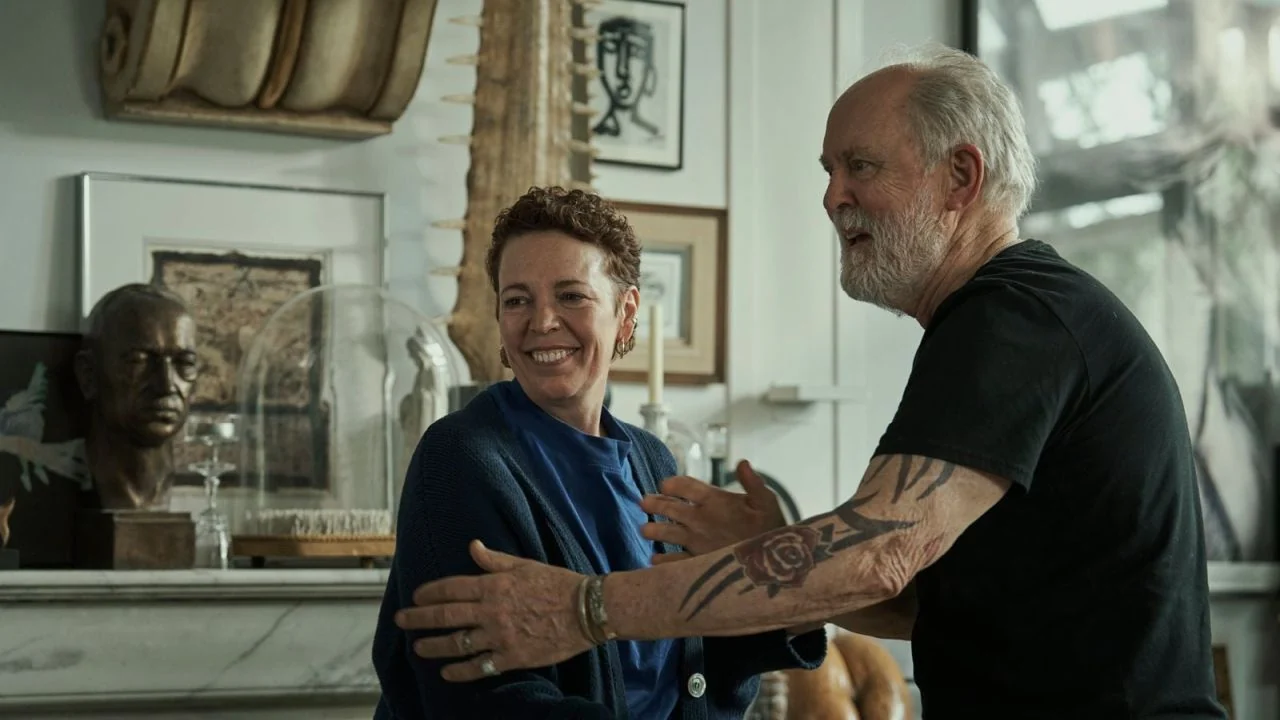
Jim (John Lithgow) likes to make big promises – but his daughter Hannah (Olivia Colman) knows that he doesn’t necessarily keep them.
The meeting between the gay grandpa and the non-binary grandchild, which never happened in real life, actually takes up surprisingly little space in “Jimpa” – and then passes without much of a bang. Instead, many strands, even when incredibly well-observed like the moment with the Friends Of Dorothy pins, remain on their own. In addition, Sophie Hyde noticeably wants to do everything right as Queer Ally. This is entirely welcome when dealing with your own child – but it doesn’t necessarily make for the best art. A few more rough edges and scenes and dialogues that seem more lived-in than thought-out might have been more effective.
Conclusion: There is clearly a lot worth telling in director Sophie Hyde’s relationship with her gay father and her non-binary child – but bringing the grandfather, who has already died in real life, and the grandchild together in a fictional scenario does not turn out to be as fruitful as it sounds at first glance. Despite the great cast and many very specific observations, “Jimpa” leaves you surprisingly cold.