
Jutta Brückner, born in 1941, is considered an icon of feminist filmmaking despite her small oeuvre. With her two autobiographically influenced major works, the documentary film essay “Do Right and Shy Nobody” about her mother’s life and the feature film “Hunger Years” about her own youth, she made female points of view radically visible. And – in the spirit of the second women’s movement of the 1970s – according to the motto: “The private is political!” So in her films she interweaves historical and social developments with women’s individual stories. “In My Mother’s Mirror” completes this trilogy with engaging mastery.
Tree skeletons rise eerily from dark water surfaces, mysterious lights flicker in the background. They seem to point the way to a small island in the moor. The beeping of an alarm clock bursts into this scene. Shortly before the sleeping woman sinks into the swamp, a female voice calls out energetically: “Wake up, you sleepyhead! Life is waiting for you with all its horrors.” Ursula (Corinna Harfouch) awakens. She has just lost her mother (Hildegard Schmahl), who died in a nursing home. Now she is alone with everything: with her grief, with the inheritance and with the dissolution of the household. As if frozen, Ursula walks through her parents’ house with the white-covered furniture and the huge amount of supplies in the pantry, even entering her old childhood room hesitantly.
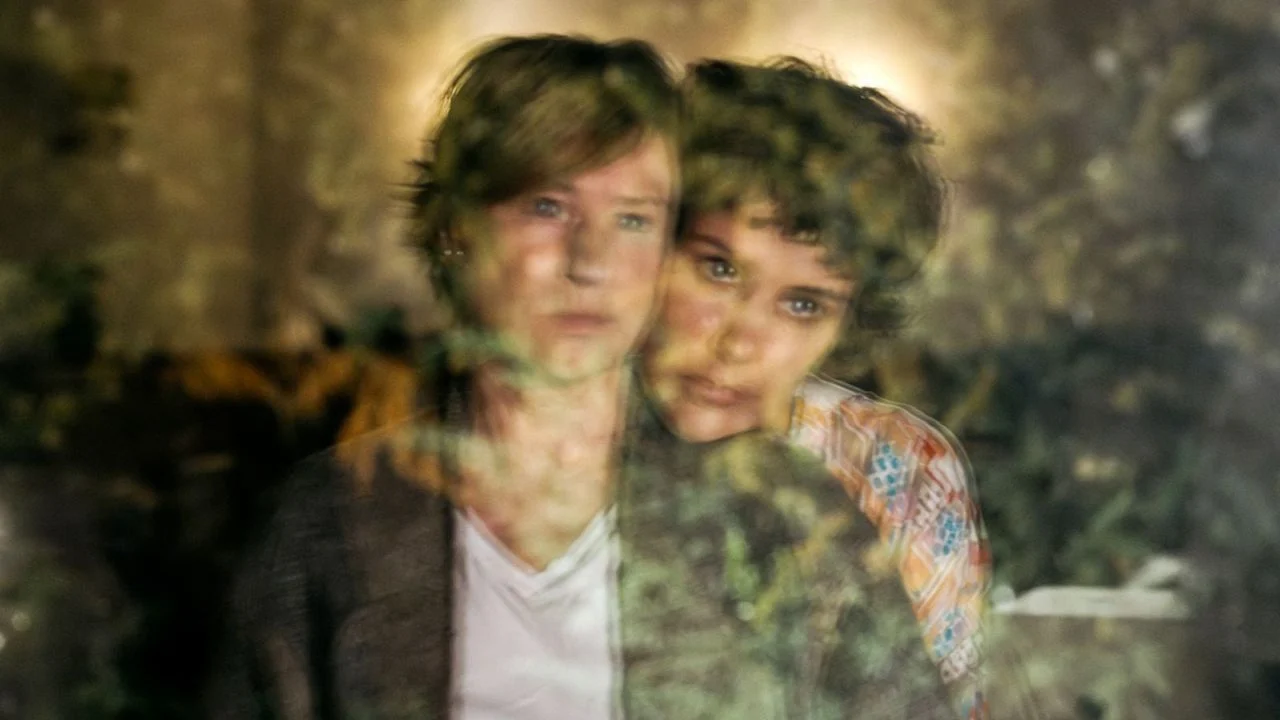
As one of the most famous symbols in film and literary history, the eponymous mirror also plays a central role in Jutta Brückner’s new work.
The quiet house stands in contrast to the noisy environment in which Ursula works: the institute where she works as an archaeologist turns out to be a chaotic permanent construction site – and now she has to give up her office. The new student assistant Melanie (Carla Juri) is already waiting there and is immediately entrusted with a delicate task: Ursula is hiding an illegally dug up bog body in the university basement that the newly minted assistant is supposed to clean. “And don’t say a word to anyone!” warns Ursula and puts Melanie up in her old childhood room; After all, the academic proletariat cannot afford their own apartment. In images between reality, fantasy and dreams, which sometimes develop an almost magical, surreal charm, Jutta Brückner develops the portrait of a lonely woman without a private life or family who, after the death of her mother, is confronted with the traumas of her childhood and at the same time has to cope with her everyday life.
Her mother’s crushing love continues to haunt her – and it’s a love that she couldn’t or didn’t want to reciprocate. It is no coincidence that the protagonist’s name is Ursula Scheuner – that was the name of the young heroine in Jutta Brückner’s “Hunger Years”, who was raised by a mother who was powerless to surrender to the restrictive female role of the 1950s. Meanwhile, Ursula from “My Mother’s Mirror” grew up in the 1970s – and yet little has changed. She has now emancipated herself, at least outwardly, and has dedicated her career to depicting the “Magna Mater” – sculptures and images of women and goddesses since the Stone Age. In her private life, Ursula still struggles with her mother and her own childhood. “You still have a score to settle with me, but I also have a score to settle with you,” says Ursula to her reflection in the mirror, in which she sees herself next to her mother, who is becoming increasingly demented.
Mirror, mirror
The mirror was and is considered a gateway into another reality – also in the sense of access to the inner world. In the film, he becomes a symbol of the passing of time and of the change in the mother from a well-groomed older lady to a helpless old woman who still recognizes her daughter in the mirror, but no longer recognizes herself. How Ursula only approaches her mother after her death, and how she rediscovers her relationship with her father through this reflection, is just as much a theme of the film as Ursula’s professional and personal examination of the role of mother. The bog body had a child with it. Why did this woman and mother become a victim of multiple killings many hundreds of years ago? Could Melanie be something like Ursula’s never-born dream daughter? “I’m a second-class angel who has to earn my wings,” says Melanie with a wink.
The self-confident, cheeky Melanie is also a symbol. She stands for the young, courageous women of today who take what they want and what they deserve. Symbols play a major role in this complex, cleverly conceived drama, in which reality is refracted like in a mirror puzzle. The boundaries between past and present as well as between reality and dreams dissolve – for example when a little girl, easily recognizable as Ursula, skips through the hallways of the nursing home. The university as a construction site represents the upheaval of society and everyday chaos. No discussions can take place in this noise. Communication is becoming increasingly difficult. A student is caught between uptightness and misogyny and becomes a threat. A student who has become a mother has no one to talk to and can no longer sleep.
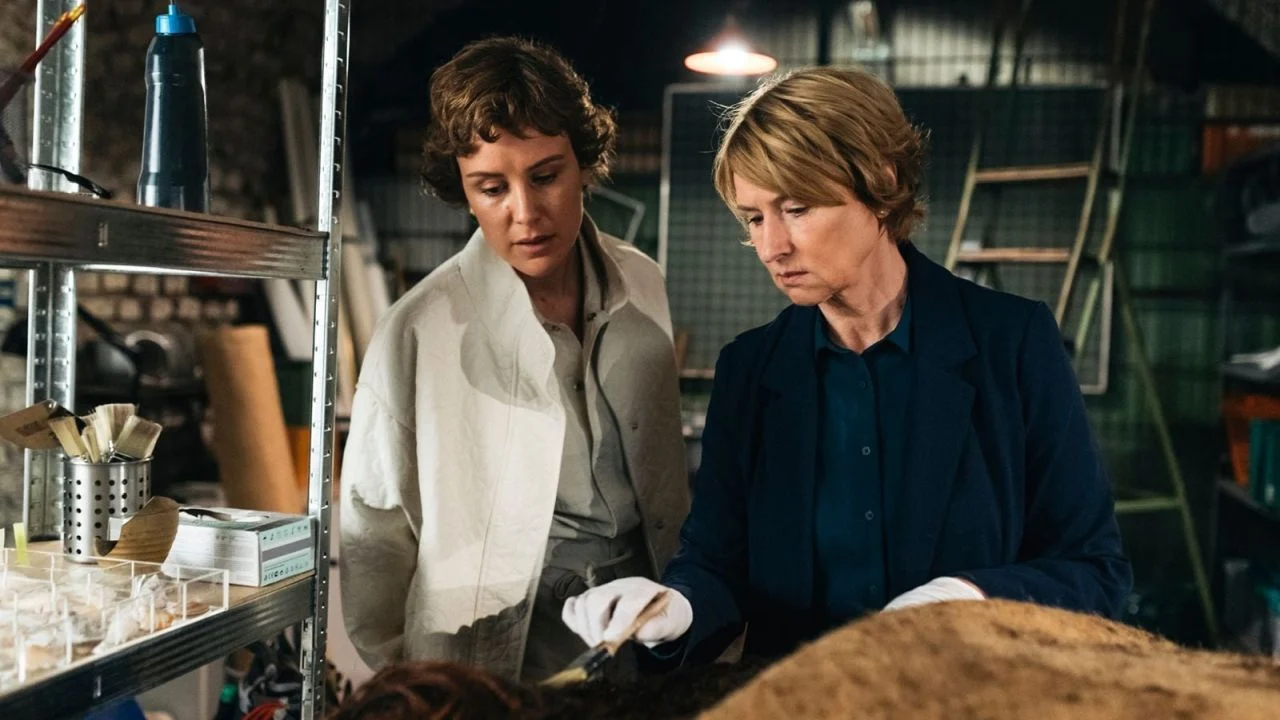
Ursula (Corinna Harfouch) and her new assistant Melanie (Carla Juri) literally have a (bog) corpse lying in the basement.
Jutta Brückner has never been a fan of political agitation – and she remains true to that. It is the individual, well-observed fates of women that interest her and which are determined by external circumstances just as they were 50 or 70 years ago. And she expects a lot of attention, thanks to the numerous flashbacks and memory sequences. What is striking are the carefully composed images, which are rare in German films. This includes not only the swamp landscape from the beginning, but also the motif of a red hose, which runs noticeably inconspicuously through the film and increasingly influences the color scheme. Some cinematic devices are reminiscent of horror thrillers, including the use of music: “La Paloma” as a symbol of the wanderlust of the post-war generation. Some things seem playful in their laconic reference to reality, such as the story of the discovery of the bog body or the question of the cause of Ursula’s mother’s death. Both appear again and again, just like Ursula’s dreams and memories: casually, without much fanfare.
Some things remain unclear, just as not everything can be explained in real life. Perhaps it is precisely this combination of emotional and dramatic understatement that makes the film so special and worth seeing. The mood remains cautiously optimistic, perhaps with a touch of melancholy. Corinna Harfouch (“Cold Dog”) plays Ursula with endearing brittleness. The way she approaches her father – the man in her life – through her mother is as calm as it is intense. Carla Juri (“Wetlands”) as Melanie could be Ursula’s younger and self-confident alter ego and contrasts her with the carefree attitude of youth. Here the professor who is always questioning herself, there the spontaneous student. Is Melanie the woman of the future?
Conclusion: From the almost lyrical beginning to the surprising conclusion, a mother-daughter relationship is dealt with in an atmosphere between psychological thriller and analytical drama. This is very well done – not as a monument to a film language that could possibly be called feminist, but as an inventory of a development, observed with female insight, that is far from complete.