
Through the open bathroom door we see a naked man peeing standing up. After a camera pan, he suddenly disappeared. No wonder, after all, the man died a few days ago – and Leyla Bouzid's third feature film “In A Whisper” takes place during the multi-day funeral ceremonies in Tunisia.
It is by no means the only place where splintered memories force their way into today's images in a surprising way. A look in the rearview mirror, a drift away, an impending drowning in the sea – everything can be an opportunity to open the door to the past. But how much has actually happened since then?
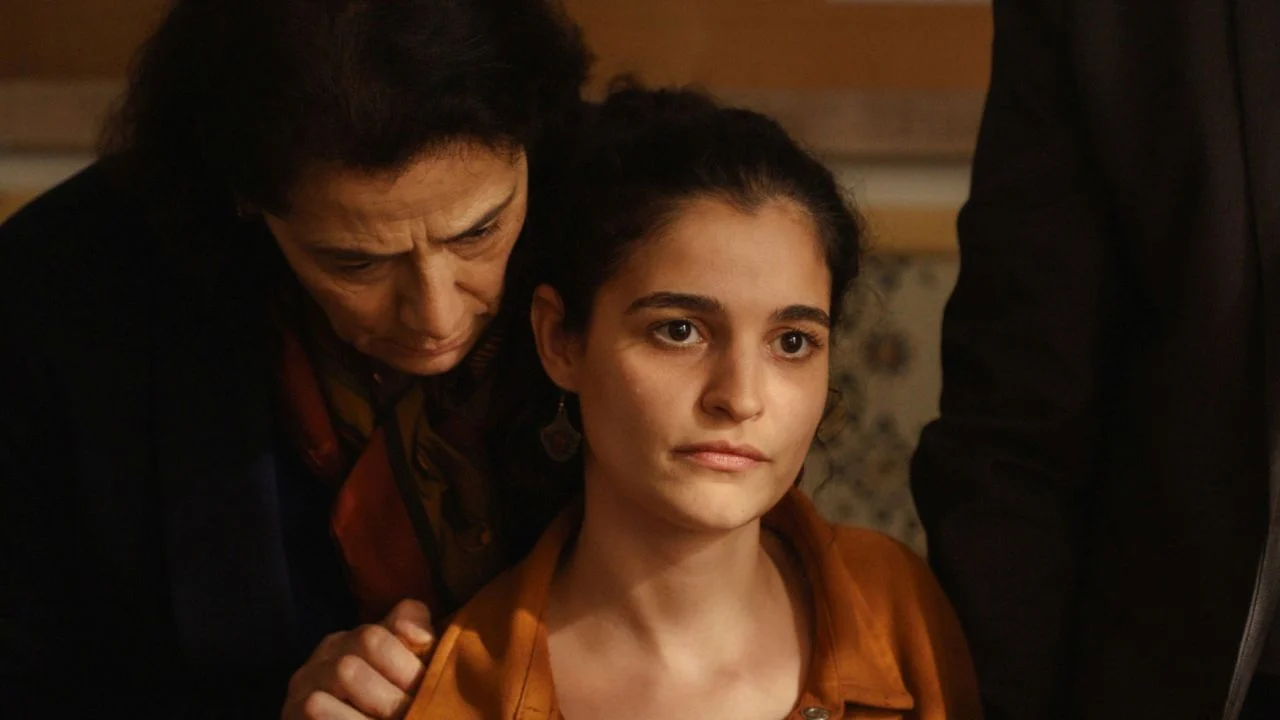
Lilia (Eya Bouteraa) is afraid of how her mother Wahida (Hiam Abbass) will react if she finds out the truth about her daughter.
The dead man was the uncle of the protagonist Lilia (really great: Eya Bouteraa). And he was homosexual, which everyone knew, but was talked about – if at all – only in very quiet voices (including the original French title “À Voix Basse”). The cause of death was determined to be a heart attack. Because the body was found naked, the police are still investigating.
For the successful engineer Lilia, it is the first time in a long time that she has returned to her homeland from France. And the death of her uncle is so close to her because she recognizes herself in him: after all, she lives with her partner Alice (Marion Barbeau) without her mother Wahida (as usual strong: Hiam Abbass) or the rest of the family being allowed to find out anything about it.
A lot of things seem all too familiar
In her best film to date, “A Story of Love and Passion” from 2021, Leyla Bouzid (“As I Open My Eyes”) tells the story of a young Frenchman of Algerian origin who grew up with repressive Muslim morals, but is then confronted with thousands of years of Arabic erotic literature – and questions his entire worldview. An exciting conflict that has never been seen in the cinema, in contrast to the central constellation from “In A Whisper”.
The fact that someone returns home after a long absence and is confronted with (dark) family secrets now seems to be something of a go-to plot in international festival cinema. And Leyla Bouzid doesn't do enough to counteract this impression of the familiar. The purely functional scenes with a corrupt police officer at a street check or a homophobic brother-in-law in a restaurant almost seem like clichés, even if something like this happens thousands of times every day.
The mother-daughter relationship is by far the most exciting
The same applies to the moments in which Lilia investigates on her own. Because even the homosexual men she meets hardly rise above the status of cue providers – they only seem to be there to (very clearly) mirror the fate of the protagonist. The relationship with her mother is much more exciting when Lilia slowly realizes that she has always advocated for her uncle and a more open approach to his sexuality. But does that really mean that she can also “safely” open up about being a lesbian?
If at some point this actually happens – although not entirely voluntarily at first – then there is definitely something liberatingly cathartic about how Lilia develops more and more self-confidence. This goes as far as negligent provocation, where you yourself as a spectator are suddenly no longer sure whether you should continue to cheer them on or whether you should also call for caution – a pleasant ambivalence. At the same time, the relationship with her mother remains in a fragile state. In any case, Leyla Bouzid would do well not to let the audience leave the cinema too forgiving and with a bow all over them.
Conclusion: The penetration of the past into the present is always surprising, and the floating ending is also strong. But otherwise too much seems too obviously constructed to have its full impact.
We saw “In A Whisper” at the Berlinale 2026, where it celebrated its world premiere in the official competition.