
Rarely has an actor merged with a role as inextricably as Sylvester Stallone. Even before his name is mentioned, there is already Rocky Balboa (later, in a different tone, Rambo would also be added). The simple but generous boxer from Philadelphia who fights his way from the depths of life into the bright light of success – and in the process learns a lesson that goes far beyond the ring: that sometimes it’s less important to distribute than to receive.
“Rocky” not only condensed the archetypal American promise of advancement, but also Stallone’s own biography. The actor, who had struggled in vain for his place in the film business for a long time, dedicated himself to the role of the outsider and turned a supposedly small underdog ballad into a modern legend against all odds. Oscar winner Peter Farrelly (“Green Book”) tells exactly this story in “I Play Rocky”. Although the film comes across as overly pleasant and well-behaved, it does develop a gripping pull.
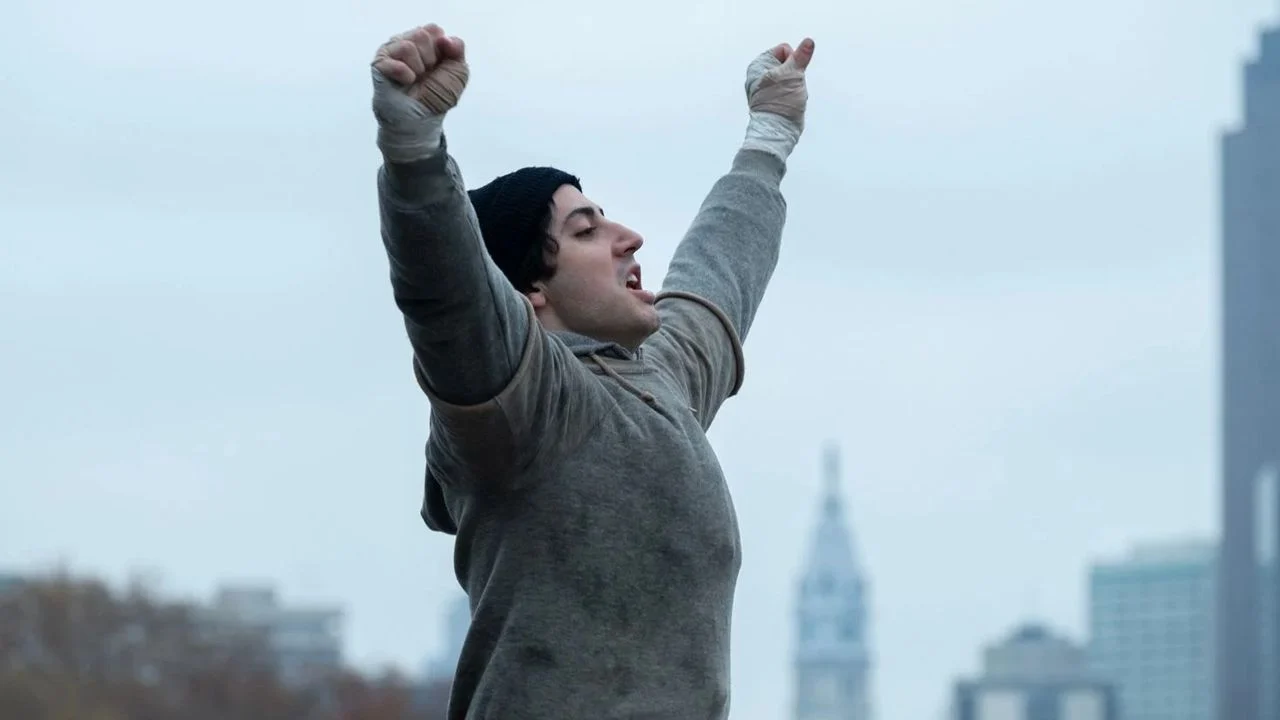
It’s not just this “Rocky” pose that Anthony Ippolito masters brilliantly as Sylvester Stallone.
New York, mid-1970s. Mike Stallone (Anthony Ippolito) is an unsuccessful actor with no money or prospects. He regularly receives laughter at his auditions, which is why he has to keep himself afloat with odd jobs. As a cinema admission he finally meets Sasha (AnnaSophia Robb). He falls in love with her and at the same time benefits from her wise advice for his career. So she suggests that he finally use his real name: Sylvester Stallone.
Together they move to Los Angeles, where Stallone writes script after script. One evening while watching the legendary boxing match between Muhammad Ali and Chuck Wepner, he had an inspiration – and then only needed three and a half days to put an idea on paper that would change his life: “Rocky”. For the first time, Hollywood is showing interest in his material. But Stallone’s demand to play the lead role himself soon brings the studio to the brink of madness…
An ode to perseverance
What makes the well-known origin story of “Rocky” so impressive is Sylvester Stallone’s persistence: even in situations that often seem financially hopeless, he steadfastly holds on to the belief that he can make his dreams come true. This is exactly where Peter Farrelly and his screenwriter Peter Gamble Robinson come in when they try to explore Stallone as a character: the strange strength of a human being who insists on maintaining his dignity and integrity under all circumstances.
With a high pace and an unfortunately flat, televisual-like digital look, but with a harmonious period color, especially in terms of equipment, “I Play Rocky” tells the episodic story of Stallone’s beginnings as an actor in New York. He endures setback after setback until he realizes that his breakthrough will only come if he takes on the lead role himself. But the move to Los Angeles also initially brings with it concerns about livelihood. In one of the most moving scenes, Stallone has to sell his beloved dog Butkus for $40 in front of the assembled customers at a supermarket in order to even get through the next week.
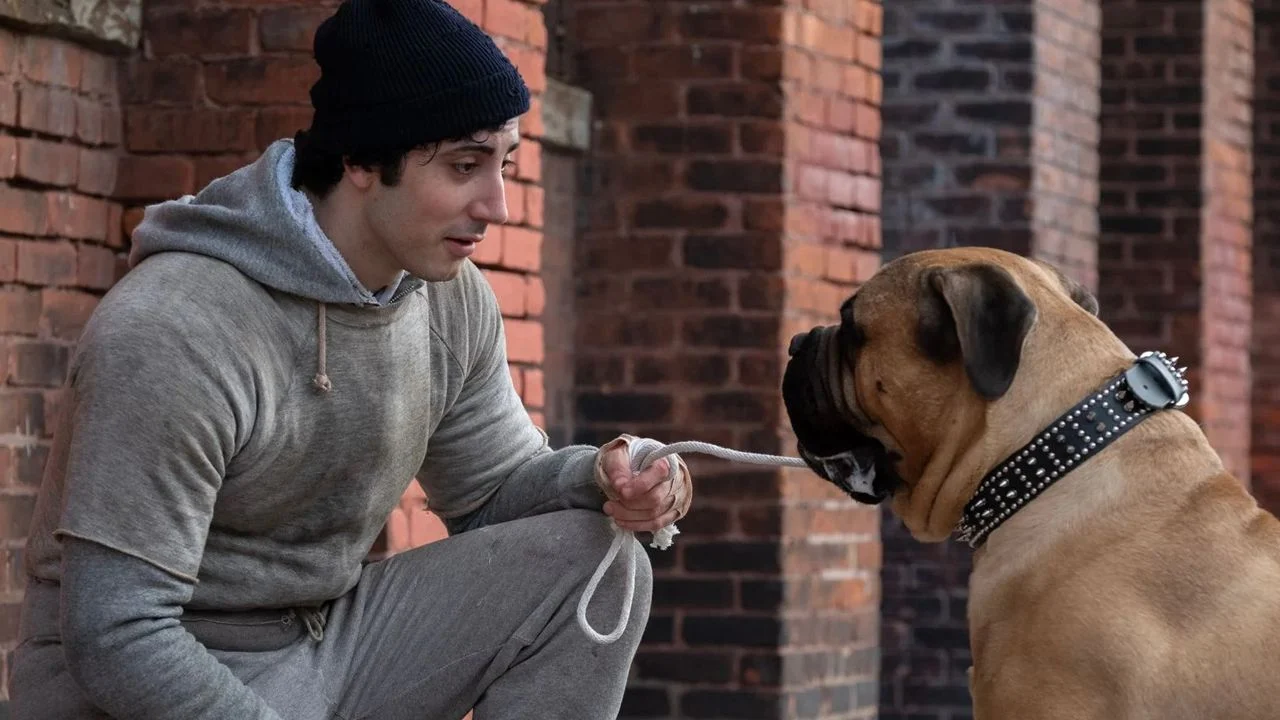
Sylvester Stallone (Anthony Ippolito) and his best friend Bullmastiff Butkus.
In fact, the almost 130-minute running time of “I Play Rocky” flies by, because Peter Farrelly, who comes from a comedy background, knows how to combine classic narrative cinema with a nostalgic superstructure and accurate situational humor with sleepwalking confidence. The film is particularly enjoyable when it activates the audience’s prior cinematic knowledge: you can hardly help but smile when the producer, who is skeptical about Stallone’s inexperience, is reassuringly assured that in the event of a flop, they still have “New York, New York” up their sleeves – and the proceeds from both films can simply be added together. After all, Martin Scorsese delivers one hit after another!
So you can be thoroughly entertained by all the references and references and rush through the creation of a pop culture milestone with a lot of momentum. This should provide a lot of enjoyment, especially in a full cinema – including thunderous applause when Sylvester Stallone repeatedly turns down offers to sell his script for several hundred thousand dollars. A deal that would have freed him from all financial worries in one fell swoop and made him rich overnight. But Stallone remains stubborn. This is exactly where perhaps the most beautiful running gag lies.
Total pandering
As humorous as “I Play Rocky” comes across, the film ultimately remains superficial and simple. The reconstruction of a story that actually inspires and shapes generations turns into a formulaic, paint-by-numbers crowd pleaser that is downright afraid to give its audience even a hint of friction. It almost goes without saying that Sylvester Stallone, who was not involved in the project, gave the film his blessing after the viewing: his character wraps the audience around his finger with endearing perseverance and portrays him as a pure ideal of the indomitable fighter.
His biggest problem is the occasional bubbling self-doubt, for which the script always offers the same solution: some supporting character, either his wife or the producers Irwin Winkler (PJ Byrne) and Robert Chartoff (Toby Kebbell), is allowed to encourage Stallone in moments of hesitation to the accompaniment of gentle piano music and assure him that they unwaveringly believe in him. “I Play Rocky” never looks beneath the surface. Even the extremely difficult relationship with his father (Matt Dillon) remains secondary and is ultimately allowed to dissolve happily. In order to completely ingratiate himself with Stallone, the film even assumes that he has a stately estate, which his ex-wife Brigitte Nielsen was once unable to confirm in the “Jungle Camp”.
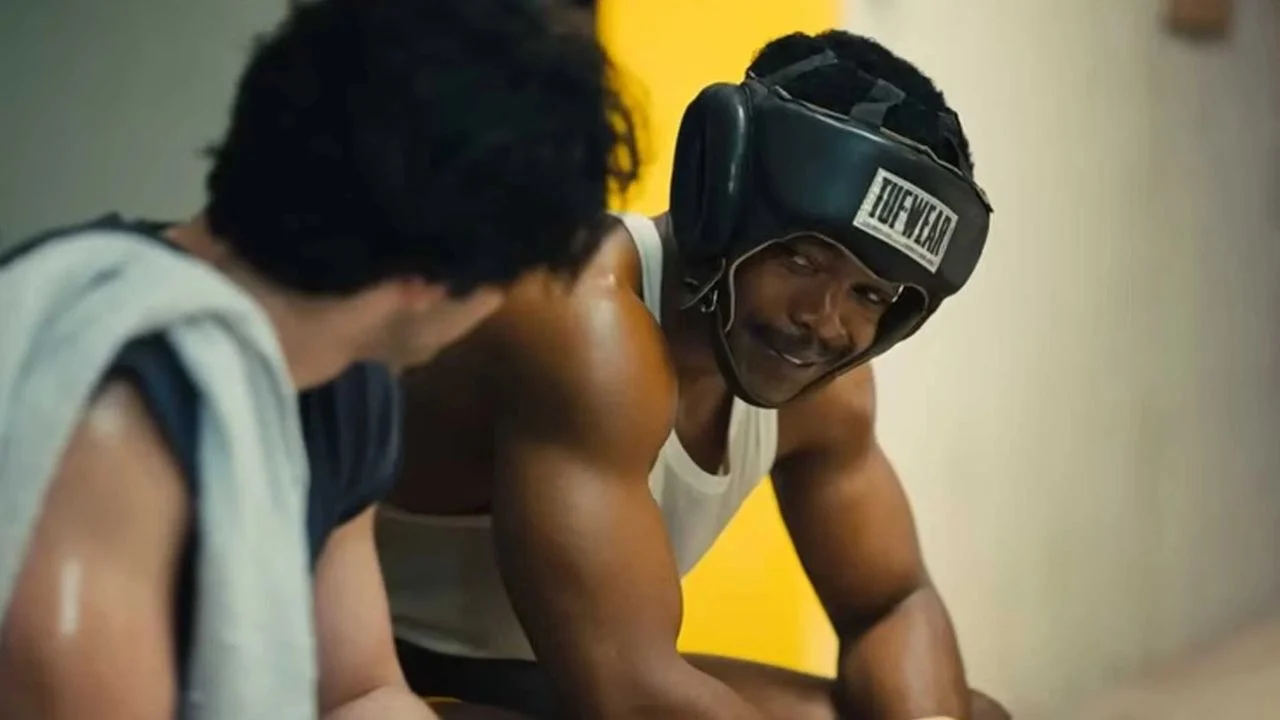
Carl Weathers (Stephen James), who embodies the larger-than-life competitor Apollo Creed in “Rocky,” can of course not be missed either.
Yes, “I Play Rocky” is a pleasant, calculated pastiche that is about imitation, not about deciphering, understanding and classifying – that is, about that profound, deeper truth that goes beyond mere imitation. This also applies to Anthony Ippolito’s performance. The Oscar nomination should actually just be a formality here. Pose, gestures, facial expressions: The 27-year-old captures Stallone with amazing precision in his detailed mimicry. It’s not just confusingly similar, but sometimes almost identical in language, movement and attitude.
However, it is nothing more than a remarkable copying of behavioral patterns, because your own identity remains hidden behind the perfect copy. “Rocky” director John G. Avildsen (Jay Duplass) explains to Stallone at one point in the film that it’s about that metaphysical, intangible “something” that turns a film worth seeing into a masterpiece. Quite apart from the fact that magic cannot be copied and “I Play Rocky” sometimes prefers to talk through the key scenes of “Rocky”, the film is missing exactly this “something”.
Conclusion: “I Play Rocky” is a real audience favorite that is a lot of fun, especially in a fully occupied cinema. Peter Farrelly tells the inspiring story of the creation of the legendary underdog ballad in a fast-paced, humorous manner and peppered with lots of industry references. Ultimately, the film remains a pleasant pastiche that, beyond perfect imitation, lacks friction, depth and its own insights. It’s definitely entertaining – and “I Play Rocky” is likely to cause quite a stir at the 2027 Oscars.