
A little provocative, but consistently light-hearted and always careful to be gentle in the ending: this is how the French family comedy has been playing in German art house cinemas for decades. The French comedian and actor Franck Dubosc has also produced solid representatives of this genre in recent years with his directorial works “Love Makes Everything Roll” and “The Rumba Therapy”, which were able to provide a few heartwarming laughs here and there.
But with his latest film “How To Make A Killing,” Dubosc takes a darker tone – at least at the beginning: after all, it’s about the momentous incursion of criminal activity into a sleepy town in the snowy Jura Mountains. Blood and snow? This is certainly not a coincidence reminiscent of “Fargo” by the Coen brothers.

What's the best way to make corpses disappear when a wild bear is known to be causing mischief nearby?
A few days before Christmas, Alan (Jeremy Senelier) leads four migrants through a snow-covered forest in the Jura Mountains, whom he describes as “goods” during a telephone conversation with his clients. But the intended handover on the country road is suddenly interrupted when Alan and his customers are attacked by a black bear. However, Michel (director Franck Dubosc himself), a family man and resident of a nearby town, doesn't notice anything about this. He is driving his car home, where he and his wife run a small, barely profitable Christmas tree farm.
There is a report on the radio about ongoing inflation, which Michel ultimately pushes away. When he spies the bear on the road shortly afterwards, he swerves and crashes into a parked car. The inmate dies on the spot. Her companion, who has gone to the edge of the forest for a pee break, is so frightened by the bloody sight that he stumbles, falls and impales himself on the sharp branch of a tree stump…
Promising start
So far, so exciting! “How To Make A Killing” takes no prisoners from the start. The crime comedy continues to maintain this darkly humorous tone when Michel, who is still in shock, confesses the hit-and-run accident to his wife Cathy (Laure Calamy). As an avid crime reader, Cathy is less shocked by her husband's escape than by the fact that he didn't properly cover his tracks. When the two of them want to do this at the scene of the accident, they discover a pistol and a bag full of money in the car, which they immediately take. After all, they are financially up to their necks.
Meanwhile, the four surviving migrants have arrived at the local police station without their smuggler and tried to inform the slow-moving gendarme about the bear in the forest despite the language barrier. But police chief Roland (Benoît Poelvoorde) is a bit distracted so close to the holidays: his ex-wife and a new boyfriend have announced that they're coming for Christmas and, as an abandoned man, he wants to make the most dignified appearance possible. Police officer Florence (Joséphine de Meaux) doesn't seem to be very alert either, as she has been struck down by a persistent cold. And so for some time both of them miss the fact that not only is there a bear wreaking havoc in the forest, but the drug deal gone wrong will also cause a lot of pre-Christmas mischief.
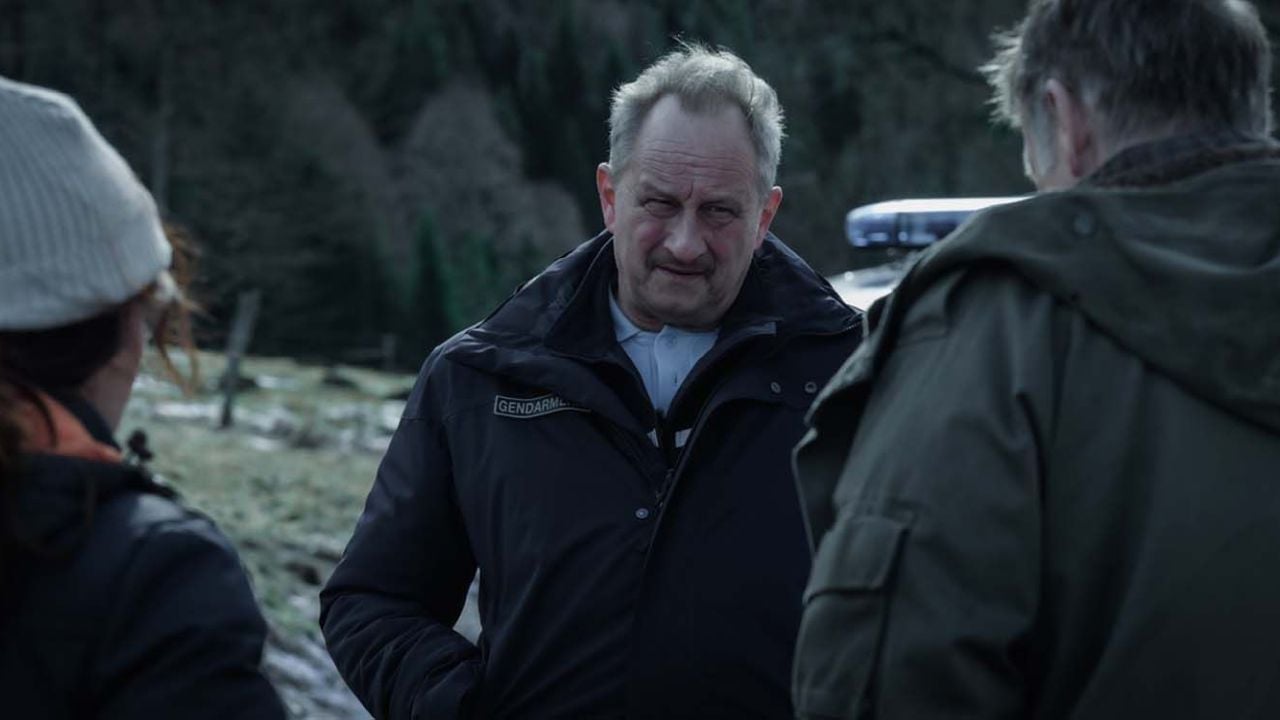
Police Chief Roland (Benoît Poelvoorde) actually has completely different things to worry about than a wild bear and an out-of-control drug deal.
The characters developed by Franck Dubosc and his co-author Sarah Kaminsky are by no means lacking in quirkiness: they are all carefully designed as characters who have to struggle with their private quarrels, peculiarities and loneliness in this scenically impressive but socially barren province. Michel and Cathy are no exception: not only do they have unpaid bills piling up, but also unspoken frustrations, such as concerns about their autistic son Doudou (Timéo Mahaut). The bag full of money comes in handy, but when they decide to make the two bodies disappear, it becomes absurd to see how much they lack criminal energy.
At first you watch with amusement at the comical amateurism that the two of them display in the cover-up. But the general inability soon leads to such outrageous decisions that they can neither be understood nor ignored. The noir element that was initially attempted disappears completely from this story, which for long stretches prefers to turn to the lighter (and more Christmassy) nuances of black humor, only to then go back to full crime thriller coldness. Despite the repeatedly flashing awkwardness of the provincial residents, “How To Make A Killing” has a hesitation that makes the differences to a consistent noir like “Fargo” painfully clear. The premise of “How To Make A Killing” certainly had the potential to do so.
Conclusion: “How To Make A Killing” shines with an atmospherically dark start, but then unfortunately abandons the darkly humorous tone in favor of a tamer, more holiday-appropriate fun. Thanks to the loving, odd characters, it's still an amusing, entertaining film in Franck Dubosc's usual warm-hearted tone.