

If Hape Kerkeling becomes a cult figure again after a long break, he will have to fulfill a big task.
The great wave of nostalgia continues to roll on. Whether it’s Christoph Maria Herbst as Stromberg or Bully Herbig in “Kanu des Manitu” – everyone is currently feeling anxious to transform themselves into their most successful role again. So too Hape Kerkelingwhich comes 17 years after the first movie in “Horst Schlämmer is looking for happiness” (Cinema release: March 26th only in Germany!) brings his cult character of the same name back to the screen. In between, he had completely said goodbye to the character for years, this prototype old white man, blatantly invasive, shamelessly selfish, but also terribly funny and lovable – at least back then. Of course, the contemporary relevance of such a figure can once again be debated.
On a mission to keep you in a good mood
Horst Schlämmer is fed up: “Germany has its back.” Because of the corona pandemic, his favorite bar has closed and he only has a few joyful encounters in Grevenbroich. Everyone seems grumpy and spoils his mood. That’s why the deputy editor-in-chief of the “Grevenbroicher Tagblatt”, accompanied by a companion who acts invisibly behind the camera, goes on a road trip through Germany in mockumentary style to meet a wide variety of people in order to bring back happiness in view of the global political situation.
His journey takes him, among other things, to drug dealers in Berlin, on a shrimp boat, to Cologne to Cardinal Woelki and the hope of divine assistance, and to Bavaria to Prime Minister Markus Söder. After all, he always praises his state beyond praise – and then there’s this one woman.
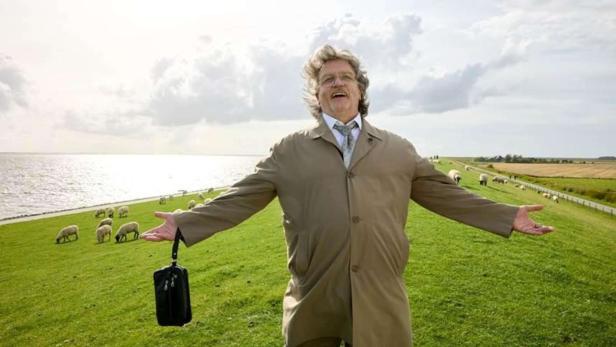
Scene from “Horst Schlämmer is looking for happiness”
Stuffy trench coat and dusty humor
The great search for happiness in different places seems so banal so far and has already happened. It is not without intention that the title is reminiscent of the 1976 film “Mr. Rossi is Looking for Happiness,” based on the Italian animated series that primarily accompanied Hape Kerkeling’s generation as they grew up. While Mr. Rossi traveled through different time zones and countries, Schlämmer traveled to places in the Federal Republic. And he goes there like in a poorly edited YouTube video.
The look is intentional, but you still have to get used to it, just like Horst’s way. Many of his gags don’t work, are exaggerated and sometimes seem “cringe”, as Gen Z would say. Somehow everything is out of date and a bit dusty, which is what the trench coat and wig actually are. Because times – and humor – have simply changed since Schlämmer’s last cinema appearance. The satire of an out-of-touch local journalist with latent sexism in times of a real Donald Trump in power is no longer a big upset. And where the boundaries between funny and strange become blurred when Schlämmer allows himself to be whipped by a dominatrix, everyone has to decide for themselves. So you have to focus on nostalgia if you want to laugh at Schlämmer. Especially since he’s no longer what he used to be because he even gives up his beloved Doornkaat. Know it.
Lots of successful meta levels
But Schlämmer is still played by Hape Kerkeling, a gifted actor and comedian. And fortunately, Schlämmer’s search for happiness is just the framework for a lot more Kerkeling. Because over the course of the film he slips into other roles that require you to go to the meta level: Schlämmer is a big fan of the actress Gabi Wampel, played by Tahnee Schaffarczyk (33), and always watches films from the 50s to 90s with her. In these, Tahnee as Gabi plays various roles in real film productions.
As a player in the satires of “Veterinarian Dr. Mertens”, “The Dream Ship” or “Tatort”, Hape Kerkeling sometimes becomes a chameleon-like strict teacher, sometimes a sophisticated crusader or a dapper groom. The film within the film and the Hape in the Horst, so to speak. This brings back memories of his legendary performance as Queen Beatrix and the sketches actually work extremely well in all their exaggeration, the nostalgia factor is right here. Comedian Tahnee in her first major film role also fits Kerkeling wonderfully.
Hape is best without Horst
By the way, he also appears as himself, the fictional Hape Kerkeling in the film has written a book and a song about happiness and is therefore of course also interviewed by Schlämmer. Kerkeling plays himself arrogantly and consistently unsympathetic. “For me, being happy doesn’t mean sitting opposite a grunting joker,” he tells Schlämmer – and in doing so, he sums up the Grevenbroicher’s demeanor in a very self-ironic way.
The funniest scenes are precisely those in which Kerkeling doesn’t play the slacker at all, but is able to use the full range of his skills. The exception is perhaps the improvised interview with Markus Söder. Because this shows Horst Schlämmer again at his best and remains the film’s highlight.
Conclusion
Does the film fit into today’s times or not? Somehow yes, in a world that is becoming increasingly extreme, he shows a focus on the essentials and asks the simplest questions. Why are we the way we are towards each other? But simple questions don’t necessarily mean that the Schlämmer gags have to be that simple. And of course the film doesn’t have any answers. To achieve this, Hape Kerkeling and Tahnee get out everything that is possible in the films within the film.
Whether it’s this Horst Schlämmer comeback from director Sven Unterwaldt So what it took is difficult to answer. Because what is needed in this world? “I’m looking for happiness, that’s all a person needs to live,” sing Hape and Horst – with a very catchy tune, by the way – in the film. Definitely needs more laughter. And if Schlämmer can ensure this with a few spectators, he has already fulfilled his goal.
3 of 5 Schlämmer menus with fortune cookies