
The first meeting plays a central role in actually all love stories. Nevertheless, in books or films – as in real life – things can still be turned around on the second or third date if necessary. But “Amrum” director Fatih Akın doesn’t have exactly this second chance in “Ghosts”, instead the chemistry has to be right after just a few seconds on screen. Finally, his protagonist dies just a few minutes after the first – as it is now called in romantic art lingo – meet-cute. If that had gone wrong and the spark hadn’t spread to the audience right away, the Golden Bear winner (2004 for “Against the Wall”) could have also thrown the following 100 minutes of his 13th feature film into the trash.
But it crackles – and how!!! Three high schools have joined forces to hold their graduation ceremony this year at a height of 124 meters in the event area of the Hamburg television tower. There is an expected, exuberant atmosphere. Only Farasha (Mariam Dawoud) and Faris (Eren M. Güvercin) order water – and after comparing their points in the physics Abitur (13 and 14), they also place a bet on their overall average grades (1.1 and 1.2). One might think: ambitious, stuffy, boring. Akin could certainly have chosen a cooler pair of lovers at this party, right? But it’s amazing: the two of them fall in love after a dialogue about partial differential equations – and the entire cinema hall too!
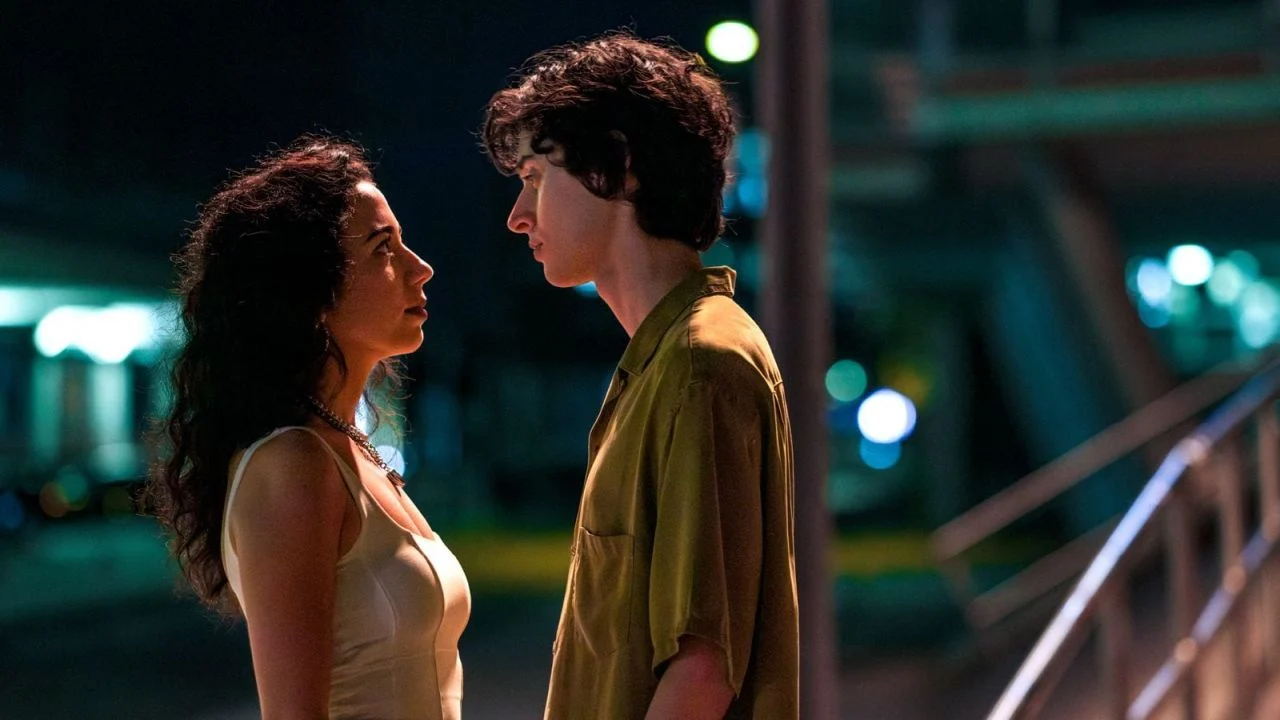
We’ve recently rooted for few cinematic couples as much as Farasha (Mariam Dawoud) and Faris (Eren M. Güvercin).
It’s actually clear that there will be more to it, even the appointment for the next lunch is certainly just the beginning. But after a particularly confusing route through a construction site in the remote harbor area, the two end up in the Elbe with Farasha’s best friend Una (Carlotta von Falkenhayn) and Faris’ best friend Max (Gabriel-Winner Amorin). As “Ghosts” progresses, we will return again and again to the spectacularly filmed underwater scenes – and only gradually find out what actually happened down there on that stormy night. One thing is clear, however: three survived and Farasha is dead.
Faris, who initially lost consciousness after the impact and checked out of the hospital on his own the next morning, only found out about it when he suddenly saw all the “RIP” comments on her Facebook profile, where he actually just wanted to confirm the planned date. It tears your heart together with him at this moment. Nevertheless, Fatih Akın is absolutely not one to force tears out. Instead, “Ghosts” is an incredibly tender, zero-point-zero percent cynical film that treats its characters with a disarming level of understanding and empathy.
Not a shred of cynicism
Faris’ mother Mine (Anna Bederke) is German, his absent father is Turkish. Farasha, on the other hand, comes from Syria and had the scars from the dog bites she suffered while fleeing to Europe tattooed into a butterfly. That sounds like a template for a classic (read: cliched) culture clash drama, in which the couple has to defend themselves against all possible resistance from outside. But as we later find out, Farasha decided to wear the headscarf at the graduation ceremony all by herself; neither her sisters nor her mother Shifa (Lama Alhalbi) wear one.
And even if the first meeting of car driver Faris and Farasha’s family isn’t a cheesy peace and joy pancake moment, Akin and his co-screenwriter Ruth Toma once again act with such enormous generosity towards all of their characters that by the second meeting at the latest you can’t help but cry uncontrollably. But why did I actually write about “couple” in the previous paragraph, even though the two had no chance of getting together? It’s simple: After her death, Farasha visits her Faris in his dreams.
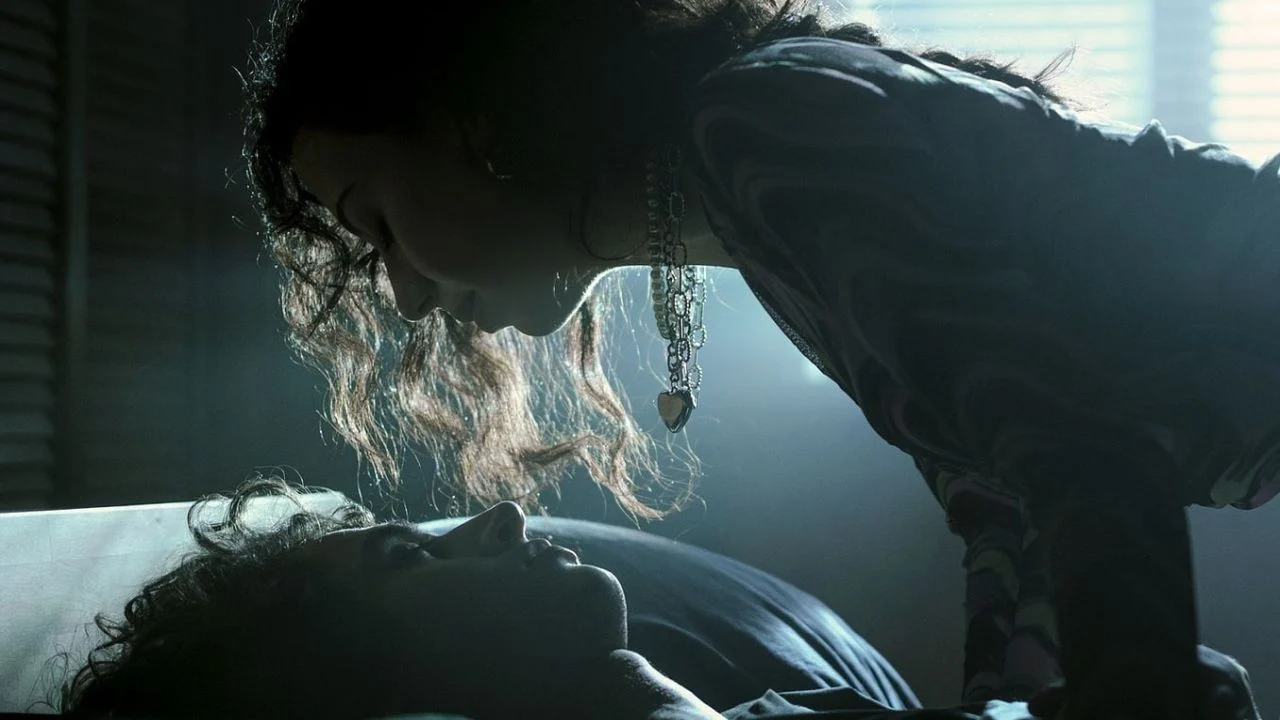
With 40 nights full of somnambulistic contacts, there are of course wet dreams.
This also potentially screams kitsch. But even if Farasha and Faris – just like a normal young couple – become increasingly closer in their dreams, “Ghosts” does not simply ignore the actual consequences of trauma and grief, quite the opposite. In the afterlife, Farasha learns from her father, who died a few years ago, that ghosts should not appear in the dreams of the living for longer than 40 days, otherwise those they visit would simply go crazy. And Faris has to choose between a red and a blue pill when he is forced to be admitted to a psychiatric ward – just like in “The Matrix”.
It is precisely this fine line between everyday life that is characterized by understanding but no less painful and an excessively romantic dream-walking that makes “Ghosts” stand out so much from the mass of tragic love stories. And Akin nails it perfectly not only in the script, but also in the truly interworldly way with which he stages his hometown of Hamburg this time – right down to the specially recreated roof of the Hamburg television tower, which is even more spectacular than the recurring scenes at the bottom of the Elbe.
Conclusion: Such tragically beautiful love stories are far too rare – not just in German cinema. Especially with two such amazing newcomer discoveries like Mariam Dawoud and Eren M. Güvercin. And for anyone, like me, who is somewhat afraid of heights, the airy finale on the Hamburg television tower will be doubly nerve-wracking.