Christianity has a difficult time in contemporary cinema. Just imagine a current film in which the inhabitants of a possibly rural setting are introduced as particularly religious in the first moments. What is the plot then? It’s probably about a young person who has to break out of this restrictive, conservative society as a kind of maturity test. There are exceptions, of course, but they are often really disgusting propaganda garbage like the now five-part “God’s Not Dead” series.
But now Romanian festival favorite Cristian Mungiu, who was awarded the Palme d’Or in 2007 for “4 Months, 3 Weeks, 2 Days,” seems to be stepping into the breach with his Norwegian-filmed drama “Fjord” for Bible-believing families. At first it sounds like an April Fool’s joke, but if you take a closer look, the author remains surprisingly true to himself in his first project shot in Norway. This challenges the usually more progressive audience of such art house fare in a quite provocative way. At the same time, Mungiu also makes it shockingly easy in many places.
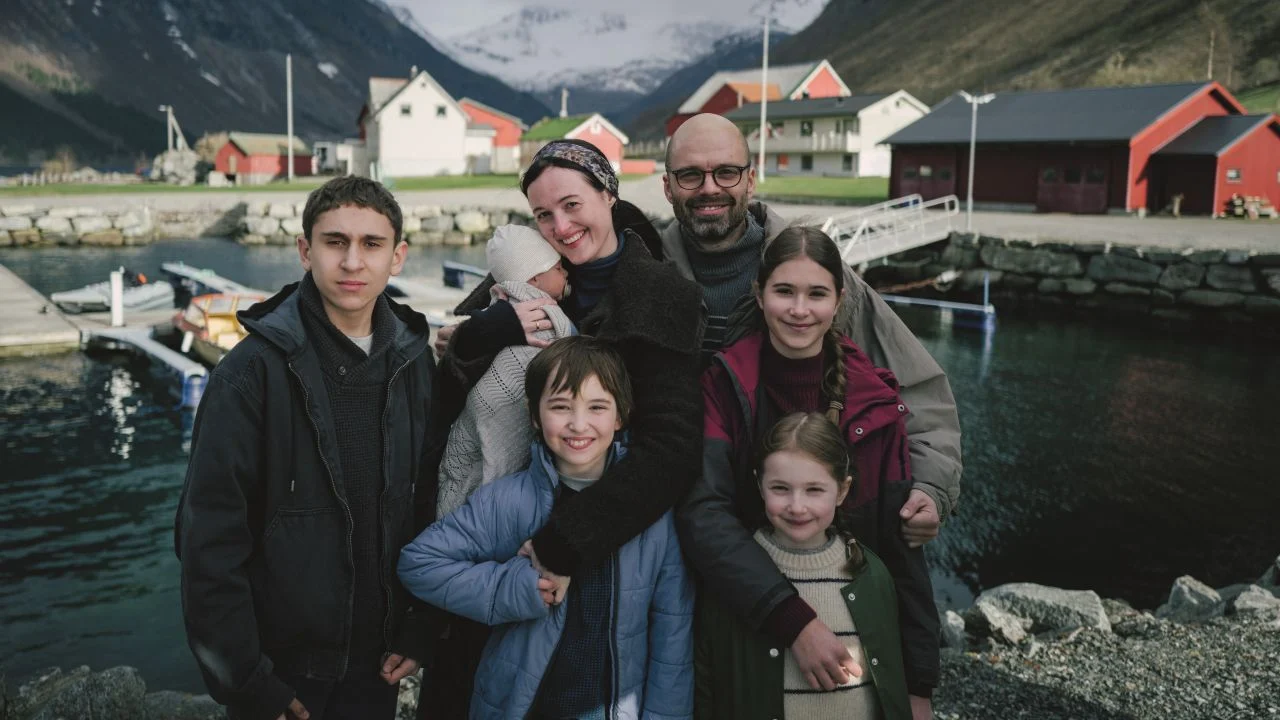
The family of Lisbet (Renate Reinsve) and Mihai (Sebastian Stan) have arrived safely and happily in their new Norwegian home.
The nurse Lisbet (Renate Reinsve) and the aeronautical engineer Mihai (Sebastian Stan) move with their five children from Romania to Lisbet’s birthplace in Norway. On the first day, the director Mats (Markus Tønseth) picks up the older children Elia (Vanessa Ceban) and Emmanuel (Jonathan Ciprian Breazu) directly from the school bus to greet them and show them around. A good connection immediately develops with the rebellious neighbor girl Noora (Henrikke Lund-Olsen).
However, Lisbet and Mihai are strictly Christian and therefore expect daily prayers and Bible lessons from their children. However, dancing, cell phones and video games are not allowed. However, this only becomes a problem when the sports teacher discovers red welts on Elias’ back. During the interrogation, the parents admit that they have given their children a slap on the bottom, but they deny that they are responsible for the welts. Nevertheless, child protection officers take the five children into custody as a precautionary measure. The family begins a months-long battle before the authorities and courts…
Oh, how beautiful Norway is
Shot in the expansive 2.35:1 Cinemascope format, the first shots of “Fjord” show absolutely breathtaking landscapes – with the fjords from which snow-covered mountain ranges protrude in the background. A Running gag of the film is that no one seems to worry anymore when huge avalanches come rushing down from up there towards the village. And then this school: everything bright and new and friendly; The tools in the workroom could probably be used to equip a modern carpentry workshop. This is obviously the very Norway that the rest of Europe keeps squinting at with envy. Or? In any case, Cristian Mungiu has little interest in simply saying “Thank you!” to the host country of his latest film. to say…
… because even if he has never spared with criticism of conservative structures in his homeland, he is obviously hardly less suspicious of Norway’s decidedly progressive institutions. At the beginning, the question may arise for a while as to whether the measures are not justified. Mihai also repeats until the end that a family consists of a father and a mother. At the same time, he secures the media support of some actually questionable conservative associations, which sometimes cause further upheaval with their own graffiti attacks on the school. Not necessarily likeable, but we quickly understood that we as an audience should still be on Lisbet and Mihai’s side.
Maximum wrong
Regardless of whether she is a guidance counselor, child protection officer, lawyer, public prosecutor or judge: When the representatives of the authorities in “Fjord” speak, they don’t occasionally slip out a careless sentence that would expose their progressive double standards – instead, almost every single comment is completely wrong! They go from one faux pas to the next without ever reaching safe ground – even if only by chance. This is undoubtedly effective: “Fjord” builds up an incredible amount of anger in its 146 minutes, which is somewhat reduced to the point of absurdity in the wonderfully ambiguous final image, but still really thrills the audience until then.
Despite almost two and a half hours, “Fjord” doesn’t feel too long – which is certainly due to the great cast across the board, from which Renate Reinsve (“Sentimental Value”) and Sebastian Stan (the Winter Soldier from the MARVEL universe), who is barely recognizable at first with his bald head and beard, stand out. But Mungiu destroys all the ambivalence that actually lies in this cleverly placed experimental arrangement with his one-sided, cartoonish exaggeration.
Conclusion: The fact that “Fjord” takes the side of those who are usually “the bad guys” in contemporary cinema is a potentially very exciting approach. But Cristian Mungiu makes it very easy for himself in his fantastically photographed and emotionally highly involving “Fjord” when he simply portrays the actors from the “other side” in every single scene like the greatest unlikable people without a shred of self-awareness.
We saw “Fjord” at the 2026 Cannes Film Festival, where the film had its world premiere as part of the official competition.