
According to Wikipedia, the first name Emily has been one of the most popular first names for girls in Germany since the 2000s. The city of Leipzig reports at least 16 Emilys for 2025 (20th place). The modified form Emilia even came in at 29, making it second place among the most common girls’ names, just behind Ella with 31. If you add both spellings together, that would clearly be the current top position! The first name Emily is also very popular in English-speaking countries. In Ireland, Wales, Scotland and Northern Ireland it is regularly among the top 3 female first names, and in England it was recently ranked 15th.
So it’s no wonder that there are a whopping 318 Emilys at the University of Manchester, with its more than 40,000 students – and since you can make a film out of just about anything these days, why not use these statistics? Because one of the 318 students is the woman of his dreams for the young musician and sound engineer Owen (Spike Fearn). The self-confident Emily enchanted him with her glittering fairy eyes: love at first sight, that’s for sure! They danced, chatted and laughed, but at some point Emily suddenly had to leave – and the phone number she left for Owen isn’t quite right. Hence the film title of Alicia MacDonald’s romantic comedy Finding Emily.
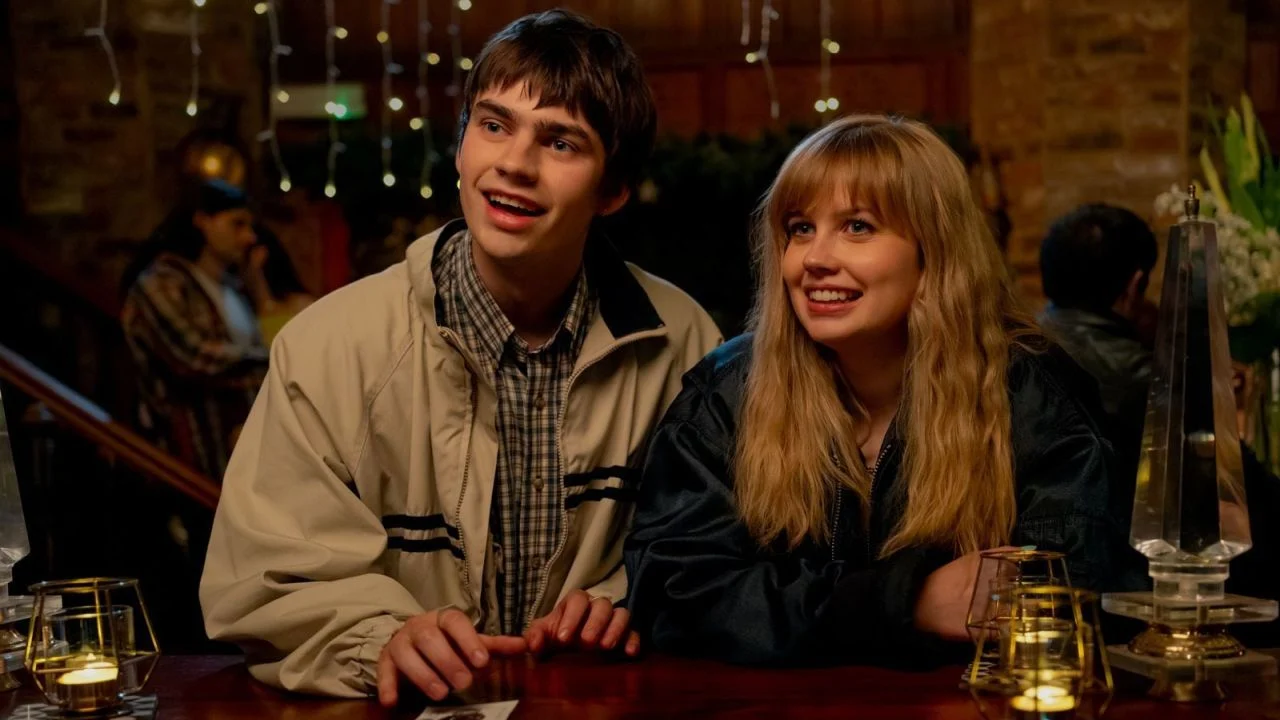
Will this sociological university experiment possibly lead to love after all?
At least Owen knows that she is studying at Manchester University. So the lover heads to campus with a few handwritten flyers. His first clue: Emily is studying psychology – and so the naive and optimistic Owen storms the lecture. But Emily Raine (Angourie Rice), who is also adorable, is unfortunately the wrong Emily. At least she not only has a surprising amount of understanding for Owen’s stormy nature, she also sees him as a possible study subject for her university thesis, which she is supposed to write about the fatal psychological consequences of being in love: According to her professor, romantic relationships lead to madness, true to a quote that is attributed to Sigmund Freud: “The state of being in love is like psychosis.”
So the fake Emily promises to help Owen find the real Emily. However, she wisely neglects to inform him of her other plans. Meanwhile, Owen sends the entire university into turmoil with his loyal search for the woman of his life. On the one hand, feminists are forming against him, and the mob is raging on social media. On the other hand, Owen, who is not even enrolled as a student, becomes a campus star when he serenades his fairy Emily with a self-composed serenade on the university podcast. But where is she?
Well-known phrases, less well-known dialect
This is all as heartwarming as it is predictable, because maybe “the wrong one” is actually “the right one.” But that doesn’t matter at all, because the entire RomCom program is played to perfection here – with lots of upbeat music and at a consistently brisk pace, which applies not only to the images but also to the dialogues. Manchester presents itself as a cosmopolitan city where there is really something going on – a modern, multicultural metropolis full of fun-loving young people of all genders who are eager to enjoy the nightlife. And that’s what it’s all about – with live bands that not only entertain the people in the clubs, but also the audience in the cinema. The allusions to cancel culture and #MeToo even bring a bit of a breath of fresh air. So many nice new trials and tribulations just from the constant social media presence – that’s the reality, but at least in comedies it’s not yet too worn out.
Some things here are reminiscent of brilliant achievements from British RomCom history such as “Four Weddings and a Funeral”, “Bridget Jones” or “Notting Hill”, which were also produced by the two clever comedy specialists Tim Bevan and Eric Fellner. Everything is there: guilt and punishment – when Owen discovers Emily’s machinations and she tries to apologize to him in public; misguided love – also called the “Ashley aberration” after the completely incomprehensible passion of “Gone with the Wind” heroine Scarlett O’Hara towards at least the second most boring man in film history. And then there’s the class struggle theme: Owen comes from a typical Manchester working-class family, while Emily Raine belongs to the educated middle class. As a little treat, the original version provides an insight into Mancunian, the Manchester dialect also known as “Manc” for short. This nice, authentic touch gives the film at least a small touch of realism, which isn’t necessarily a bad thing.

Not only Owen, but also Emily (Angourie Rice) has to realize that she may have been idolizing the wrong people so far.
In addition, there is an immensely high cuteness factor, especially thanks to Spike Fearn, who, as Owen, seems significantly younger than 26 and plays the slightly idiotic, almost Freudian-like madly in love man very convincingly. The Alien: Romulus star looks like a grandson of Mick Jagger and embodies Brit-pop so aggressively that it’s a joy to behold. Angourie Rice (“Spider-Man: No Way Home”), who has apparently qualified for bigger things with the catfight college musical remake “Mean Girls – The Girls Club”, acts with similar comedic confidence. With her clothes almost always being way too big, she embodies the ambitious, completely unpretentious, but still lovable, unfortunately fake Emily. At the beginning she adores the university pretty boy and clearly doesn’t fit in at all with the sloppy, ditzy Owen. Will that still change?
Conclusion: With her first film direction, Alicia McDonald has already positioned herself as a comedy specialist with a lot of speed, momentum and timing as well as an incredibly snappy soundtrack. However, we will only find out in a year at the earliest whether the pretty, likeable RomCom will have a significant impact on the Emily statistics worldwide and in Germany.