
After the highly acclaimed “On the Night of the 12th,” which was based on a real but still unsolved murder case. director Dominik Moll (“The Disappeared”) remains true to the genre of legal drama: Against the background of the yellow vest protests in Paris at the end of 2018, this time in “Dossier 137” he does not tackle a specific case, but rather summarizes several real events in a fictional case – but that does not make the film seem any less authentic, quite the opposite: the crime drama consciously avoids overly blatant accusations However, it is painfully clear how deep the cracks are that now run through the state, society and the police.
After the yellow vest protests, in which hundreds of thousands demonstrated on the streets of Paris, Joelle Girard (Sandra Colombo) shows up at Stéphanie Bertrand's (Léa Drucker) office to file a complaint about alleged police violence. Her son Guillaume (Côme Péronnet) was hospitalized with a serious head wound, and apparently it was an anti-terrorist unit that simply left him unconscious on the street. Together with her team, the experienced officer begins to question witnesses in the titular “Case 137” and evaluate surveillance videos and medical documents. Contradictions in the statements, especially from a small special police unit, raise questions that increasingly no longer let the internal investigator go, even outside the office…
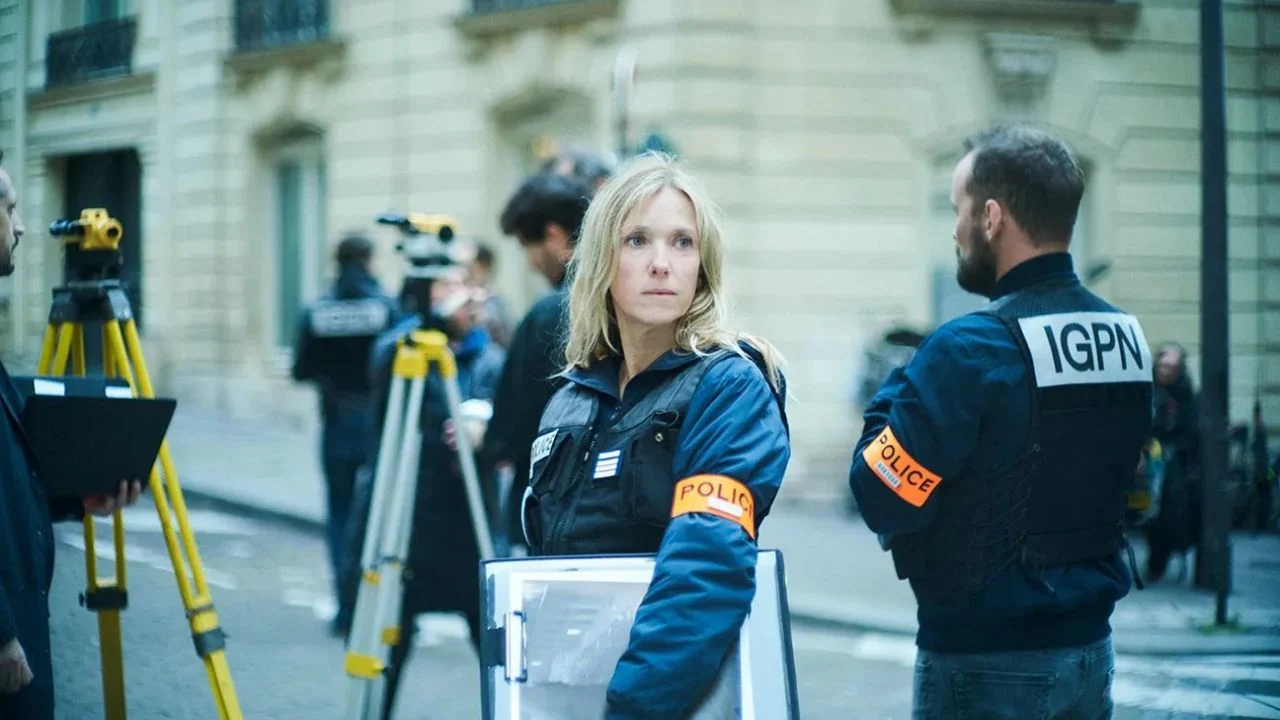
As an internal investigator, Stéphanie Bertrand (Léa Drucker) is repeatedly treated with hostility by her colleagues.
The script by Dominik Moll and Gilles Marchand, who have already worked together on “Lemming” and “Harry means well with you”, is based on several tragic incidents that occurred in December 2018. The grassroots yellow vest movement brought the masses onto the streets to protest against high costs of living and a perceived unfair tax burden. In the film, the Girard family sets out from Saint-Dizier to take part in their very first demonstration. For mother Joelle and her son Guillaume, who has just come of age, the initially exuberant demonstration trip soon turns into a nightmare when tear gas is used and general chaos breaks out. “Dossier 137” only begins in the aftermath, which is why the events only gradually unfold for the audience as part of the police investigation.
The political tension in France in 2018 is palpable. The yellow vest movement does not appear in “Dossier 137” as a decorative framework, but as a real crisis of legitimacy of a state whose monopoly on violence is in question. For large parts of the population, the police were seen as aggressive actors during the protests, while within the units any doubt about their own esprit de corps was viewed as a threat. It is precisely in this explosive zone that Moll places his protagonist: Stéphanie is viewed askance by her colleagues, and her ex-husband, also a police officer, also has no understanding of her investigation. At the same time, the official on the side of the demonstrators encounters, in personal conversations and on social media, a deep skepticism that has built up towards state authorities over the years. The fact that this conflict reverberates not only professionally but also privately becomes clear when her son becomes increasingly ashamed that both parents are police officers – and even Stéphanie's mother expresses massive reservations about the police.
A deeply divided society
Investigating colleagues is an extremely thankless job, which Stéphanie chose as a single mother primarily because of the supposedly more structured working hours. By consciously placing his main character between the two fronts, Dominik Moll manages to take a nuanced look at an issue that has divided France for years. Stéphanie Bertrand is neither a whistleblower nor a great hero in the classic sense. She is simply a dutiful investigator who takes her job seriously. We experience the social conflict not only from the outside, but from Stéphanie's perspective, i.e. from a position in which loyalty to the “police family” and professional responsibility inevitably collide.
The director attaches great importance to attention to detail. The investigative work is captured with a precision that almost seems documentary: the viewing of countless videos, the bureaucracy surrounding obtaining medical documents, the writing of endless emails, the precise formulation of protocols, the extreme precautionary measures when questioning witnesses and suspects. All of this forms the basis of a production that is deliberately kept unspectacular, but which also suits the main character, whose strength lies precisely in her quiet persistence. Léa Drucker (“Last Summer”) embodies this with ostensible toughness, as a woman who is exposed to enormous pressure, but never breaks, but remains courageously committed to solving the case. Her precise, believable performance carries the film effortlessly.
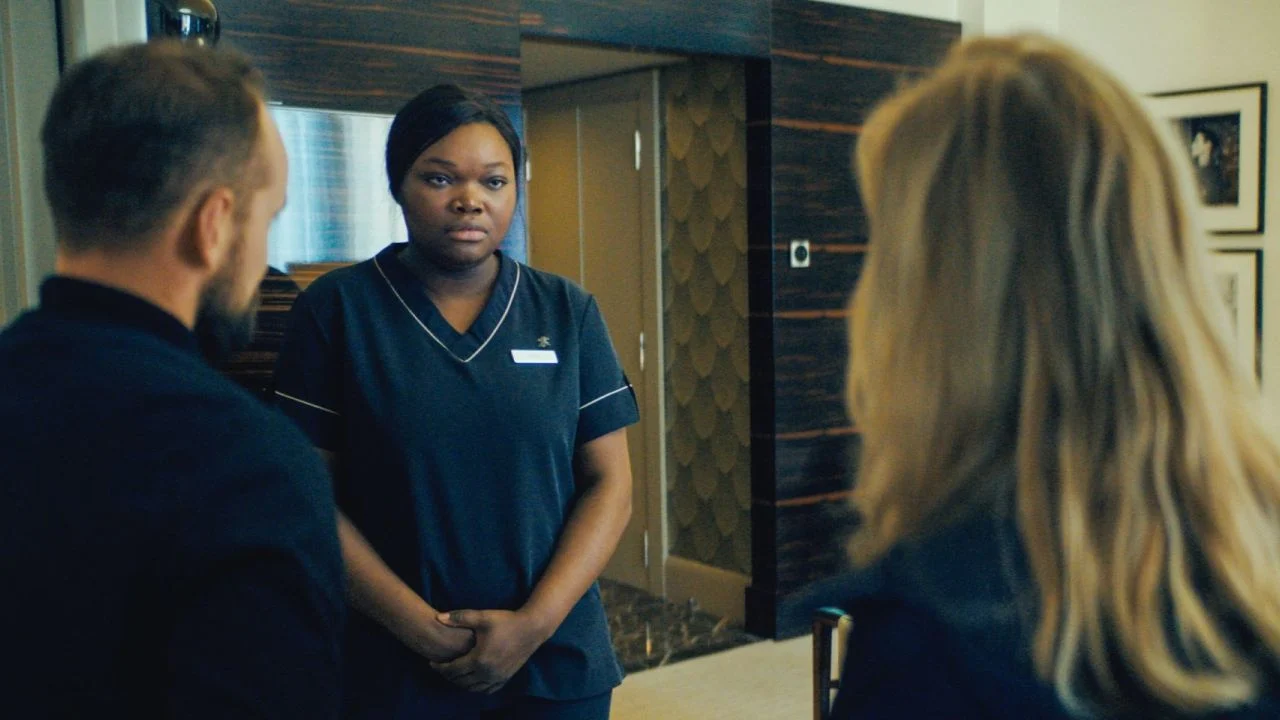
Chambermaid Alicia Mady (“Saint Omer” star Guslagie Malanda) turns out to be one of the most important witnesses in Case 137.
Nevertheless, “Dossier 137” has individual moments that tonally fall out of the concentrated sobriety. When the protagonist later pursues an important witness almost single-handedly, this is a bit out of the ordinary given the otherwise realistic depiction of the laborious police work. While this sequence creates additional tension, it feels slightly contrived as a sudden genre twist. But Moll quickly switches back to the precise, calm portrayal that characterizes his work. Despite the factual production that is interested in capturing the complex investigative process, “Dossier 137” is an exciting film that raises uncomfortable questions about the responsibility of the police.
Conclusion: “Dossier 137” paints a sober, realistic picture of an internal police investigation and captures the climate of a society that is increasingly drifting apart. Between the police apparatus and the citizen movement, this analytical crime drama features the magnificent Léa Drucker, who shines with her natural, differentiated and courageous portrayal of the protagonist.
We saw “Dossier 137” at the Seville Film Festival.