“Who are you?” A son asks his father in Tarik Salehs “Eagles of the Republic“. Not a simple question, especially not when the father is the greatest star of the Egyptian cinema and is celebrated in public as a“ pharaoh of the canvas ”: this dandy-like George Fahmy (Fares Fares) plays two roles in the course of only a little tough polit drama-one on the screen, and the other after it has been forced to a propaganda roll than Incrimental part of the political rank games at the head of today's Egypt. But if you write the script for this, Fahmy only learns when he has long since lost his self -respect and almost his life.
The third part of Saleh's Cairo trilogy after “The Nile Hilton Affair” and “The Cairo Conspiracy” is a portrait of a city and a (autocratic) society. He tells of a man who considers himself to be inviolable, but then has to fight for his independence. Sometimes that's a little too much, the film threatens to fall apart. But the always worth seeing main actor Fares Fares and a spectacular last half hour make “Eagles of the Republic” an intensive political drama that does not make false illusions about how easily (almost) everyone can be bent in a autocracy.
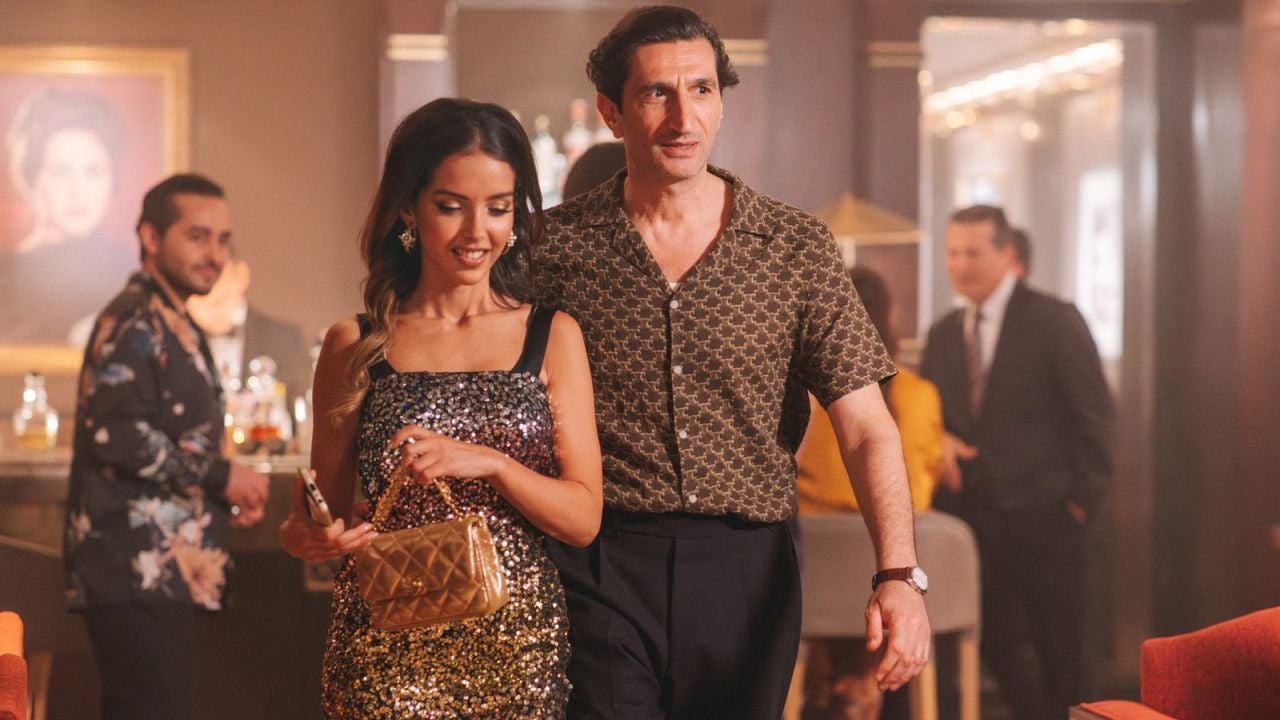
As a superstar, George Fahmy (Fares Fares) is used to all freedom – and still has to suddenly have to cope with the fact that the regime sees no more than a puppet.
George Fahmy is the largest canvas star in the country, who makes a powerful cash register with popular blockbusters such as “The first Egyptian in space”. As a Coptic Christian, George lives Frei from the Islamic regulations that shape the Egyptian Republic: he lives separately from his wife, he drinks and has affairs. All of this makes it vulnerable, a scandal and the end of the career threaten. But before this happens, George bends to state pressure and takes on a role in a cheap-patriotic work.
This deals with the career of ABD al-Fattah AS-SISI, the current Egyptian president, who in 2013 was pushing in power in a coup d'état with the help of the military. During filming, George begins an affair with Donya (Lyna Koudri), the wife of a high general who monitors the shooting. George's connection to the circles are getting stronger – and soon he too is one of the title -giving the republic without wanting to see it (or even to see through it), who have not sworn loyalty to the president in their oath …
Arab spring, religious school and now a cinema propaganda
The son of an Egyptian and a Swede was born in Stockholm in 1972. He initially worked as a graffiti artist and made animation and documentaries. On the other hand, he found it late for the feature film: In addition to rather unsuccessful commissioned work such as the Chris-Pine thriller “The Contractor”, Saleh has above all turned his loose Cairo trilogy, which deals with different spheres of Egyptian society in the form of thriller women-sometimes a commissioner is the focus shortly before the Arab Spring, sometimes a murder in the milieu of a religious school, and Now a cinema superstar who is forced to play the role of his life.
In all three films, Fares Fares embodies the leading role-a Lebanese-Swedish actor who is known in Germany primarily by various films by Jussi-Adler-Olsen-Crime for Television. Fares Fares' face is actually made like for the cinema: penetrating eyes, striking facial features, surrounded by a certain tragedy that makes him perfect for the role of a passive puppet that quickly no longer knows what to do here.
The real and the wrong president
A passive figure is this George, who sees himself as apolitical, who only wants to make good films and have his pleasure. But fence guest on the side cannot be remained in an increasingly radical autocracy in the long run. In Germany, actors such as Ferdinand Marian or Güstaf think Gründgens, who made themselves available in the Third Reich after more or less pressure by Joseph Goebbels for patriotic films. In the present, Russian artists or athletes are faced with the choice of at least silent about the machinations of their regime or to leave their homes. Some of the strongest scenes in “Eagles of the Republic” are moments in the shooting of the propaganda film, on which George is not unwilling.
The reluctance initially has little to do with political beliefs. Instead, Fahmy simply does not want to make scrap film because it runs counter to his professional ambitions: This is how this project even grabs him as an actor in this project, and he tries to make his role as convincing as possible-only to find out that the propagandists do not want a real representation at all: The canvas as-Sisis should not be small and bald-too, but look like the real dictation, but look like a whole head, but like a whole. George Fahmy built much better. When film posters later hang next to election posters, i.e. the real and the wrong president side by side, then the full absurdity of the occupation coup becomes clear. At the same time, the sight reveals the whole shamelessness that the regime not only puts on the day, but with which it also gets through.
Of course that's political, and that of
Tarik Saleh represents his films (perhaps also out of self-protection) as apolitical, she wants to be understood primarily as films about the Mega-City Cairo (although for obvious reasons it was not even there, but in Istanbul). Nevertheless, “Eagles of the Republic” always convinces the most when it becomes specific when he tells of the Egyptian reality: an autocracy in which various factions fight for power; A country in which the military coups with unsightly regularity, even if it specifies to do this in the service of the country; A society in which the Islamic Muslim Brotherhood gains influence. More than 115 million people now live here, but whoever becomes a game ball of the system has practically no chance of protecting his self -respect and life, not even if he is the pharaoh of the canvas.
Conclusion: The political drama “Eagles of the Republic” peppered with thriller elements develops slowly but surely with its closely knitted consolidated consolation, in which various factions within Egyptian society fight and influence influence, while a actually apolitical cinema star gets caught up in the network that it seems as good as impossible.
We saw “Eagles of the Republic” at the Cannes Film Festival 2025, where he celebrated its world premiere as part of the official competition.