“Downton Abbey: The Great Final” is not only the end of a cinema trilogy that started with “Downton Abbey” (2019) and continued with “Downton Abbey II: A new era” (2022). The two-hour family drama is also the final end of the “Downton Abbey” saga about the social and private fates of the noble family Crawley and their staff on their magnificent property in the British Yorkshire between the 1910s and 1930s.
Thus, the film is aimed at the hardcore fans, who have seen all six seasons of the series and the two cinema films in front of it and understand all allusions to the history of the crawleys. In the hands of “a new era” director Simon Curtis, this is sometimes touching and sometimes strange-but unfortunately it has not become an unforgettable finale. Figures and action turn too much in a circle.
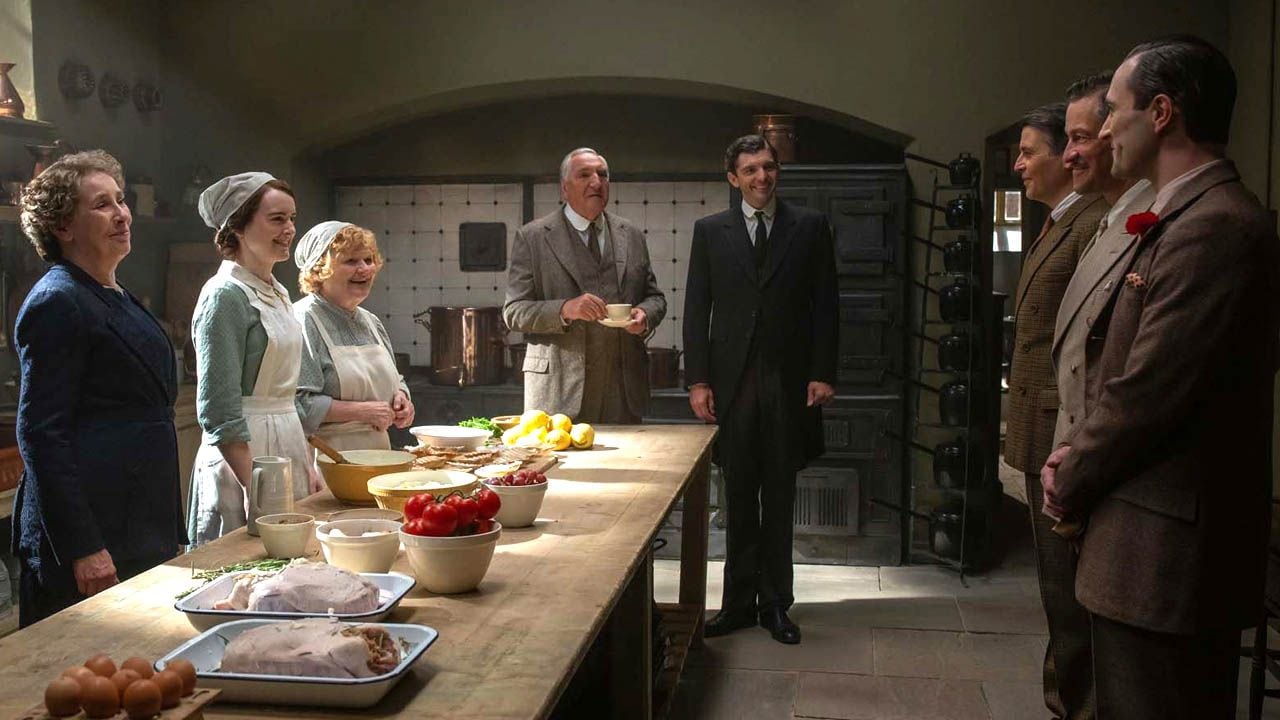
The film can no longer gain new facets to the characters who are loved, but fans are happy about a last reunion with Lady Mary Talbot & Co.
The great grief of the death of Violet Crawley (Maggie Smith) is still deep, and the Crawley family is already overrun with the next unexpected scandal. And whoever other than Lady Mary Talbot (Michelle Dockery) is again the focus of the excitement in fine society. Mary agreed to the divorce from her husband what makes her a persona non grata in the London high society.
Downton Abbey's stubborn landlord is no longer welcome, which makes it difficult to lead the property. The US recession of the 1930s has also not passed the crawleys and shows itself in the form of Mary's American Uncle Harold Levinson (Paul Giamatti), who has played out the inheritance of his sister Cora (Elizabeth McGovern) and is now asking for money, for which Mary's father Robert (Hugh Bonneville) has to sell her Londoner …
Everything at the same
The origin of “Downton Abbey” for the author and series creator Julian Fellowes lies in his Oscar-winning screenplay for Robert Altman's social satire “Gosford Park” (2001). Originally, the ITV series should simply be a standard evaluation of the cinema success. But then Fellowes wrote a new story that plays in front of “Gosford Park” (from the 1910s instead of in the 1930s) and the Murder Mystery of the cinema model, the upstair-down-dramatics along the class barriers between a rich nobility family, their relatives and the servants on an opulent English country seat. What was lost was the satirical bite of director Altman-who was replaced by the typical melodrama of a SoAP-OPERA. Despite one or the other elaborate camera trip, the “Downton Abbey” films remained true to this concept.
“Downton Abbey: The Great Final” begins with a long tracking shot through a rainy London in the early 1930s into a nightly theater performance, all without a recognizable cut. But apart from this imposing start and a satisfactory sentimental end full of farewells and reviews of 15 years with the figures of “Downton Abbey”, part 3 at the core has remained the same dialog drama in chamber play atmosphere-including a magnificent costumes and rooms in which a ranks of solid performers, often explain, but mostly less subtle and lead funny conversations.
Big moments are missing – but everyone can shine again
As usual for a series of this kind, the characters do not change very much, but only play their idiosyncrasies in new scenarios. This sometimes feels soothingly familiar, but overall there is a lack of development. This is how father Robert and daughter Mary keep talking about the sequence and how modernity will evaporate the tradition – they and the series have been conducting this discussion since episode 1.
Unfortunately, there is no particularly virtuoso in the last act of “Downton Abbey” either. With melancholy you think back to the second half of the first film, which contains the best sequences of the entire saga – all the figures and action lines have been so perfectly combined that drama and comedy up to the climax, a funny faux pas of a servant of the royal family, were able to increase. Such moments are rare in the last and rather tedious part of the series. Even one of the characters indirectly addresses this fact when she comments on the end of the crawley family with the following words: “I thought we would end with a bang, not with a whimper”.
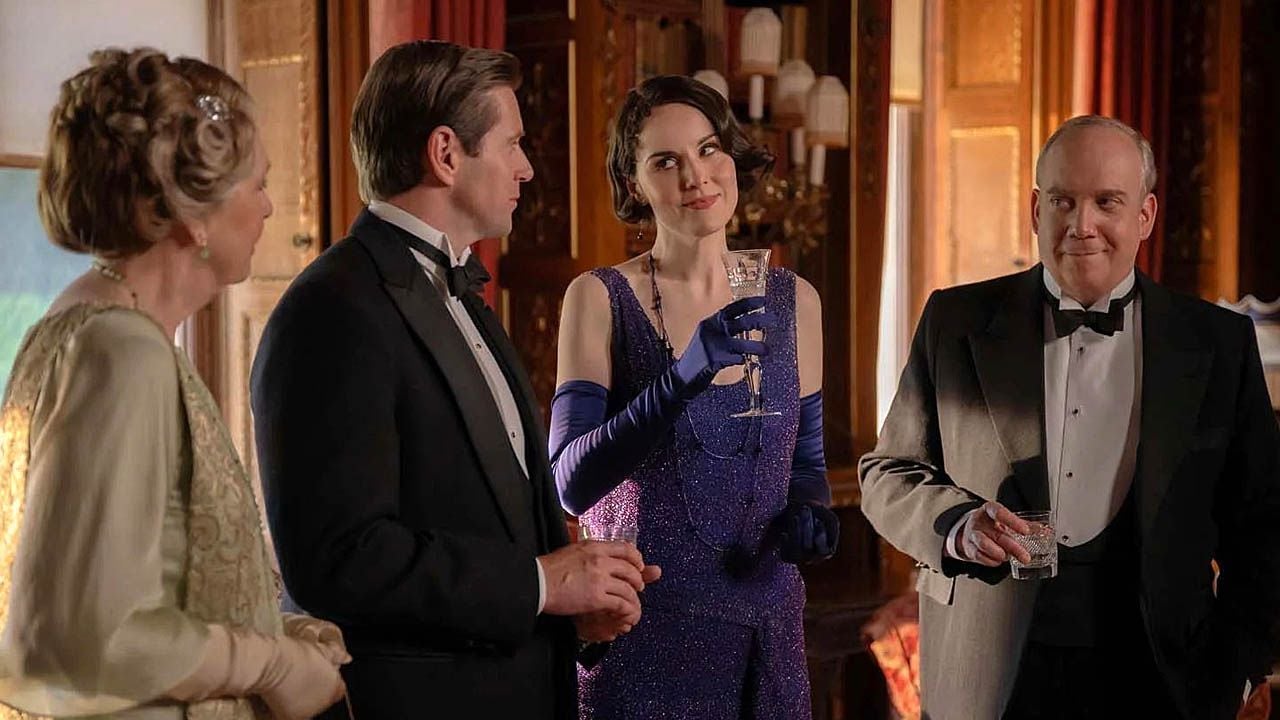
Oscar winner Paul Giamatti (right) also stops this time.
The lack of incorrectness from the “big final” is not quite as serious. Despite a narrative trailer in the middle of the film, Julian Fellowes can still win the hearts of the spectators on the home stretch – with a dinner in which the nobles, the invited artists' heroes of their time and even the staff come together one last time. The routine ensemble is so strong that even a Paul Giamatti as a guest uncle does not protrude from the crowd.
Conclusion: Unfortunately, the final act of the saga does not provide a cinema -compatible “grand finale”, but yet a solid, nostal -sized reunion with loved ones, which is aimed primarily at real fans. All figures have more wrinkles on their face, but their personalities have essentially remained the same, so that they end up with the same issues and problems in a circle. This is not particularly exciting, but the bottom line is emotionally satisfactory.