When the protagonist looks out the window of his prefabricated building, he spies a car that, for no apparent reason, flies over the edge of a roof and crashes into the building opposite. Something like that actually only exists in “Fast & Furious” (especially in the zombie car sequence in part 8) – or in surrealism: With “You believe in angels, Mr. Drowak?” After several documentary films (“Above And Below”), Nicolas Steiner delivers his first feature film – flying car included.
But as is often the case with debuts, the Swiss filmmaker crams in so much that his ambitions eventually tip over into self-absorption. Especially since the story at the center is so much stronger than the interchangeable red tape surrealism around it. After the 100th anniversary of Franz Kafka's death, the chances of finding anything original in this well-worn segment were slim anyway – and in fact, not even the completely free-wheeling Lars Eidinger as the pineapple-attacking head of office can change that.
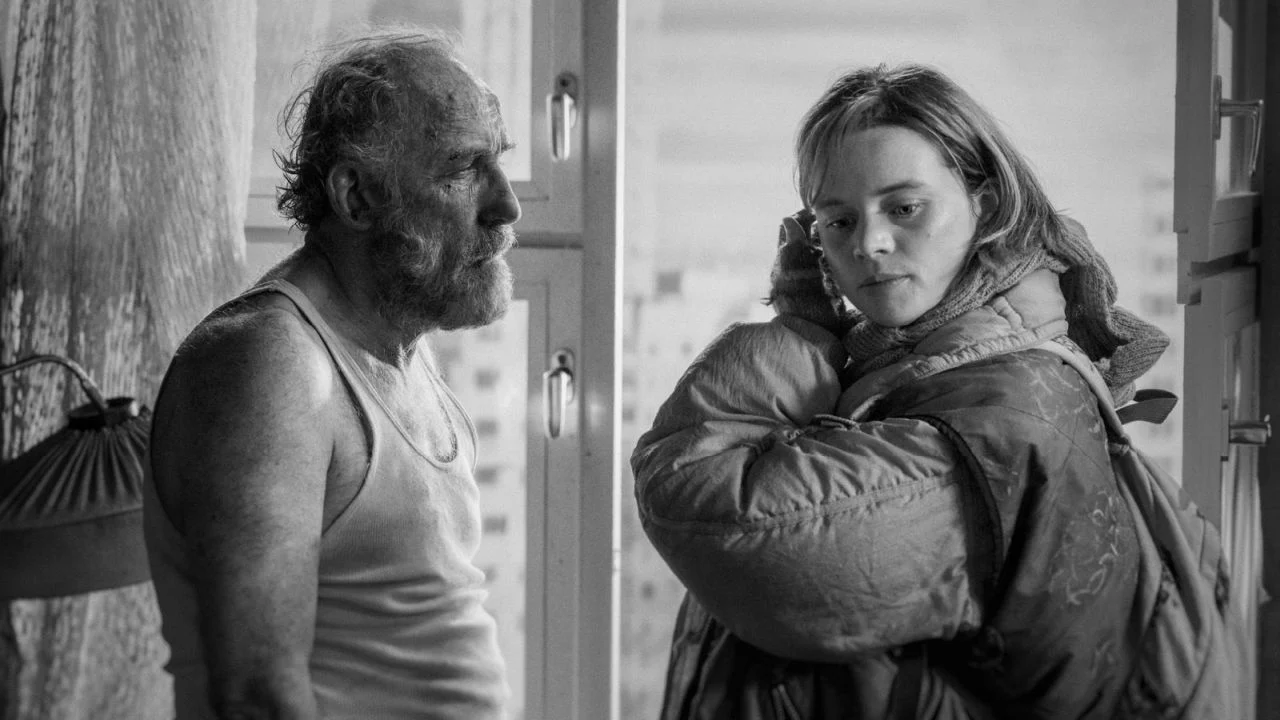
Great together: Karl Markovics as the grumpy title character and Luna Wedler as his unwavering writing coach.
Hugo Drowak (Karl Markovics) is not a Messi in the classic sense, because the empty liquor bottles that take up a large part of the space in his small apartment are neatly lined up. The convinced misanthrope is also well prepared for the arrival of the officials who want to throw him out: there are balloon bombs filled with urine ready to be dropped on the windowsill! But now there is only one chance left of not ending up on the streets: the head of the office (Lars Eidinger) has started a program in which troublemakers are supposed to be guided back to the right path with creative courses.
The idea behind it: Anyone who bursts into tears while painting a flower meadow will be a better person afterwards! But where the acting or singing courses are well attended, only Hugo has registered for “literature”. This means Lena (Luna Wedler) can concentrate fully on her student: no matter how much he insults her during her visits, the social worker consistently insists on her writing exercises, which focus on things like what causes fear or joy. For Hugo the matter is clear: the absence of alcohol would be horror – and the absence of people would be a reason to celebrate…
A (very) strange couple
From “Pretty Best Friends” to “St. Vincent” to “A Man Called Otto,” lively curmudgeons who regain their joy in life through meeting young people are a safe bet in the art house segment. But anyone who goes to the cinema with such expectations given the plot will experience a blue – or razor black and white – miracle: “You believe in angels, Mr. Drowak?” certainly has certain feel-good qualities – and Hugo's unrestrained bluster also has great entertainment value. But beyond that, the film moves primarily in the realms of surrealist experimental cinema.
Normally this means that the number of potentially interested viewers is massively reduced, but one or two more stars stand out in the reviews. But in “You believe in angels, Mr. Drowak?” The best part is precisely that part that would certainly have worked well in a more typical arthouse title: Karl Markovics (“The Counterfeiters”) and Luna Wedler (“22 Bahnen”) harmonize perfectly with each other as an unequal couple. And when Hugo reads one of his writing exercises (on the topic of “longing”) for the first time, you literally get goosebumps while listening – even though the story is about how the devil kicks the globe into the universe.

In the flashbacks we not only find out why Hugo is so grumpy, but the matter suddenly comes into color…
But that's only half the film. After the (too) proud running time of 127 minutes comes “You believe in angels, Mr. Drowak?” especially through his constant touches of surrealism: we see the office manager in his office playing mini billiards or opening a pineapple, where the knife is replaced by a hatchet after the first failed attempts. In addition, the troublemaker twins, who were kicked out of the choir, sit on a wooden shelf in the stairwell, where they have to announce the floor as punishment – even though everyone except Lena takes the elevator, which is much too small anyway. Aside from melting clocks, there is nothing that lends itself to a surrealist treatment as much as the (German) civil service.
But in “You believe in angels, Mr. Drowak?” There is hardly anything we haven't seen more convincingly in Kafka or the iconic A38 pass sequence from “Asterix Conquers Rome”. Meanwhile, the elevator, which is too small, is reminiscent of “Being John Malkovich,” and the girl next door suddenly quotes Pablo Neruda when she’s in elementary school. Meanwhile, the head of the office works in front of a picture of the windmill from “Don Quixote”, and the casting of Dominique Pinon, the star of the modern surrealism classics “Delicatessen” and “The Fabulous World of Amélie”, is certainly no coincidence. It's all well and good on its own, but together it eventually seems arbitrary and overloaded. Surrealism shouldn't be a free pass to just do anything.
Conclusion: At its core – thanks also to the fantastic acting duo Luna Wedler and Karl Markovics – there is a really strong film, but it always threatens to get lost in a surrealistic monotony.