He was still left out in the spring of 1945: American President Franklin Roosevelt, Soviet ruler Josef Stalin and British Prime Minister Winston Churchill were present at the Yalta Conference, at which the Allies discussed the European post-war order – but not Charles de Gaulle. A few months later, when Hitler was dead and World War II ended, France was still at the victor’s table – the nation not only controlled part of defeated Germany, but also received a seat as a permanent member of the United Nations Security Council. And all because of one man: this same Charles de Gaulle, who is still admired and sometimes romanticized in France half a century after his death.
So it’s no wonder that more than two million cinema tickets for Antonin Baudry’s “De Gaulle – Time of Resistance” were sold within a short period of time. Incidentally, this is only the first part of a two-part biographical film (part 2 “De Gaulle: The Sovereign Edge” does not yet have a German title), which will go down in history as one of the most expensive French productions. With its focus on the first years of the war and the legendary desert battle of Bir Hakeim as the grand finale – before the sequel focuses on the final years of the war – “Time of Resistance” proves to be a true epic that succeeds in a fascinating way in both glorifying Charles de Gaulle and at the same time making fun of his historical transfiguration.
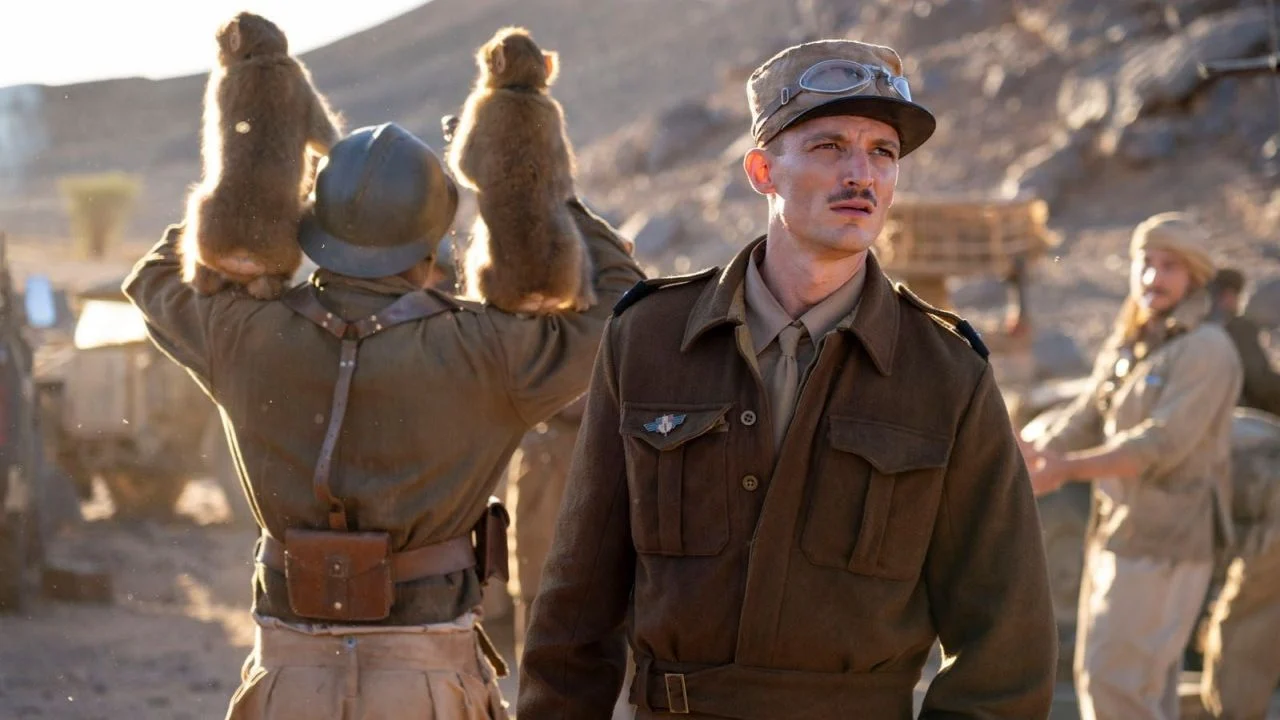
Legendary trademark: Not only in the field, but also on the political stage, Charles de Gaulle (Simon Abkarian) can only be found in his military uniform.
June, 1940: General Charles de Gaulle (Simon Abkarian), little known even in his native France, has fled to London to escape the German Blitzkrieg. There he forces a meeting with British Prime Minister Winston Churchill (Simon Russell Beale), to whom he declares with an insane confidence that would later become his trademark: “I am France.” Churchill and the Allies should not recognize the puppet regime in Vichy, but rather the Free France led by de Gaulle.
At this point it only consists of a few figures, but gradually more and more soldiers and other patriots answer de Gaulle’s call. Including the young Fernand Bonnier de La Chapelle (Florian Lesieur), who joins the Resistance, is sent to the colony of Algeria by his father and finally dares to confront the Vichy-loyal Admiral François Darlan (Mathieu Kassovitz). Meanwhile, de Gaulle is looking for a way to prove to the Allies that the troops of Free France are capable and ready to fight and will not surrender again as easily as they did during the German Blitzkrieg…
War hero with Sun King appeal
The French national holiday is July 14th, but June 18th would also be suitable. Finally, on this day – to follow the pathos of French self-perception – the rebirth of a defeated nation began. On June 18, 1940, Charles de Gaulle spoke for the first time via radio from London to the French and thus to a people who had only recently been overrun and humiliated by German troops in just a few weeks. Official France had made peace with its arch-enemy and set up the Vichy government to rule in the south of the country, whose authoritarian ruler, Marshal Philippe Pétain (Alain Libolt), was to be convicted as a collaborator after the war.
He was opposed by de Gaulle, who despised Pétain, who would rather die than surrender to the Germans, who fought for a free France – but acted in a similarly authoritarian manner as his opponent. It is no coincidence that his statement “I am France” is similar to the legendary saying “I am the state,” which is attributed to the Sun King Louis XIV. Like Ukrainian President Volodymyr Zelensky, de Gaulle was never seen in the suit of the politician caste, but always only in uniform, with the famous kepi on his head. At 195 centimeters, de Gaulle towered over everyone and stood like a tower in the surf. Simon Abkarian (“Casino Royale”) plays him with an impassive expression in a biographical epic in which, as a neutral audience, you cannot always be completely sure whether director Antonin Baudry is making fun of de Gaulle or is completely enraptured by his pathos.
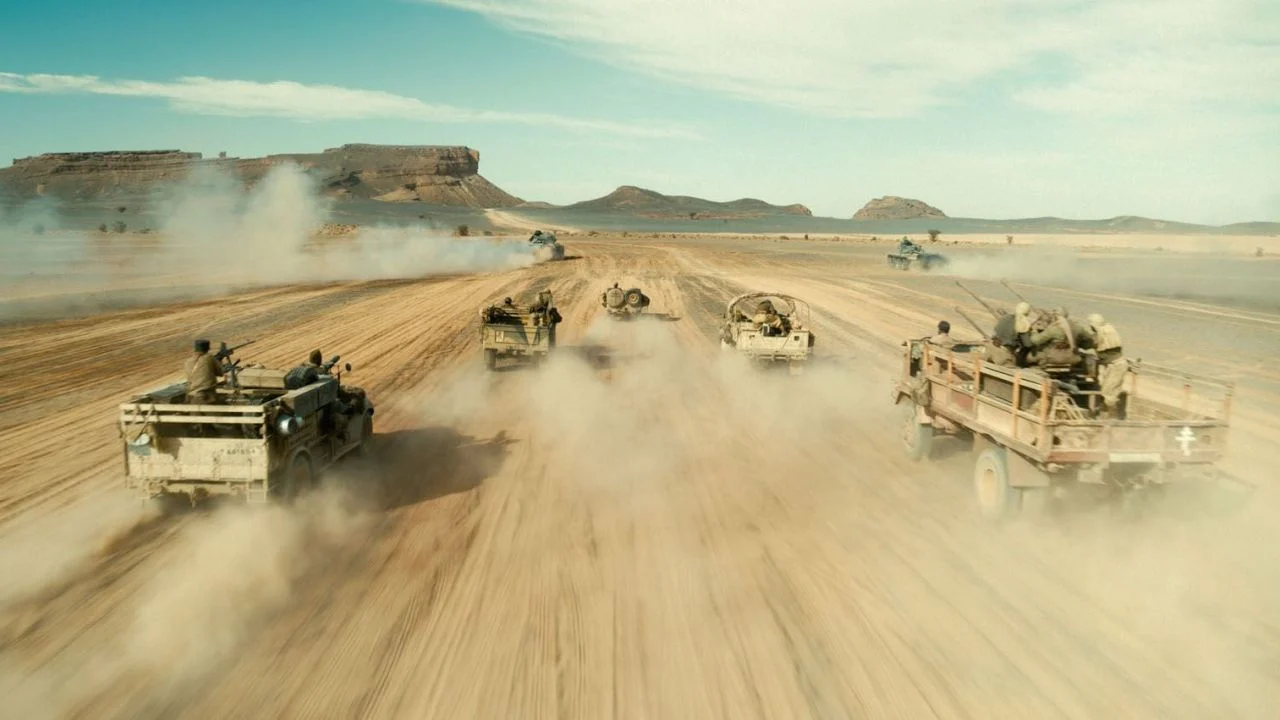
Given the huge budget, “De Gaulle – Time of Resistance” is made with lots of money and no mess.
At one point, de Gaulle stands at a map and explains the progress of the war to those listening. A rocket hits outside, the windows explode, everyone ducks – only de Gaulle remains standing, wipes the dust from his uniform and continues talking unaffected. A typical macho scene that you know from many clichéd war films – but de Gaulle was actually known for not being irritated by nearby explosions. Other scenes also almost seem as if the screenwriters were inspired by the famous Chuck Norris meme (“It’s not Chuck Norris who gets cancer, but cancer gets Chuck Norris”):
We are in Africa, everyone is sweating like crazy and looks exhausted, only de Gaulle is standing upright in the middle. “Be careful of the mosquitoes,” a Brit advises him, and de Gaulle replies: “De Gaulle doesn’t get bitten by mosquitoes!” As absurd as the sentence may sound, this quote is actually guaranteed – although biographers argue about whether de Gaulle meant the sentence seriously or ironically. Baudry also leaves both options open – and just one cut later, de Gaulle is in bed with malaria and chills.
Longing for the Grande Nation
Charles de Gaulle may seem like a caricature in such scenes, but “De Gaulle – Time of Resistance” is of course not a distant or even critical biopic. Baudry had at least 80 million euros (some sources say almost 100 million) at his disposal for both parts of the film in order to bring one of the greatest national heroes closer to a new generation. But why now? There may be no anniversary, but the number of films about the Second World War and especially the Resistance that were shown at the recent Cannes Film Festival indicate a return to a time of national greatness. Like Germany, Great Britain and many other Western countries, France is also in crisis, both economically and emotionally. Right-wing populists are enjoying growth, democratic politicians are being criticized.
Under Charles de Gaulle, the Grande Nation was very different, self-confident and powerful, even stood up to the USA and even temporarily withdrew from NATO. However, de Gaulle is only of limited use as a democratic role model – he acted too self-important, too conscious of power, and this also shines through again and again in the two and a half hours of the biopic. On the other hand, it was precisely through this self-confidence, this aura, that de Gaulle managed to weld an entire nation together and encourage it to resist Nazi Germany. The fact that Antonin Baudry succeeds in depicting this ambivalence makes “De Gaulle – Time of Resistance” an exciting film – both patriotic and critical. A historical epic that tells a lot about the Second World War, politics and power, especially from a German perspective.
Conclusion: In his biopic “De Gaulle – Time of Resistance”, which is as elaborate as it is visually stunning, Antonin Baudry shows the legendary Charles de Gaulle as a rock in the surf, who fought for his country with all the political tricks during the Second World War and encouraged the French to resist with a lot of pathos and self-confidence.
We saw “De Gaulle: Time of Resistance” at the Cannes Film Festival, where it had its world premiere as part of the official program.