

The true story of a Scottish activist with Tourette’s syndrome relies on great emotion and humor.
“Damned Normal” (original title: “I Swear”) is actually a classic biopic that translates an extraordinary life into an accessible film biography. However, many may have only become aware of Kirk Jones’ film through the BAFTA incident: When the real John Davidson uncontrollably shouted out a racist term due to his Tourette syndrome during the awards ceremony in February, a debate about stigmatization broke out. With this incident in mind, “Damn Normal” hits even harder emotionally. Because suddenly you’re not just sitting in front of a biopic – but in front of the story of a real person whose life is still characterized by misunderstandings to this day.

Scene from “Damned Normal”
A body that doesn’t obey and a society that doesn’t understand
Kirk Jones’ film tells the life story of Scottish activist John Davidson, who lives with a severe form of Tourette’s syndrome. At the beginning we see John (played by Scott Ellis Watson and Robert Aramayo) as a child in a loving but chaotic family. His life changes abruptly when uncontrollable noises, movements and verbal outbursts suddenly appear. Nobody understands what is happening to him. He quickly becomes an outsider at school, and the situation at home also becomes increasingly difficult for everyone. Only the diagnosis brings clarity – but no real relief.
The film follows John over many years. The insecure boy becomes a man who learns to live with his illness and at some point discuss it publicly. People play an important role in this: they don’t just reduce him to his tics, but see him as a person. With her support, John slowly finds his place in the world, becomes involved in education and is later even honored by the Queen for his efforts.

Scene from “Damn Normal”
In the shadow of the BAFTA incident?
Lead actor Robert Aramayo, who won a BAFTA for his role, is particularly impressive. His portrayal never seems like a pure acting performance, but rather like a person who is constantly fighting against his own body. Many scenes seem spontaneous and are sometimes actually improvised – which gives the film enormous authenticity.
Despite this strength, the film remains relatively classic in its narrative style. He condenses many phases of life and works with clear emotional highlights. As a result, the story loses some of the complexity that the real original obviously has. At the same time, it is precisely this simplification that makes the film more accessible and easier to understand for a wide audience.
The BAFTA incident involving John Davidson seems like an unwanted but present subtext. The memory of this evening changes the perception of individual scenes: What appears in the film as a challenge to individual control is overshadowed by the real incident with questions about public interaction, sensitivity and media responsibility. This double perspective gives the film a gravity that goes beyond its actual dramaturgy.
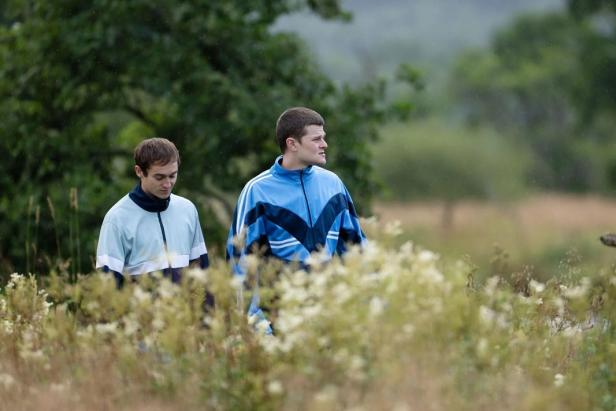
Scene from “Damned Normal”
Conclusion
In the end, one thing remains: Many people think they know Tourette’s because they know the cliché about swearing. “Damned normal,” on the other hand, shows how much more complex, more stressful, sadder – but also more humane – this reality is. The film repeatedly breaks through this heaviness with a large portion of typically British humor, creating a balance between emotional moments and scenes in which you have to laugh.
“Damned Normal” is therefore not just a moving film about Tourette. It’s a film about dignity, prejudice and how quickly people react to what they don’t understand. One of the most emotional and at the same time most human films of the year.
4 out of 5 #*?*%** points