
When Belgian filmmaker Lukas Dhont (“Girl”) discovered a black-and-white photo of a soldier from World War I, his interest was piqued. Directly behind the front line, the picture showed the young man in women’s clothing. During his subsequent research, he came across a little-known tradition: the morale of the troops was kept high with entertaining theater performances, with comrades who were unable to fight usually dressing up as mothers, wives or lovers for the plays. But one thing fascinated Dhont even more: he found evidence that for some gay men, of all things, the brutal war became a place of freedom.
His research inspired Dhont to create one of the most extraordinary works in the genre. Despite some intense scenes in the trenches, moments on the Belgian front in 1916 are few and far between in “Coward.” Especially in a genre that is otherwise primarily about harshness, willingness to sacrifice and the courage to die, the filmmaker instead tells about tenderness, art and desire. In the end, “Coward” is a very sensual, tender, but at the same time overwhelming love drama in its strongest moments.
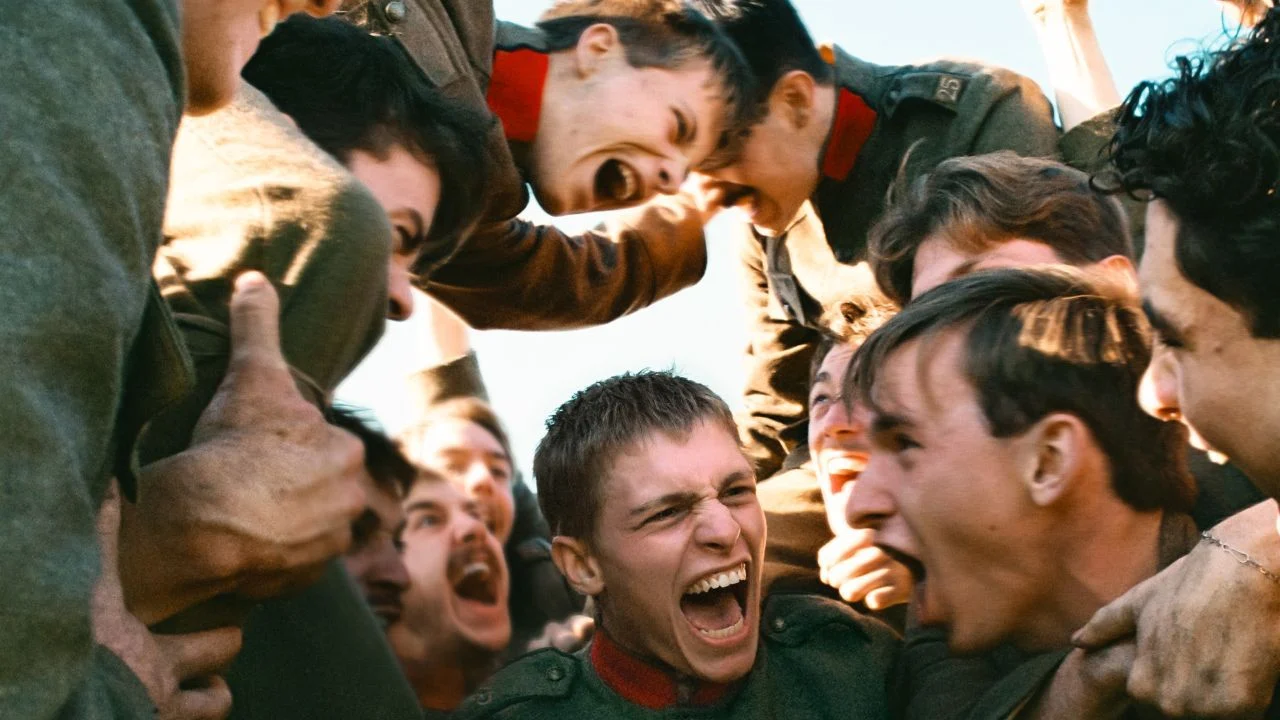
The mood is whipped up at the front: young Pierre (Emmanuel Macchia) among his comrades.
The young farmer’s son Pierre (Emmanuel Macchia) arrives fresh at the front. The sense of duty and the desire to prove himself can be seen in him. But first there is the grueling everyday life. Again and again he and other soldiers have to carry heavy ammunition for the howitzers through the mud or rescue fallen comrades from no man’s land. Not everyone can handle the pressure. A comrade dares to escape, but is branded a coward and shot.
At the same time, Pierre also meets Francis (Valentin Campagne), who organizes opulent theater performances with other decommissioned soldiers in order to distract the troops from the horrors of war. Thanks to his craftsmanship, Pierre begins to support the group in building sets. The two men get closer. But for Pierre it always goes back to the front. When he barely survives one night, the fear of dying grows within him. He has to find a way to stay with Francis and his theater group permanently…
Dirty mud and soft light
Dhont clearly distinguishes the protagonist’s two worlds from each other. Apart from a violent scene in which the young soldier barely survives repairing barbed wire at night, the actual work as a soldier is not a varied series of dramatic set pieces. Instead, it’s all deliberately monotonous: the dark, dirty images are similar, although the same actions are always necessary to unload the heavy load and carry it forward.
In contrast, there is the small theater world, which is bathed in bright colors and soft light. “Coward” is not a war film trimmed with muddy realism, but an often downright elegant drama. This contrast sometimes stands out clearly. Many emotional climaxes are staged very precisely for maximum effect. At times it seems calculated – but it still works because Lukas Dhont, as he did in “Close”, simply knows how to carry the audience along.
An intimate space on stage
The theater choreographies in particular have an almost infectious energy. As the men sing patriotic songs, march, dance and lose themselves in their roles, you immediately understand why such performances had such an impact on the troops and were encouraged by the generals. Dhont cleverly gives them a threefold function: they incite those who have to go into battle tomorrow; they comfort those who have lost a comrade; and they deafen everyone who thinks of home. At the same time, the opulently furnished and costumed scenes offer the men the opportunity to openly show a different side of themselves.
The love between Pierre and Francis develops in this free space. Dhont takes a lot of time for this. The first dance while fooling around during rehearsals is embarrassing for the young farmer’s son, but with the second he gets a little more involved. The insecurity of both men is given enough space. When they have sex for the first time, the initial question is how it even works. It’s this awkwardness, which ultimately leads to them masturbating instead of penetrating each other, that makes the scene so touching.
A film about the courage to be cowardly
The acting of the two main actors is outstanding. Emmanuel Macchia, who was discovered for the film, plays the tall blonde as a character who is often silent but still very open to the audience. This Pierre explains little with words, but when his shoulders tense or his look conveys a certain shyness, it still tells us a lot about his inner life. Valentin Campagne (“Dossier 137”) counters the great silent man with a more lively energy as Francis. He seems to have understood the mechanisms that give him a permanent role at the front, where he does not have to constantly put his life in danger. But the strongest moments are those in which it becomes clear that he is not the self-confident seducer, but also has his insecurities.
He’s a coward too, but that’s clearly not an insult to Dhont. Rather, it is completely natural given the constant death just a few meters away in the trenches. Despite the title, “Coward” is not about cowardice at all, but rather about the courage to find yourself and not become hard and bitter in the face of horror, but rather maintain a soft side. That’s exactly why it’s one of the most unique war films. It has the usual images associated with the genre. The cruelty is there, not only in the scenes at the front, but also in a hospital full of physically and psychologically battered wounded. But Dhont adds others to the well-known scenes, showing men singing to each other, dressing up, kissing, comforting each other. And that is often heartbreakingly beautiful.
Conclusion: In Lukas Dhont’s exceptionally sensual First World War film “Coward”, not every emotional escalation is free of calculation, but the tender, strongly acted and visually impressive love drama at the front is still incredibly touching.
We saw “Coward” at the 2026 Cannes Film Festival, where it had its world premiere as part of the official competition.