When Kazuo Ishiguro received the Nobel Prize for Literature in 2017, the Swedish Academy’s citation specifically highlighted his ability to reveal “the depths of our supposed connection to the world.” And if you watch the film adaptation of his novel “Everything We Had to Give,” you immediately understand what that means: In the 2010 film, Andrew Garfield, Keira Knightley and Carey Mulligan play boarding school students in a love triangle who at the same time have to sort through their teenage hormones and serve as human spare parts warehouses. After all, they were only cloned so that their internal organs could be harvested later. Director Mark Romanek demonstrates great sensitivity for the everyday emotional lives of his protagonists – and at the same moment pulls the rug out from under your feet by expanding your view of the big picture of their existence.
Now Ishiguro’s 2021 bestseller “Klara and the Sun” is less harsh, but despite the title sounding like kitschy train station literature, it remains a profound dystopia following in the footsteps of Steven Spielberg’s “AI – Artificial Intelligence”. But you can’t be sure whether director Taika Waititi (“Thor 3: Day of Decision”) noticed this: his cinema adaptation with “Wednesday” superstar Jenna Ortega as the eponymous AI android at times seems as if he didn’t necessarily read every page, but instead made a film that you would immediately imagine under the name “Klara and the Sun”. Or to put it another way: A whole packet of icing seems to have spilled over the script. Although, at least for kitsch-insensitive non-novel connoisseurs, in the end it’s not as bad as it might sound at first.
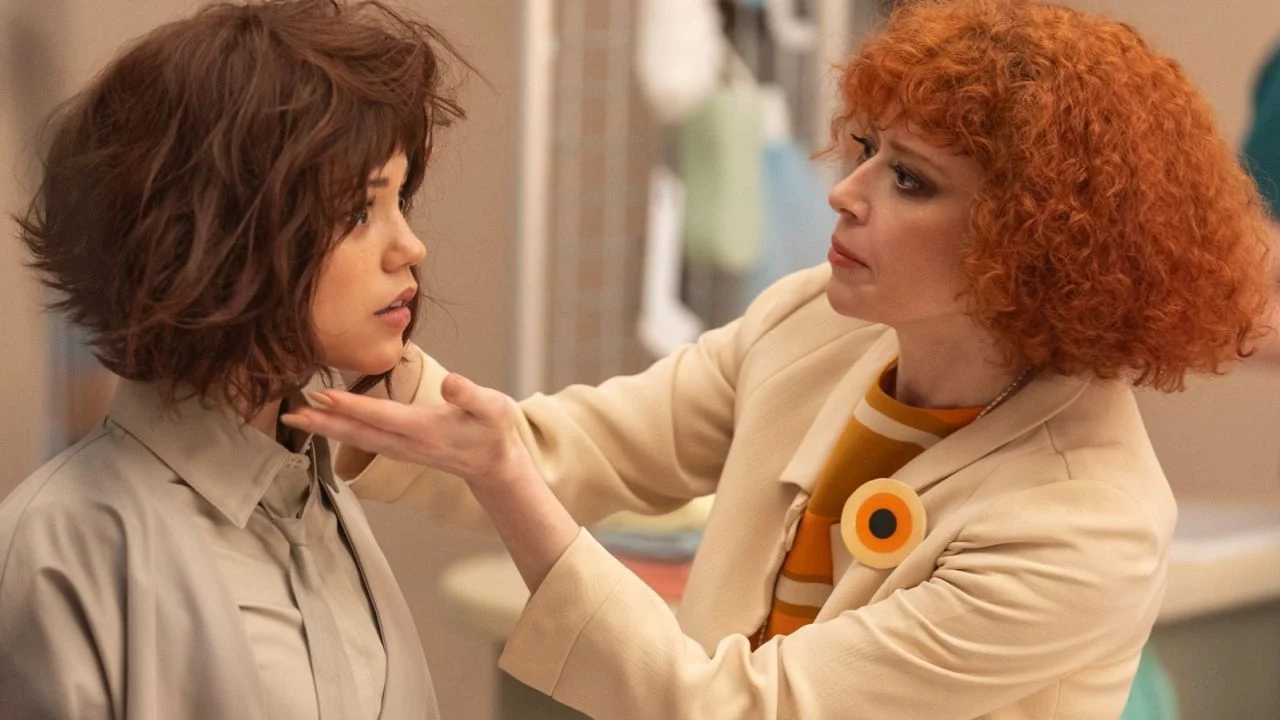
Even with discount campaigns, the store manager (Natasha Lyonne) has little hope of getting her quirky robot AI Klara (Jenna Ortega) sold.
The store manager (Natasha Lyonne) has good and bad news for her human robots, who drape themselves in the shop windows in the morning as skiers or beach vacationers. First the good: The summer holidays have begun – and many parents are looking for AI friends for their unemployed children to accompany them through the strenuous years of puberty. And the bad news: A new megastore has opened right opposite, whose new B3 models all look as if they were fitness influencers and Instagram models at the same time. Of course, an outdated B1 model like Klara (Jenna Ortega) has a hard time – especially since she constantly stands around on one leg for no apparent reason.
She only has three days left to stand out in the shop window – after which she is in danger of melting down. But then the miracle: The teenager Josie (Mia Tharia), who was pimped into being highly gifted using genetic engineering, actually chooses Klara – even though her mother Chrissy (Amy Adams) strongly advises her to choose a newer model. As Josie and Klara become more and more friends over the coming weeks, it becomes clear that something tragic and dark is going on in the remote country house – and the mysterious portrait artist Capaldi (Steve Buscemi) seems to have something to do with it…
The fantastic world of Klara
Although she is introduced as a housewife and mother in the novel, which is consistently told from the perspective of the naive AI Klara (the family lives on the fortune left behind by her absent father), Chrissy is a successful and busy interior designer in the film adaptation. Now one might think that this decision, just five years after the novel was published, was primarily a question of the spirit of the times. But those responsible were probably more interested in finding a logical explanation for the look of the film:
If the original still offers a classic, gray dystopia, “Klara and the Sun” suddenly appears in the cinema as retro-futuristic equipment overkill. The country house is filled with 1950s-style accessories, while even Chrissy’s autonomous car has the look of a vintage car. It almost seems as if “Moonrise Kingdom” mastermind Wes Anderson had made a strange hybrid remake of “AI – Artificial Intelligence” and “The Fabulous World of Amélie”.
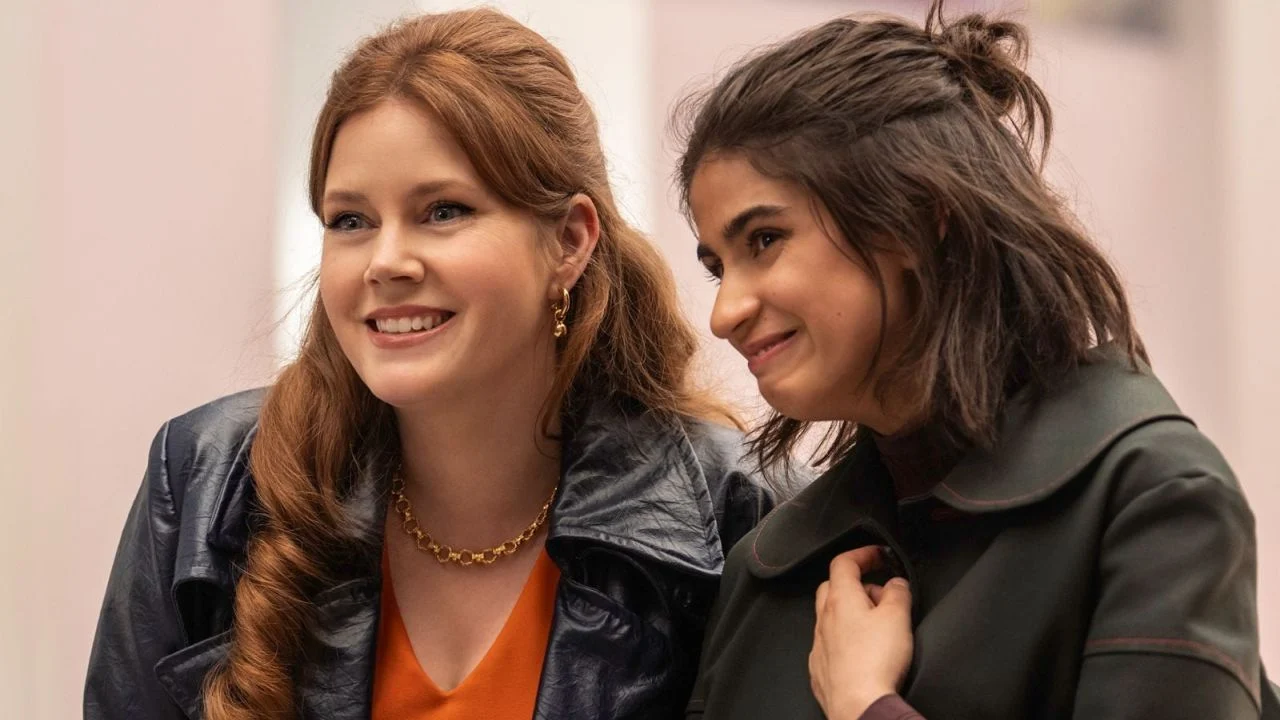
Josie (Mia Tharia) first has to persuade her mother Chrissy (Amy Adams) until she agrees to buy Klara.
So at least you always have something to look at, because the film is not only peppered with detailed sets, but also with lots of little sci-fi ideas. Jenna Ortega (“Beetlejuice Beetlejuice”) also really shines in the role of the always optimistic AI who naively worships the sun like a goddess. The real star remains newcomer Mia Tharia (“September & July”), who easily plays everything and everyone. But all of that only helps to a limited extent if you can’t shake the feeling that Taika Waititi isn’t really up for the darker elements of the second half…
… and instead would much rather just continue to let off steam in its sun-drenched kitsch equipment. The book is about learning something about the core of humanity through the eyes of AI – but little more than a few calendar pieces of wisdom remain in the film. And even though you should start howling like a castle dog in the finale, “Klara and the Sun” leaves you disappointingly cold.
Conclusion: Unfortunately, it never becomes entirely clear until the end whether director Taika Waititi actually wants to say something with his film adaptation of the dystopian novel masterpiece or simply wants to deliver the most light-filled, tear-jerking, feel-good film of the year. You therefore need a fair amount of tolerance for kitsch, but then “Klara and the Sun” offers a whole range of likeable sci-fi ideas despite its tonal derailments.