
The (men’s) dream of the beautiful statue that turns into a living woman has probably existed longer than literature has existed. One of the oldest written traditions comes from the Roman poet Ovid: The sculptor Pygmalion fell so much in love with one of his sculptures that the goddess of love Aphrodite even brought it to life for him. The motif also served as a model for Bernard Shaw’s “Pygmalion” and later as a template for the musical “My Fair Lady” – as well as for some genre cult material from “Mannequin” to “LISA – the madness”. Interestingly, the theme of the idealized female figure, who acquires consciousness along with life, is already questioned ironically by Ovid…
… and it is precisely this subtlety that was most strikingly taken to the extreme by Greta Gerwig’s billion-dollar mega-hit “Barbie”. The FILMSTARTS review says: “… an anti-patriarchal, anti-fascist satire in pink …” In “Breakfast at Audrey’s” things are not quite as anti-patriarchal and anti-fascist, but here too the theme is varied by director and screenwriter Sophie Beaulieu, at least in a relatively original and at times quite funny way: Rémi (Vincent Macaigne) is an almost pitiful guy with a deadly boring one job; He works as an artificial turf sales representative and still suffers from the traumatic effects of his last relationship. Thanks to the sex doll Audrey, with whom he lives on the advice of his psychiatrist, he now at least has a contact person at home who shares a table and bed with him – and at work he can show off the world with his new girlfriend.

Suddenly Audrey (Zoé Marchal) is no longer a doll – but a person not only made of flesh and blood, but also with her own demands.
But one day Audrey (Zoé Marchal) comes to life for no apparent reason. And not only that: she makes demands almost immediately. Rémi’s first reaction is complete panic. He tries to get rid of Audrey, but soon accepts his fate, also because Audrey obviously loves him. Rémi is also somewhat proud to have a girlfriend that he can actually show off. However, Audrey doesn’t behave as desired. She wants to have a say, becomes more and more self-confident and increasingly questions her role. Finally, she even criticizes Rémi’s lax use of the toilet brush. Her behavior, which is characterized by ignorance, is anything but ladylike: she speaks unabashedly about her period and sometimes walks around in a lace camisole.
Rémi, who was initially completely inspired by sex with the now alive Audrey, is increasingly overwhelmed and annoyed by this emancipated woman with the mind of a child who learns particularly quickly and the perfect body of an erotic icon. And then there is the new colleague Patricia (Cécile de France), who has burst into the men’s group of artificial turf sellers as a substitute for a colleague – and turns out to be a really good friend. Could she become competition for Audrey?
Cécile de France outshines her co-stars
Cécile de France (“High Tension”) plays Patricia with a lot of spontaneity and a boyish, casual charisma that is somewhat reminiscent of the young Diane Keaton – only without the omnipresent neuroses. She seems as fresh as a spring day and seems to perfectly complement the indifferent, silty Rémi. And – there’s no denying it – she steals the show from the pretty ex-doll. Zoé Marchal has little chance of holding her own in the relatively thankless role of Audrey. She plays a pretty shell who is increasingly filled with feminism. Unfortunately, it doesn’t quite work, which is also due to the script not being entirely coherent. The concept of explaining as little as possible doesn’t always work here and ultimately makes Audrey less credible.
And a third woman plays a role in Rémi’s life: his sister Domi (Adèle Journeaux), who – without this being discussed much – is more inclined to the same gender. She is Rémi’s only confidante, helps him selflessly and has a few nice, sharp-tongued one-liners ready. Unfortunately, like Audrey, Domi also gets little opportunity to make a name for herself. Of the exemplary, quite original three types of women – feminist doll, self-confident lesbian, uncomplicated companion – who simultaneously represent and ironically question classic and modern female role behavior, only Cécile de France as Patricia can fully meet the requirement. She dominates the screen at will.
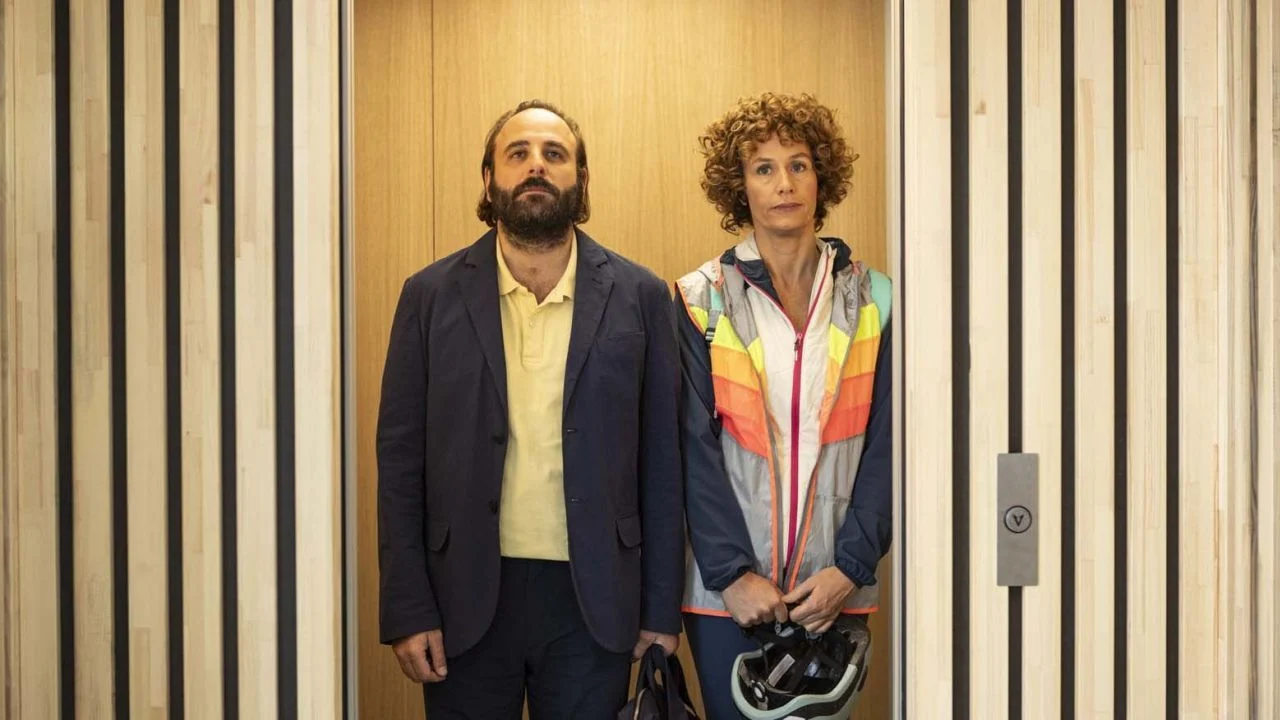
First Rémi (Vincent Macaigne) suddenly has a living sex doll at home – and then a possible relationship with her new colleague Patricia (Cécile de France) is on the horizon.
Vincent Macaigne (“Diary of a Paris Affair”) as a neurotic average loser is a “lovely loser” who, due to trauma, has decided to live with a life-size Barbie-style doll rather than a woman. “I can’t live with a woman,” he tells Audrey. “I’m lazy, I’m old.” But Audrey is programmed to love Rémi, she says, although one wonders how that is possible for a doll. Or was it perhaps planned for her to come to life? This question, like many others, remains unanswered.
And even if the topic of sex only comes up in passing, it is fairly clear that Audrey is obviously there for Rémi not only as a means of combating loneliness, but also as a way to relieve her urges. As a living woman, Audrey has memories of being a doll – so she knows Rémi’s preferences in bed. So she had consciousness before she lived. And so there are more and more inconsistencies that only at first glance seem as if the old male motif of the doll woman who has come to life is being critically brushed against the grain here – as was recently done very masterfully in “Obsession”, the surprise horror hit of the year.
Conclusion: At least there are some bizarre situations in Sophie Beaulieu’s film debut that provide entertainment. And the constellation of a clumsy man between two women, a feminist ex-doll and a sporty friend’s wife, both of whom are clearly superior to him, certainly has a certain humor to it and despite everything gives the film a certain RomCom charm. But “Breakfast at Audrey’s” still doesn’t really do justice to its own concept.