
Good roles for older actresses are generally few and far between. In a recent interview, Katja Riemann also called for more roles for women over 50. Before her, among others, Michaela May, Gisela Schneeberger and Jutta Speidel publicly criticized the level and number of role offers for women their age. Things are looking a little better in France in this regard. One reason for this could be the lively theater scene, which also has a positive influence on film production.
But it is also unusual here for a career to really take off as you get older. Hélène Vincent (born 1943) is one of these rare exceptions. In François Ozon's “When Autumn Approaches” she recently starred as a resolute pensioner with a family secret – and now, at the age of 82, she is following up with the euthanasia comedy “Bon Voyage – Up to Here and Beyond”.
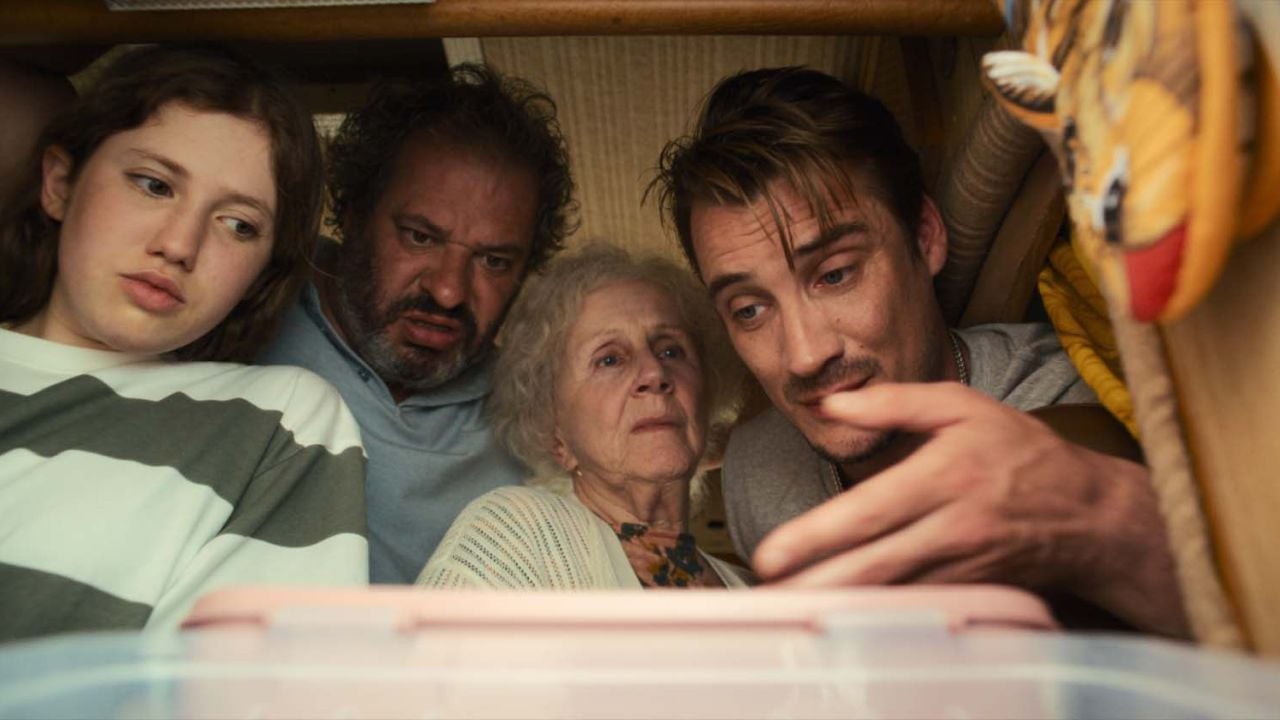
At some point things get really tight in Marie's (Hélène Vincent) mobile home.
Marie (Hélène Vincent) has a fixed daily rhythm. Surrounded by memories, she lives alone in her senior-friendly house with a stair lift and an emergency call. But she is sick, very sick – the cancer has come back and spread. Marie has had enough of suffering and wants to decide for herself how her life ends. The date in Switzerland, where euthanasia is permitted, has already been set – next week. But before Marie leaves, there are two more problems: she needs a relative's signature on the euthanasia document and she needs someone to drive her to Switzerland.
The solution to both problems is Rudy (Pierre Lottin), a geriatric nurse who comes to her aid because Marie's stair lift is stuck. Without further ado, Marie makes him an accomplice: she passes him off as her son and uses a little blackmail to get him to act as a chauffeur. The cunning Marie also manages to get her chaotic and chronically insolvent son Bruno (David Ayala) to come along. Her 15-year-old granddaughter Anna (Juliette Gasquet) invites herself because, like Bruno, she thinks that Marie is going to Switzerland because of an inheritance. Marie's old motorhome is floated – and off we go! The only question that remains is: How does Marie tell her son and granddaughter that she is planning a journey of no return?
Long introduction – but then it gets really fun
With her remarkable directorial debut, actress Enya Baroux (“Visitor From The Future”) proves that she can keep up with the established comedy competition of Toledano/Nakache (“Pretty Best Friends”) or Louis-Julien Petit (“The Splendor of the Invisibles”) – and not just when it comes to cleverly wrapping a serious topic in an amusing plot. She also manages – and this seems to be a hallmark of French comedies – to credibly develop a rather unlikely premise into a functioning plot. However, that takes time – and so “Bon Voyage” has a relatively long opening. At the same time, a new genre is being installed: the euthanasia comedy. There are already a few films that have approached the topic in a rather light way, such as “At the End a Party” by Sharon Maymon and Tal Granit or “Everything went well” by François Ozon – but none of them have dared to be as exuberantly comedic as Enya Baroux.
With all the conflicts within the family and the many unexpected twists and turns, the topic of suicide always falls somewhat into the background (but even there it creates tension and emotions without ever slipping into the trivial): It is absolutely understandable that Marie wants her son with her – but the fact that he is a real good-for-nothing who also turns out to be completely immature, unreliable and chronically broke is more of a typical comedy cliché. There is also a granddaughter who – again understandably – doesn't want to miss the supposed family trip and has a pretty bad relationship with her father, who in turn doesn't even shy away from plundering his daughter's savings account. The story about the geriatric nurse Rudy, who is both an accomplice and a carer and who more or less even becomes the savior of this dysfunctional family over the course of the story, makes the story complete.
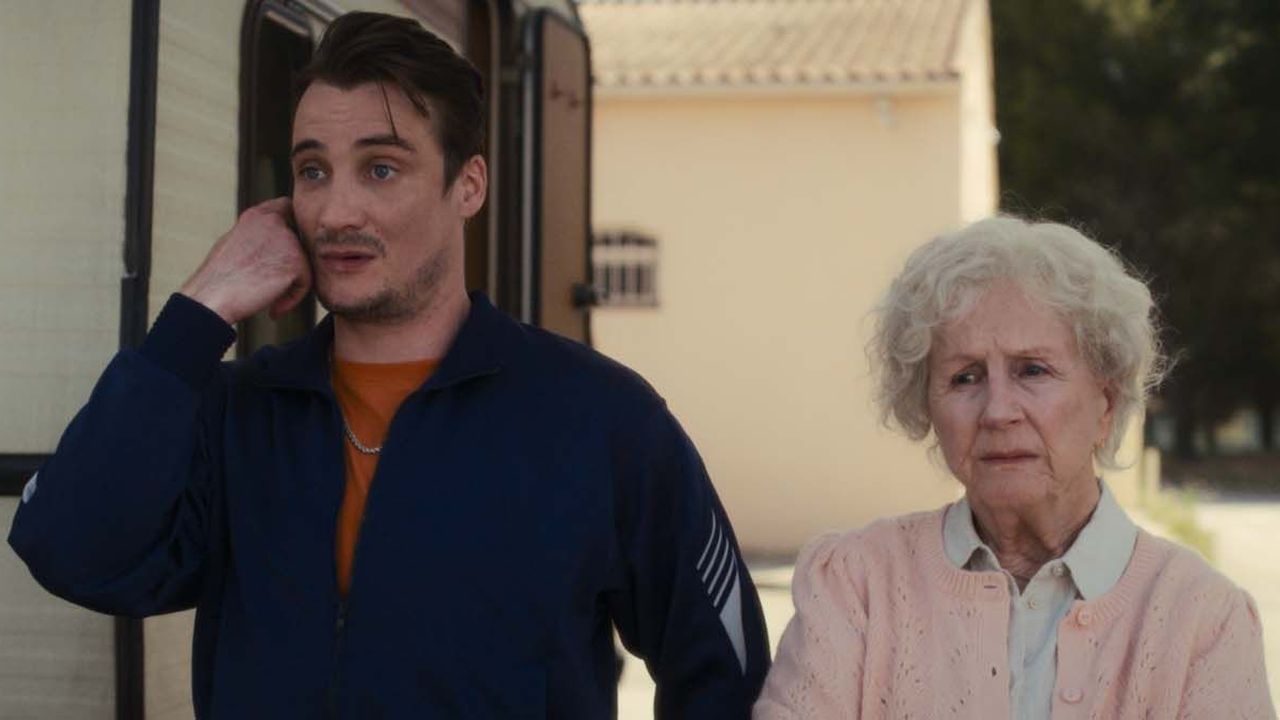
The geriatric nurse Rudy (Pierre Lottin) becomes something of a catalyst for the pent-up conflicts in Marie's family.
But it takes quite a while until all of this is installed. Some things are, as one would hardly expect, something over the top. The fact that Rudy has a tame rat named Lennon who comes with him actually has a dramaturgical significance – albeit a minor one – but it wouldn't have been necessary. Speaking of exaggeration: the actor playing Bruno, David Ayala, proves to be the king of overacting here and unnecessarily exaggerates his acting – his role is not only well characterized, but also very grateful: with the charm of an oversized stuffed teddy bear, he plays a spoiled loser who has never grown up, has neither money nor self-respect and is therefore at odds with his entire family – including Rudy as a new acquisition. Perhaps David Ayala wanted to create an alternative to Pierre Lottin, who (as always) shows a very good performance. Rudy comes from a family of doctors and has become aware of the career as a nurse (“a nurse in a family of doctors is like a fat man in a family of athletes”). Pierre Lottin not only gives Rudy a lot of gentle irony, but also a level of reason that makes him very different from Bruno and Anna.
The two ladies, on the other hand, are completely convincing: Juliette Gasquet as Anna is a real discovery – she gives the pubescent girl, who experiences her first period on the trip, a stunning personality between childlike naivety, female emotions and general human warmth. This makes her the perfect complement to Hélène Vincent. She plays Marie as a fine, old lady who goes her way with small steps, but with determination, taking as much fun and joy of life with her as possible. When she says goodbye to her house before leaving in the motorhome, it is on the one hand touching and heartbreaking – after all, it is a goodbye forever. But on the other hand, there is still a quiet humor in all this melancholy. Hélène Vincent carries this film and she outshines it.
Conclusion: Staging a truly enjoyable comedy about a topic as serious as suicide due to illness requires a lot of courage and empathy. Enya Baroux achieves this with ease – thanks to a wonderful leading actress and an original script.