
The Italian documentary filmmaker Gianfranco Rosi spent three years on the edge of the Vesuvi, the only still active volcano on the European mainland. “In search of the traces of history”, as the director (“The other Rome”), which was awarded both with the Golden Bear of the Berlinale (“Seefeuer”) and the Golden Lion of Venice (“The other Rome”). However, his mostly static camera seems to be less of a seeker than a patient observer who does not interfere who, rather a minute, remains too much than too little on landscapes and subjects. Traces of history can still be found in “Below the Clouds”.
In 79 AD, an outbreak of the Vesuvian destroyed the Roman city of Pompeii. Around 2,000 people were buried under ash and pumice, some of them are preserved in their last moments in the form of plaster prints. Archaeologists and historians have been working on the ruins of the ancient city – and thus frozen time – since 1748. Almost two millennia after the catastrophe, vapors and gases from the small openings on the crater rim of the Vesuvi still flow – and remind you that the volcano, which was recently broken out in 1944, is still alive, but is still alive.
At the emergency center you get to know the city
An even greater threat to the residents of Naples represent the so -called Phlegräische fields, a super volcano, the underground activity of which is repeatedly noticeable in earthquakes and soil surveys. In the scenes located in an emergency center, we hear numerous concerned people who are torn from sleep by smaller and larger shocks. And yet danger is a relative size: one of the Syrian seafarers on a grain ship on the cell phone expresses his relief, at least for a short time in a “safe city” after he has just left the Odessa drawn by the Ukraine War.
Said emergency call center is one of the central places of “Below the Clouds”, which, in addition to the interactions between tutor Titti and his students, harbors the most lively moments. Here we not only get an insight into a community in the constant alert and their very different ways of dealing with it, but are also thrown emotionally back and forth – just laugh at a caller baptized by the dispatchers “Mr. What's the time”, who regularly explores himself after the time, the next moment we are worried about a woman who is beaten by her drunk husband.
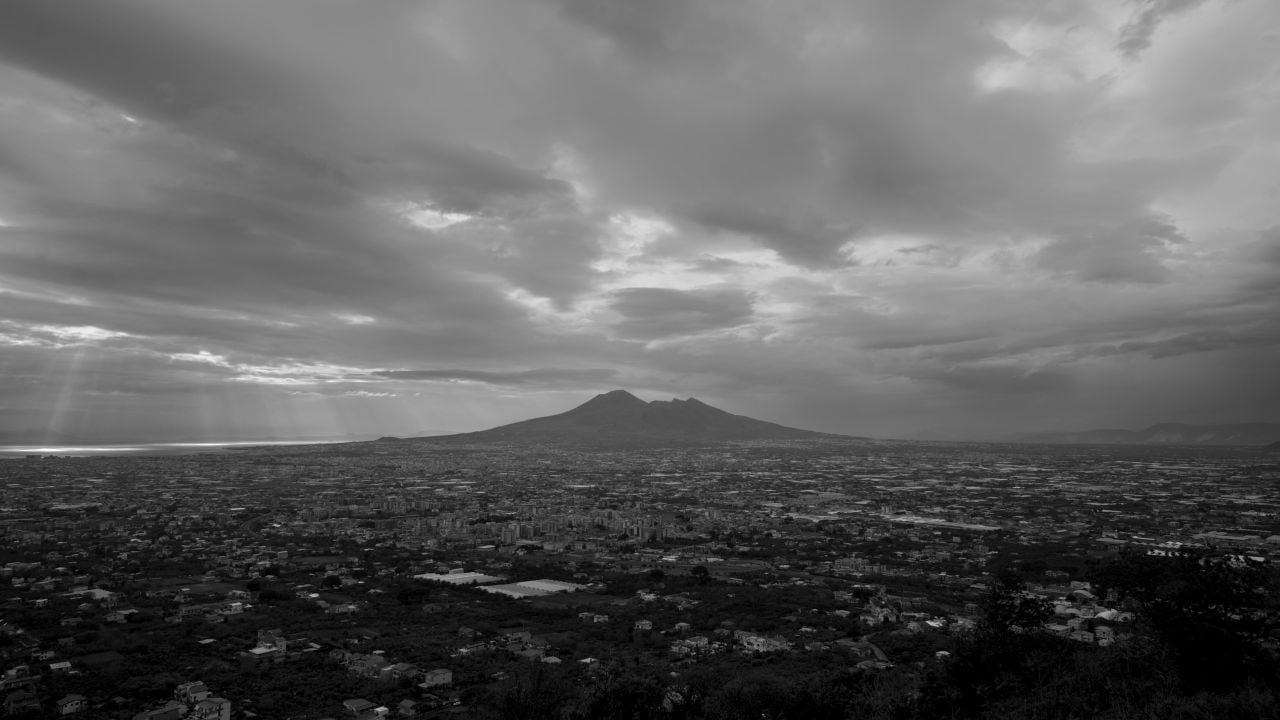
The extremely contrasting black and white shots make “Below the Clouds” a visual feast for the eyes.
Rosi briefly closes the city panorama in this way. Assocatively, the camera links the rain of flowing lava, the most of the rain in the rain, the most grateful of grain on the ship's wall with the meticulous exposure of ancient finds. A dilapidated cinema shows scenes from Roberto Rossellini's “Stromboli”, older documentation and the monumental film classic “The last days of Pompeii”. The present becomes history, history to art. The preoccupation with both always includes a confrontation with transience.
The extremely contrasting black and white recordings have always been enrolled, and the preserved bodies of Pompeii, suddenly torn from their everyday life, are reminiscent of the volatility of the time that Rosi tries to overcome with its long, recurring tableaus. A cinematic river does not always result from this, and some redundancy can make the visual experience difficult. The observing instead of commenting documentary form, which represents “Below the Clouds”, knows more compelling representatives. And yet Rosi always finds motifs that get stuck – especially in the breathtaking final sequence, for which the view is already worthwhile.
Conclusion: After his big festival winners “The other Rome” and “Sea Feuer”, documentary filmmakers Gianfranco Rosi is devoted to Naples with the risk of a volcanic eruption-and is again more observing and associative. Whenever it threatens to get bored, “Below the Clouds” surprises with a reverberating picture.
We saw “Below the Clouds” at the Venice Film Festival 2025, where he celebrated its world premiere as part of the official competition.