
Five years have passed since Peter Meister presented his award-winning debut with the bizarre nonsense “The Black Square”. We were impressed too. FILMSTARTS gave it a full 4 stars for the prominently cast crook comedy about two art thieves who stumble from one crazy situation to the next on a cruise. In “The Black Square” Meister addresses the play with identities as well as the absurdities of interpersonal relationships. He also examines the question of what dynamics can develop in perpetual deceptions and lies. Why are we mentioning this here?
Quite simply because the Bonn filmmaker deals with similar content in his second feature film “Bear Hunting” – but this time in the form of a pitch-black historical tragicomedy that takes us back 200 years into the past. “Bear Hunting” is wrapped in a completely different narrative guise than “The Black Square”. But the film exposes the bourgeois façade and the “beautiful appearance” at least as radically and in a comparably laconic way. But you shouldn’t be allergic to a peppery portion of local color if you want to have fun with “Bear Hunting”.
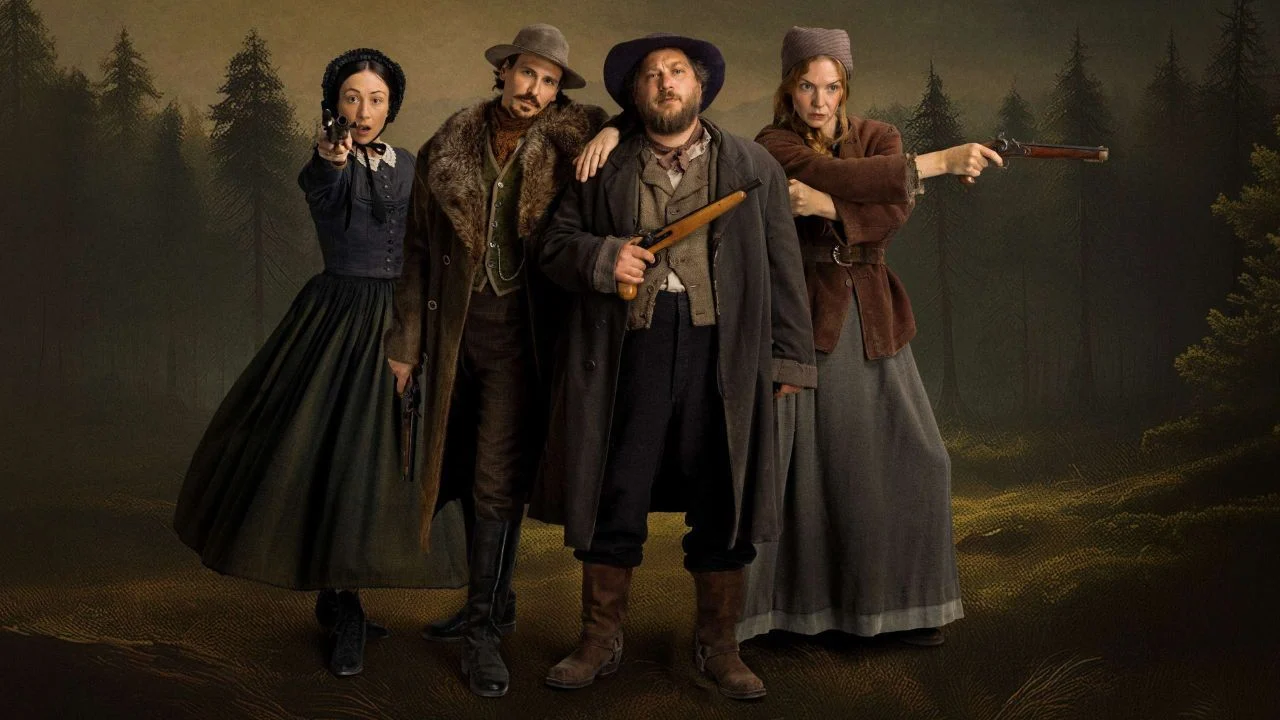
A German whodunit western: the extraordinary genre of “Bear Hunting” alone makes you curious!
In 1834, famine, crime and resistance to the authorities were the order of the day in many areas of Germany. In these confusing times, the printer Heinrich (David Scheid) falls in love with Minna (Aenne Schwarz). The couple wants to leave poverty and oppression behind them and make a new start together in the USA. However, there are two problems. First: Minna is the wife of Heinrich’s brother Gustav (Christopher Schärf). Second: Heinrich doesn’t have the money for the trip. Meanwhile, the gendarmerie blames a mysterious murder case on the last German bear – who therefore has an attractive bounty on his head. Heinrich and Minna sense their chance…
A “problem bear” in the Hessian wasteland
Bear Hunting is a film that derives much of its appeal from its regional flavor. Set in the historic Grand Duchy of Hesse, we find ourselves in a time of great social upheaval and increasing protests. No wonder: the rural population suffers while the Grand Duke and his people indulge in luxury and have set up a rigorous police state (or better: soldiers’ state) to maintain order. This background knowledge is needed to understand the characters’ behavior – and also the dynamics that the fairy tale about the alleged bear and the subsequent hunting hysteria takes on.
Meister creates the microcosm of a poor, isolated Hessian village community (filmed on original locations in Bad Homburg and the Frankfurt region). The eccentricity and quirkiness of the residents and, above all, the macabre wit that they display – as a pattern of survival – are sometimes reminiscent of Marcus H. Rosenmüller’s “Those who die earlier are dead longer”. Here and there, elements of rustic provincial comedy, home westerns and folk-traditional folklore can be seen. But “Bear Hunting” is not only significantly more melancholic and darker than Rosenmüller’s cinematic success, but above all also more political.
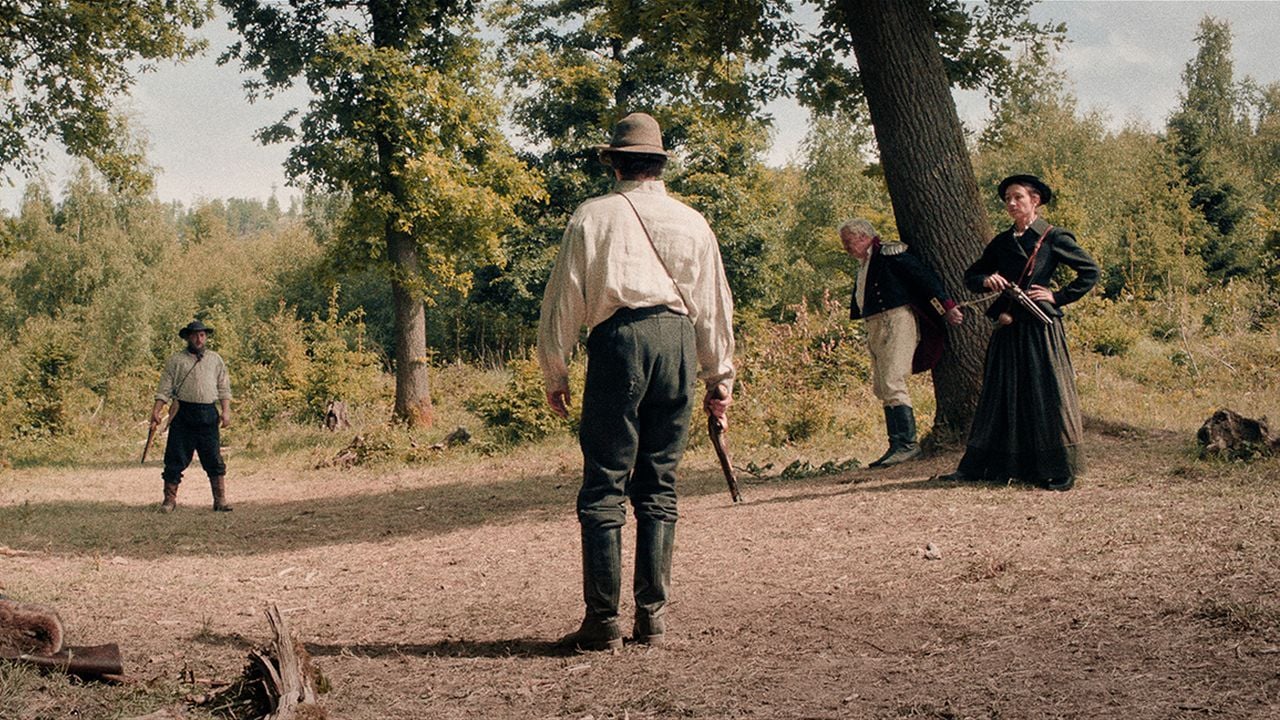
Of course, a real duel is a must for such a decent home western!
In “Bear Hunting”, the government serves up fairy tales to citizens in order to appease them. A hunt that distracts people from their own dilemma and nourishes hope for better times (the 5,000 guilder bounty)? 1834 seemingly the perfect “fake news” at the right time. Ultimately, the ruling elite fears nothing more than – as the major puts it at one point – “a tangible revolution of the bourgeois rabble”. One of the characters sums up his own plight aptly: “Everything is going down the drain here.” These are all clever correspondences and references to contemporary questions, themes and problems in 2026.
It’s about manipulation, gullibility, egoism, the control of the masses and the question of what actions people are prepared to do in their time of need. An (anti-)homeland film could hardly be more political! Meister cleverly packages his swipes at the establishment and the impotence of politics with the means of macabre comedy. Not forgetting to laugh in times of tragedy and hopelessness is a fine art. An art that masters “bear hunting”. The film makes you smile – or at least grin – even in the dreariest, darkest moments. This is ensured by the dry, cynical gallows humor and the peppery OnelLiners.
What could go wrong with a band name like that?
The strong cast also contributes its part. Also nice: the polyphonic singing and the dreamy sounds of the Essen folk band Düsseldorf Düsterboys, which acoustically accompany the film in an atmospheric way. The only real point of criticism is that “Bear Hunting” seems a bit indecisive in the middle part and there are unnecessary digressions in the content that drag out the plot and artificially inflate it. The wonderfully crazy finale, which almost drifts into the grotesque, makes up for this, in which events come to a head. In the face of death, everyone involved loses their last inhibitions and, in a crazy final fight, brings the whole tragicomic nature of the events to the point again in just a few seconds.
Conclusion: No home idyll – “Bear Hunting” is a bitterly evil, allusive and thoroughly socially critical mixture of historical film, provincial farce and western adventure. The film digs deep into the wound and deconstructs the myth of the ideal village world as a place of repression, lack of freedom and bigotry. But: It requires a minimum of historical awareness and a penchant for satirical parables.