
The theater of the absurd, like champagne and tin cans, is considered a French invention – its origins go back to the 19th century. But it was only after the Second World War that absurdity on stage really began – fueled by the existentialist philosophy of Jean-Paul Sartre and Albert Camus. “Waiting for Godot” by Samuel Beckett became the best-known work of this movement – and the German author Hanno Rinke also seems to have felt a certain inclination towards the theater of the absurd at a young age:
His rarely or never performed play “Downstream”, parts of which can be read on the author’s website, has at least elements that are reminiscent of Beckett and even more so of Eugène Ionesco (“The Lesson”). “Stromabwärts” was filmed by Maximilian Moll under the working title “Strom” at the end of 2021 – and renamed “Autocrats” in the five years between filming and the theatrical release.
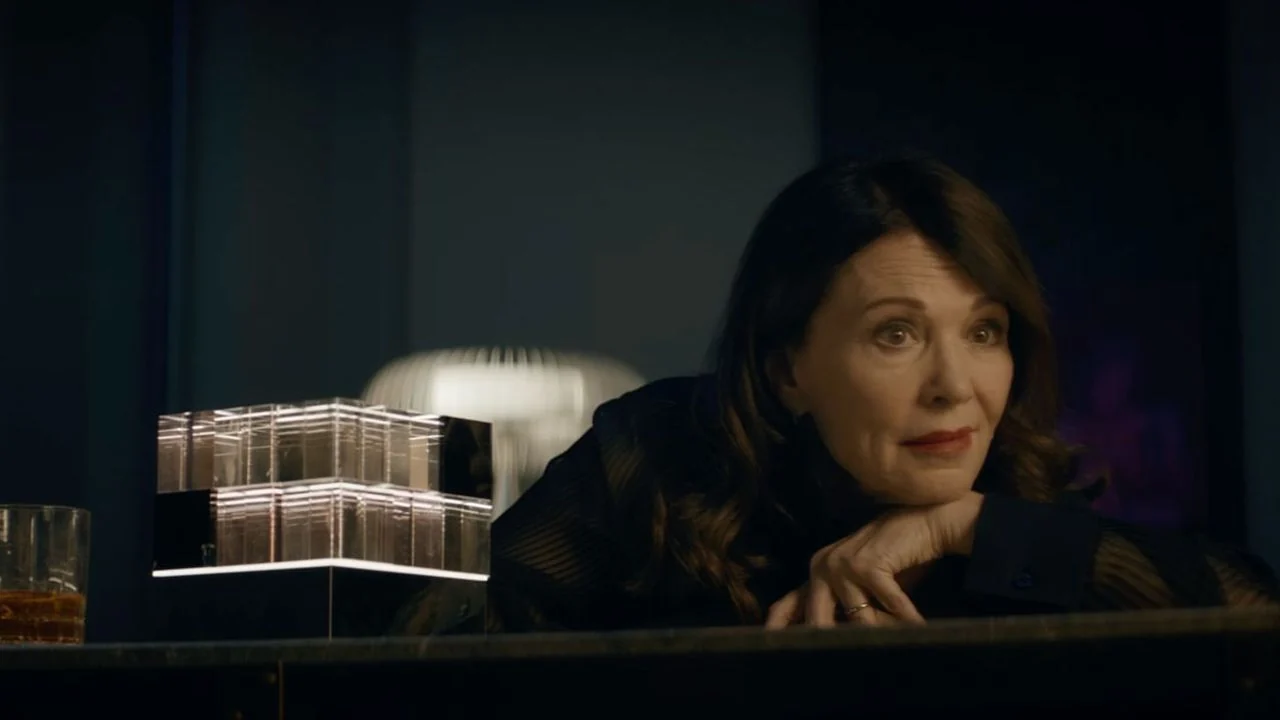
Iris Berben as a femme fatale, who for a long time remains unclear what she actually plans to do with her young playmates.
The mysterious Diana (Iris Berben) lives with the much younger Stefan (Ingo Raabe) in a very tasteful Berlin penthouse apartment directly on the Spree. Today they invited the attractive Pan (Dennis Mojen) to their place via an advertisement. It seems to be some kind of game night – whether with sex or without remains a mystery, like so many things. In any case, Pan is excited and obviously ready to go along with whatever the couple has thought up for him. But first of all, cultivated conversation takes place.
People talk skillfully about the cookies and the whiskey, for which chunks of ice are effectively broken up. The balance of power is clear: Diana is the boss, Stefan follows her orders, Pan obeys and submits. Pan’s realization that his hosts are not only rich and beautiful, but also somehow dangerous, comes rather late. However, when the supposedly unsuspecting Olga (Alexandra Maria Lara) shows up, the previous power structure is suddenly turned upside down…
As lively as a furniture store catalog
As is well known, first impressions are formative – and above all, this film exudes a high degree of slightly frosty sobriety. Of course the couple is supposed to seem mysterious, but that doesn’t really work; Instead, Diana and Stefan seem rather bored right from the start. And that’s not at all due to the brave actors, but rather to the complicated script and the glossy furniture store production, which seems overly theatrical and artificial for long stretches. There is a lack of consistency, credibility – and above all, liveliness. Instead, the strained, enigmatic dialogues are exhausted by educated middle-class arbitrariness.
Some topics that were already popular 50 years ago when the piece was written are not explored further now: illness, old age, homosexuality, violence and, again and again, power. But ideas about mechanisms of domination are presented here, if at all, at a shockingly low level. How would an elementary school teacher talk about the topic of power? Maybe she would say, “Yes, there are bad people, but you can’t tell by looking at them.” Or in high school: “Describe the three pillars of autocratic stability!” But at the time the author probably gave little thought to legitimation, repression and co-optation for his little chamber play.
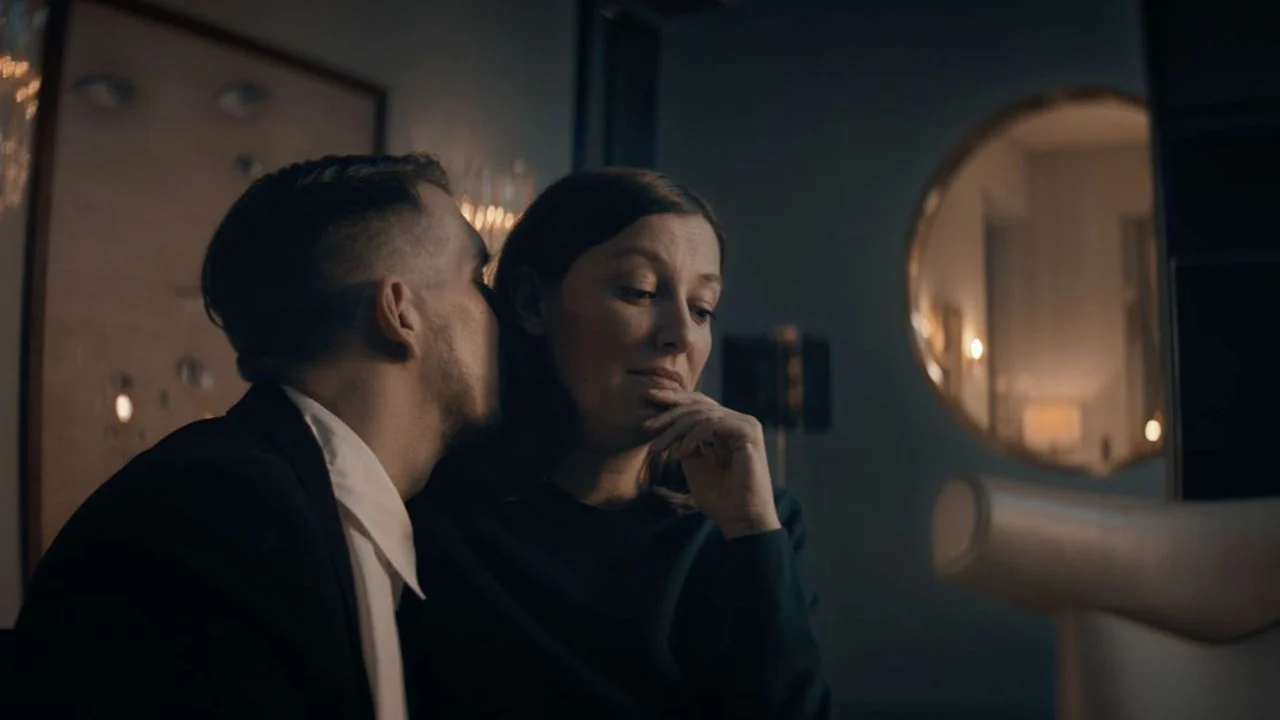
Alexandra Maria Lara brings a bit of momentum into things with her performance in the final third!
The film is also a chamber piece – extremely stylishly furnished – that vacillates uncertainly between psychological thriller and criminal grotesque. Still, there are few to no surprises, the plot is predictable. The most important question could instead be: What actually makes power so attractive? Why does a Pan fall for the obviously obscure couple? There is an essential aspect missing that would have ensured that the place would come to life a little more: human greed. But neither Diana nor Stefan nor even Pan give the impression that they really want anything. They all seem pretty indifferent. As for Pan, it is completely unclear what led him to the two of them. If only it were greed for money! But boredom as a motive for getting involved in strangers’ power games? This probably only works in clearly sexualized relationships, but this topic is not the focus here either.
While Oskar Roehler celebrates excess and provocation in his films as the first means of choice to castigate the fundamentally desolate state of society more or less successfully – but always mercilessly – Maximilian Moll’s production remains rather bloodless. The relationships between the people remain in an unclear state of limbo. That’s another reason why they’re so uninteresting. The rare attempts to change this cause more confusion than clarity. Pan has a traumatic experience behind him, which Stefan and Diana are strangely well informed about. And Diana has major health problems – at the beginning she takes off an orthosis that keeps her back straight. At times she seems to be in pain, but it remains unclear what that means. Is her illness the explanation and perhaps even the excuse for her behavior? Should we feel sorry for this woman?
Iris Berben outshines everyone
Iris Berben (“The Last Name”) is undeniably the star of the film. Meanwhile, the younger men at her side find it difficult to play against her overwhelming presence. Nevertheless, they carry out their tasks with as much decency and dignity as their barely developed characters allow. Only Alexandra Maria Lara, alongside Iris Berben, is really convincing in her role as Olga, which she plays with ice-cold harshness and the occasional hint of a cynical smile. In the end, she at least provides a small acting highlight in an otherwise rather confusing conversation piece.
Conclusion: A frighteningly lifeless mystery chamber play that increasingly loses itself in a symbolic to surreal arbitrariness and takes its discussion about the dangerous fascination of power to a very superficial level.