
Kornél Mundruczó stands for a cinema of pain that is only too happy to show off grand gestures: in the much-acclaimed Netflix psychodrama “Pieces Of A Woman” (2020), for example, he blew up what was essentially an intimate story about grieving and emotional asynchrony – a couple is crushed by the loss of their newborn child – by preceding it with a 24-minute planned sequence in which a painful home birth occurs meticulously and in all its drasticness. The fact that the Hungarian director formally disarms in his latest film “At The Sea” and that in the end you don't find anything to talk about in technical efforts primarily exposes other problems.
The first shot consists of a sustained close-up of Amy Adams, whose gaze drifts slightly past the camera leaving no doubt about her damage. The “Enchanted” star plays Laura, who once took over the renowned dance company of her brilliant and scandal-proven father and subsequently rose to become a modern dance great herself. She has now completed a few months in a rehab clinic and is about to return to her parents' house, which is idyllically located close to the sea. This leads to a conflict-filled reunion with her husband Martin (Murray Bartlett), teenage daughter Josie (Chloe East) and her little son Felix (Redding Munsell).
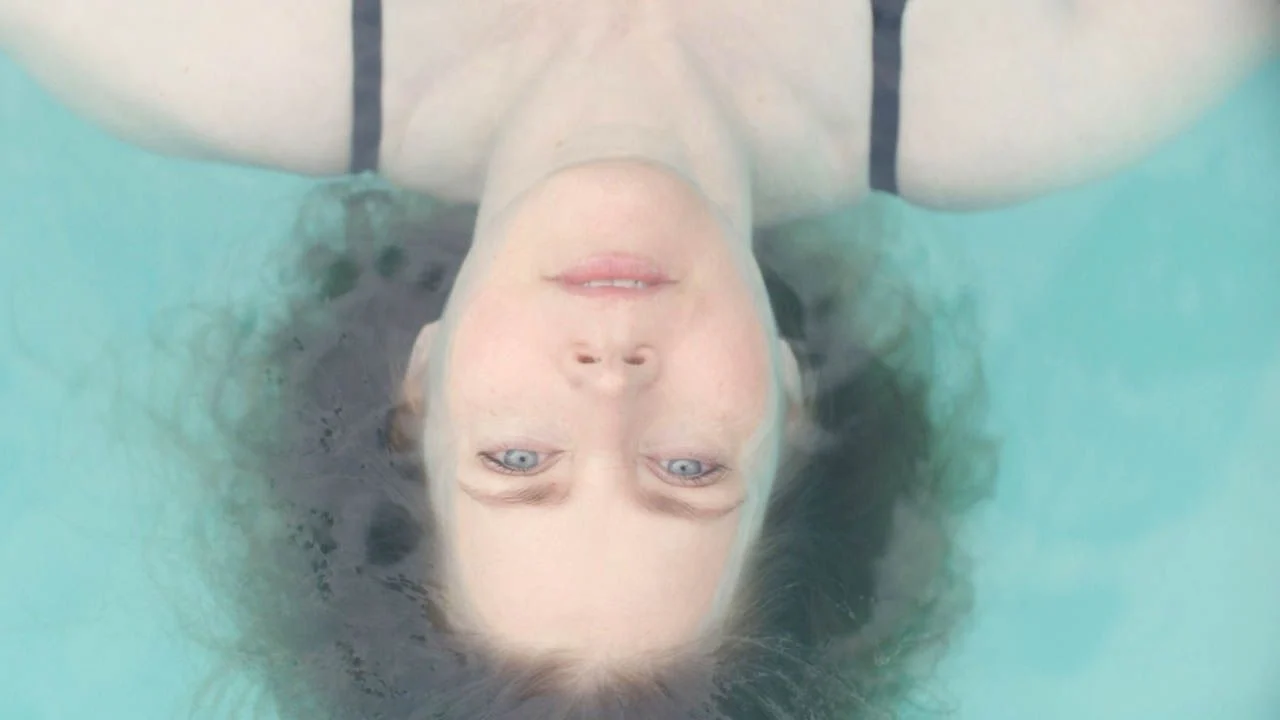
Laura (Amy Adams) returns to her family after a hospital stay of several months – but unfortunately not everything is well again.
Associatively mounted memory fragments provide ample information about the nature of Laura's traumas, for example when a rotating top is short-circuited with bloody ballet shoes that perform pirouettes. Yes, the protagonist still carries around a lot of heavy baggage, some of which has been accumulated since her childhood: a famous, toxic father, pressure to succeed and incapacitation, a tendency to self-destructive behavior, which is expressed in excessive alcohol consumption. The psychological report virtually writes itself.
Those around them are overwhelmed by the situation: Martin's efforts to restore at least a semblance of normality fail because he is also very busy trying to prevent Laura and Felix from becoming too close – who already approaches his mother at a distance. Josie – who, much to Laura's displeasure, is aiming for a dance career herself – is actually in a downright hostile mood: When she picks up her mother from the airport, she doesn't even wait for the answer to the question of whether she can put on music. The circle of friends, most of whom coincide with Laura's professional environment, are not even informed about the actual reason for her absence. Martin spread the version that his wife was relaxing in Bali.
Tough therapy session
“At The Sea” wants to be understood with dogged seriousness as a psychological and character study, but at times it has more of the character of a dime novel. The emotional distortions and the resulting misfortune are little more than generic plot building blocks; the musical background is provided by melodic, caressing violins, which sometimes swell dramatically in moments of tension (does Laura reach for the glass again or not?). Mundruczó, who is rarely at a loss for an overly clear metaphor anyway, basically uses the most worn-out of all possible images to illustrate the inner world of his protagonist – it is certainly not entirely a coincidence that the film takes place by the sea, which in the history of art and literature has always stood for the hidden and repressed, but whose vastness is also an ideal motif of longing that Kitschauer Nicholas Sparks already appreciated.
You also think of his work when Laura meets the quite attractive Keegan (Brett Goldstein), who is also struggling with an addiction problem, and who explains to Laura his enthusiasm for kite flying by saying that this is how he learned to let go. With Sparks (or his modern counterpart Colleen Hoover) the plot would have developed from this scene – in “At The Sea” Keegan only has the function of a cue who disappears from the film immediately after his job is done.
One would be willing to swallow all the clichés if the film embraced them and confronted them with emphasis. But Mundruczó is simply the wrong director for this. Until the quasi-finale at a garden party, which is riddled with numerous micro-escalations, “At The Sea” appears to be a tough therapy session that sadly pokes at the same old wounds. In the end, mother and daughter communicate everything that cannot be said via dance, and Laura can now perhaps let go to some extent – at least that is what the image of a kite soaring into the sky suggests.
Conclusion: Dull psychogram that unfortunately doesn't draw the right conclusions from its penchant for kitsch and cringe.
We saw “At The Sea” at the Berlinale 2026, where it celebrated its world premiere in the official competition.