Just under a month ago, Luca Guadagnino showed his seven-hour documentary “Joie de Vivre” about director legend Bernardo Bertolucci (“1900”) at the Venice Film Festival, and now he is already presenting his latest feature film, “Artificial”. This had already made a lot of headlines because, like the majority of Guadagnino’s directing works since “Suspiria” (2018), it was made in collaboration with Amazon MGM, but the studio no longer wanted to distribute the film after its completion.
The cause was linked to Amazon’s recently concluded partnership with OpenAI – but there is no official confirmation of this conflict of interest. In any case, a new partner was quickly found in the independent distributor Neon for the publication of the corporate satire, which should not only be met with enthusiasm even beyond the controversies behind the scenes: Guadagnino scores with his directorial brilliance, but he doesn’t always make things easy for his audience.
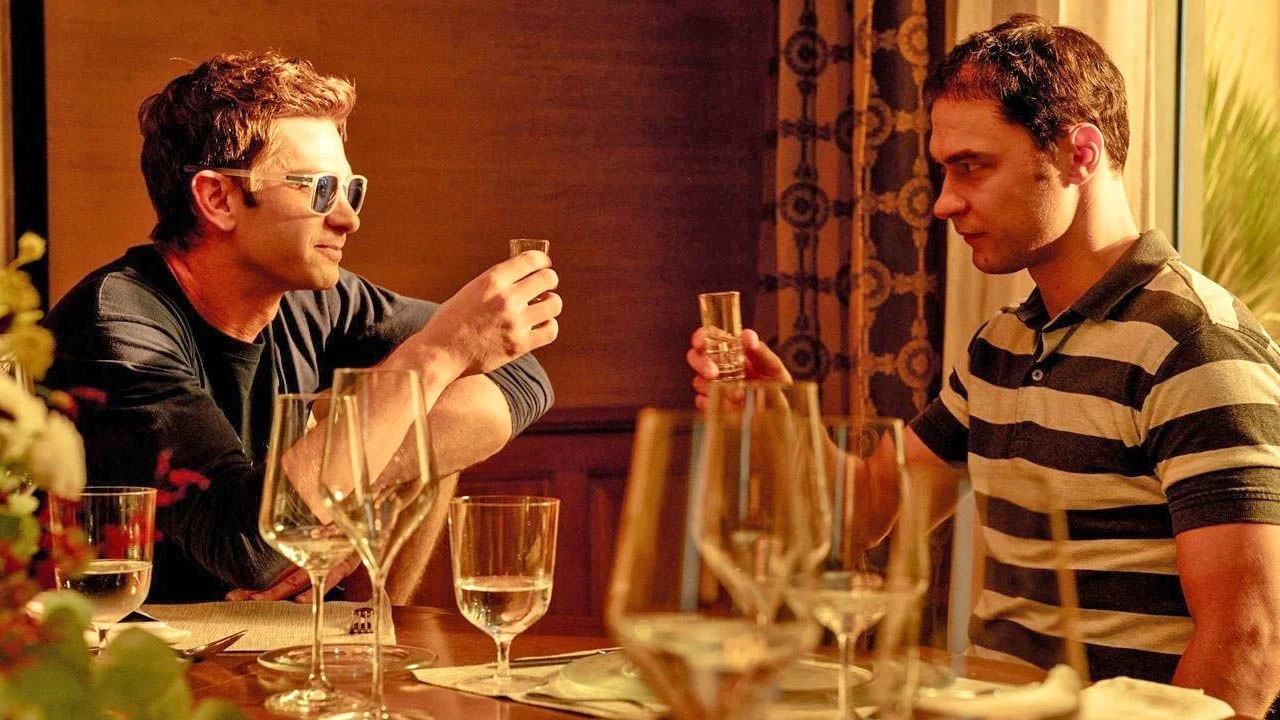
Ilya Sutskever (Yura Borisov) and Sam Altman (Andrew Garfield) are among the founders of OpenAI – but the collaboration is not free from power games and conflicts of interest.
After ex-Spider-Man Andrew Garfield appeared in Luca Guadagnino’s thriller “After The Hunt” last year as a university professor who is confronted with allegations of sexual assault, he now plays a central role again in “Artificial”: Sam Altman, the co-founder of the software company OpenAI, which is best known for its AI chatbot ChatGPT. But the film starts earlier – and initially doesn’t start with Altman, but with the student Ilya Sutskever (Yura Borisov, “Anora”), who works on artificial nervous systems and literally beats up the computer science professor Geoffrey Hinton (Mark Rylance, who already starred in Guadagnino’s “Bones And All”) at the University of Toronto.
The two quickly begin to work together and develop a neural network that is specifically designed to process visual data. Even though they could have gotten significantly more money for it elsewhere, they are selling their development to Google – not least because they want to prevent the technology from being used for military purposes such as the use of combat drones. However, due to similar interests, Sutskever’s paths soon cross with those of the tech entrepreneurs Elon Musk (Ike Barinholtz, “Bad Neighbors”) and Sam Altman, and since he already feels thwarted by his mentor, he turns away from him. The impatient young men no longer want to wait for the future, but rather usher in it themselves. By founding OpenAI, they open Pandora’s box – and the film takes off.
The figures also appear “artificial”
Like an ominous modern version of the Knights of the Round Table, the actors sit together and revel in their power – with Sutskever initially mistaking their interest in his research as sincere admiration of his abilities. Borisov’s game is initially reminiscent of Sheldon Cooper from “The Big Bang Theory”, as it thrives on the same form of stubbornness and social incompetence. What sets him apart from the iconic sitcom character is his strong Russian-Israeli accent, which incidentally goes hand in hand with one of the film’s most fantastic details – so subtle that viewers would hardly notice it from a single scene: With every year that the computer scientist spends in Canada and the USA, his pronunciation becomes clearer. Elon Musk, who speaks openly about his Asperger’s syndrome off screen, also focuses on unconventional gestures and manner of speaking. Ike Barinholtz imitates this so precisely and at the same time exaggeratedly that his performance could have come from a “Saturday Night Live” sketch.
The characters appear so strange that the film title soon takes on an ambiguity. These men seem artificial themselves – they always seem to be striving to imitate the behavior of those around them. Of course, they are the ones who control a machine that learns from and imitates human interaction. Greg Brockman (Cooper Hoffman, “The Long Walk”), who is introduced to Sutskever as “probably the most American guy he’ll ever meet” and speaks and laughs at twice the volume, seems, of all things, the most human. The external design of the figures also contributes to this impression of artificiality. Unlike in many other productions, the colored contact lenses that give Andrew Garfield Altman’s blue eyes are not at all distracting here. The alienation effect this creates, which gives it something unreal, seems to be intentional. The facial and dental prosthetics are also so inconspicuous that as a viewer you instinctively notice that something is different about the actors’ faces, but you cannot determine it exactly.
Between Pinocchio and Peter Pan
Sutskever’s inability to lie can also be read as an indication of possible neurodivergence. He would rather end a lecture in Montreal early than come up with an answer. Right at the beginning of the film, Hinton draws a comparison to the wood-carved Pinocchio. In order to become a real boy, the jumping jack must be courageous, honest and unselfish. While Sutskever takes this as his guide from now on, he is, as in Carlo Collodi’s story, exposed to manipulations and seductions that are intended to dissuade him from his path. This is most evident in a restaurant scene with a potential investor, in which Altman and future OpenAI technology chief Mira Murati (Monica Barbaro, “One Night Only”), like the fox and cat from the “Pinocchio” story, try to wrap Sutskever around their finger with the promise of quick, effortless riches.
Sam Altman seems like a mythical figure in his own right. It’s not just his idiosyncratic clothing and running style, which is reminiscent of the exuberant hopping and skipping of a prepubescent, that bear witness to this. Like the eternal child Peter Pan, he has no interest in growing up and twists every story to portray himself as the hero (or victim). When the board first expressed concerns about his leadership style, this resulted in a rude call to his parents. The words are literally spoken: “They are mean to me!” Much of this depiction is actively exaggerated – but to call the film a comedy outright, the subject matter is simply far too bitter. “Artificial” shows in a frightening way that our world is now on the brink of the abyss due to the traumas and vanities of individual men. In contrast to most people, those responsible in their survival bunkers will be safe from personal consequences.
The better “The Social Reckoning”, but…
In “The Social Network” (2010), Andrew Garfield played Facebook co-founder Eduardo Saverin, a real-historical figure in the clinch over the founding of a billion-dollar company, so the comparison to David Fincher’s celebrated satirical drama is not far off. While the sequel “The Social Reckoning,” directed by screenwriter Aaron Sorkin, recently lacked verve and bite, many critics even see “Artificial” as the better sequel. But while Sorkin lacks the kinetic directing skills of Fincher, Guadagnino lacks the script of a word wizard like Sorkin.
The script for “Artificial” was written by “Saturday Night Live” writer Simon Rich and scores points primarily because it presents the many technical developments in a way that laymen can understand. At the same time, a lot of things have to be laboriously established before the actual story about the problem of artificial intelligence really begins. Although the film explains a lot, a little prior knowledge is also an advantage. The seemingly spontaneous example given by Mira Murati in a conversation of how a lack of safety regulations could cost human lives (“What if a suicidal girl asks ChatGPT for help with her suicide?”) is by no means taken out of thin air: a comparable case is the subject of the ongoing legal dispute Raine against OpenAI.
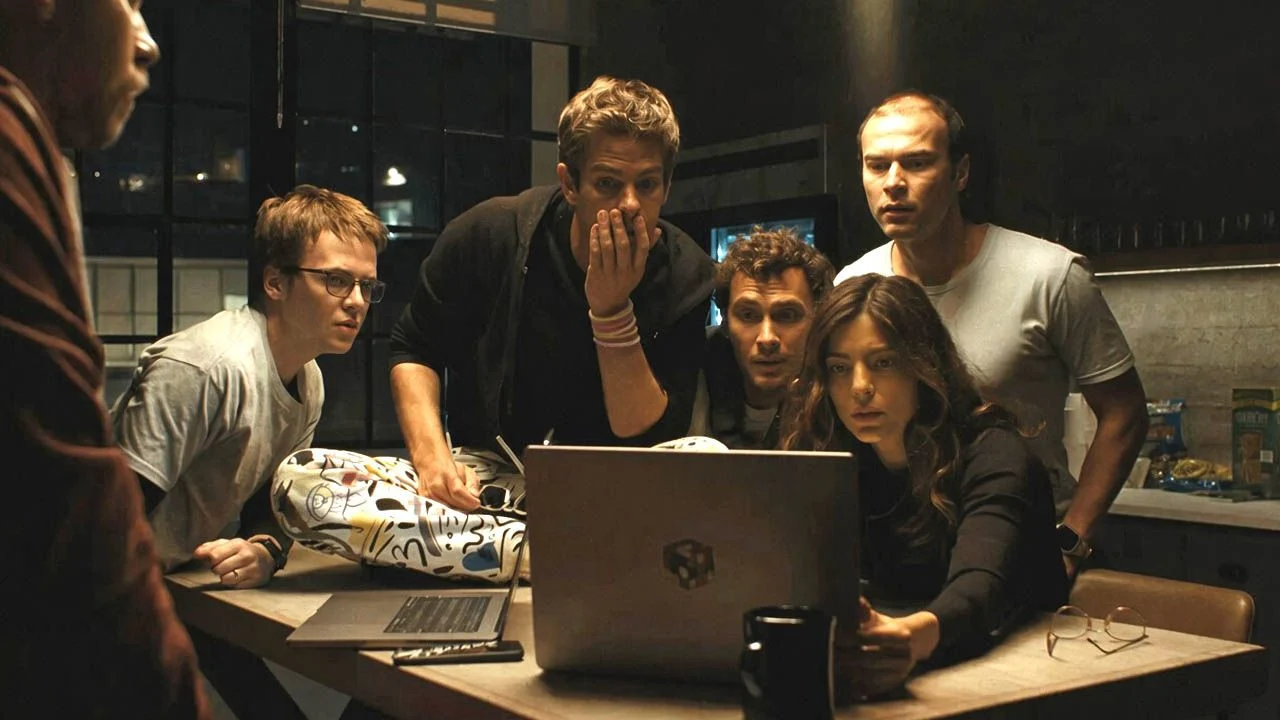
The future of artificial intelligence lies in the hands of a small group of tech enthusiasts – with potentially huge consequences for the entire world.
Malik Hassan Sayeed, who was already responsible for the cool, calculated images of “After The Hunt”, is allowed to take over the visual design again in “Artificial”. His style is virtually the exact opposite of the intimate, soulful shots of Guadagnino’s regular cinematographer Sayombhu Mukdeeprom (“Call Me By Your Name”). The relationships between the characters and the places and spaces they occupy seem to have been calculated with almost mathematical precision. Everything seems extremely precise, but also consistently distant and aloof.
However, individual images are burned in – for example when an algorithm is written directly onto the camera lens. Or when, in slow motion, a success is celebrated in the office, while Sutskever and Altman in the foreground move at a different pace. Although the question arises as to whether it is really necessary from a dramaturgical perspective to trace Sutskever’s career between 2003 and 2023 so meticulously: the multitude of sophisticated sets and locations for every scene, no matter how small, is impressive. Precisely because many modern productions tend to limit themselves to characters and settings that can be counted on one hand, the creative range and dedication to detail in “Artificial” stand out all the more clearly – and show how much more vivid a space shown in deep focus feels with meticulously captured details such as visible food residue, full trash cans and bookshelves. Marco Costa’s editing is also brilliantly timed.
Lots of staff, little depth
The cast list is just as long as the list of filming locations: new appearances by familiar faces follow every minute, so that you are on the verge of losing track. The aforementioned core cast includes “Star Wars” star Billie Lourd, Zosia Mamet (“Girls”) and Cooper Koch (“Monsters: The Lyle and Erik Menendez Story”). Laura Dern (“Blue Velvet”) can also be heard as the voice of an artificial intelligence. The director and his costume designer Jonathan Anderson also make cameo appearances as cameramen accompanying an interview with Altman.
But with all the staff, the psychological, deeper development of the characters falls by the wayside. Guadagnino is known for masterfully visualizing human complexity and emotional worlds. The way he stages desire in all its facets remains unmatched. In “Artificial,” however, his obvious dislike for some of the actors deprives him of his secret weapon: empathy.
Conclusion: “Artificial” impresses primarily with its technical skills such as sophisticated imagery and intoxicating editing. The film hits its shots with full force when it comes to the unpredictable risks of artificial intelligence, but these first have to be worked out over a long period of time. Casual viewers are likely to have already switched off before it even happens.
We saw “Artificial” at the 2026 BFI London Film Festival, where the film had its international premiere.