
Blonde, blue-eyed and dressed in a low-cut denim outfit, Sydney Sweeney poses for US fashion company American Eagle Outfitters. Above her body is emblazoned in large letters: “Sydney Sweeney has great jeans”. On the day it was published on July 23, 2025, the campaign sparked a heated cultural debate because in English “jeans” sounds like “genes” – i.e. “Gene” in German. Critics perceived it as ideological ciphers with eugenic undertones. At the same time, Sweeney was accused of exhibiting her physical charms in a way that reproduced patriarchal perspectives – and thereby set back modern feminism.
Sydney Sweeney addressed the allegations for the first time in a calculated manner just a few days ago – namely during the launch of her new film “The Housemaid”. For months, some voices have even been calling for a boycott of their upcoming projects. However, it remains doubtful whether “Americana”, which was released in US cinemas less than a month after the jeans campaign, actually failed at the box office for this reason – not least because no one really expected it to be a mass hit. Whether Tony Tost's feature film debut deserves to be overlooked from an artistic point of view can be answered quite easily when viewed soberly: you can do it, but you don't have to.
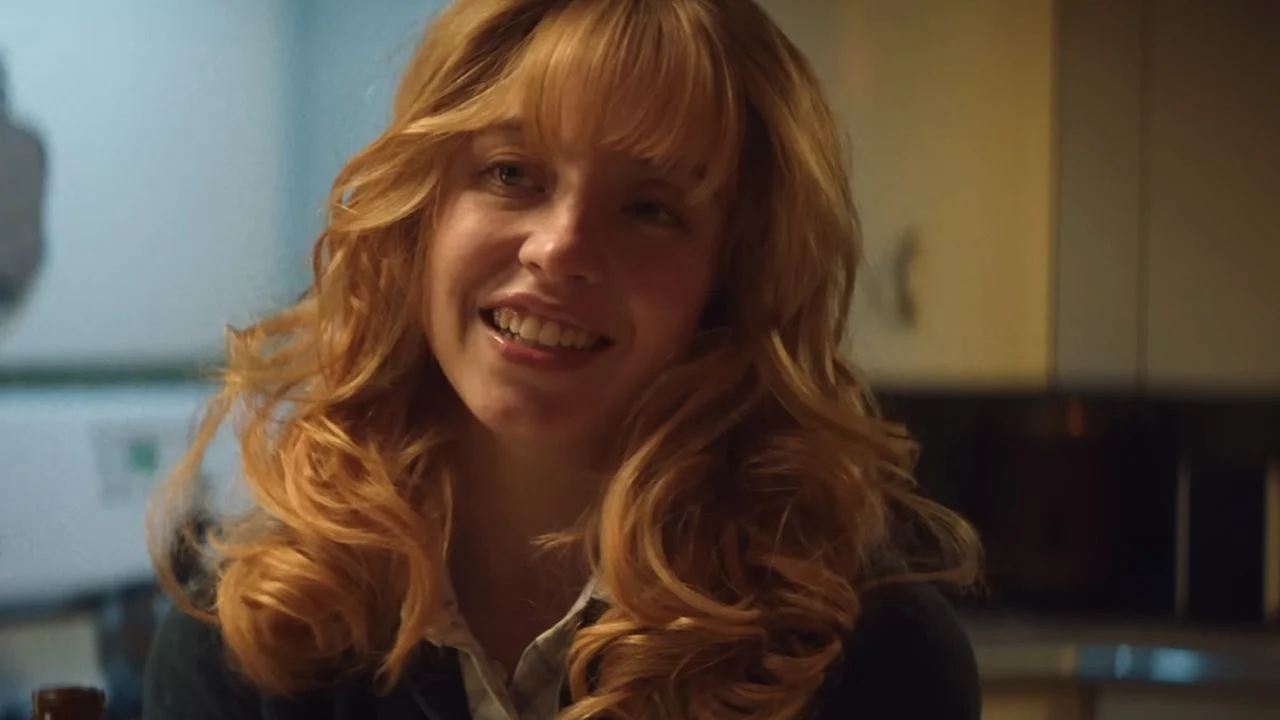
Penny Jo (Sydney Sweeney) wants to follow in Dolly Parton's footsteps and become a country singer.
A so-called ghost shirt was stolen from the indigenous Lakota people – an artifact of symbolic significance that can hardly be overestimated. It ends up on the black market via a winding path, where it arouses the interest of antique dealer Roy Lee Dean (Simon Rex), who hopes to make a small fortune with the sacred garment. In order to get possession of the Ghost Shirt, he would have to eliminate the wealthy industrialist Pendleton Duvall (Toby Huss), in whose hands the artifact is currently located.
But Roy and Ghost Eye (Zahn McClarnon), leaders of a local indigenous resistance movement, don't remain the only ones after the Ghost Shirt for long. An unfortunate chain of coincidences means that several people are suddenly hunting the same treasure. Mandy (Halsey) sees the artifact as her chance to make a radical new start. Penny Jo (Sydney Sweeney), on the other hand, works as a waitress in a small diner, but dreams of finally finding her way to Nashville and launching her career as a country singer. It's only fitting that the kind-hearted, simple Lefty (Paul Walter Hauser) has heard of the very object that could quickly enable her to make this leap…
In the footsteps of Quentin Tarantino from the Coen brothers
The fact that Tony Tost's feature film debut is clearly based on the cinema of Quentin Tarantino (“Pulp Fiction”) and the brothers Joel and Ethan Coen (“No Country For Old Men”) may be anything but original, but it is still understandable. The genre mix of neo-western, crime thriller and black comedy, taken from the models, ultimately offers plenty of scope to pay homage to one's own cinematic preferences. What Tost does with noticeable pleasure, especially in the first half, for example when he clearly seeks contact with John Ford's outstanding masterpiece “The Black Falcon” in long shots of the barren expanses of North Dakota.
The deliberately quirky characters, the verbal exchanges and the non-linear narrative structure divided into chapters can also serve as a training ground for central filmmaking processes: for the artfully interlinked mechanisms of sophisticated storytelling as well as for the importance of precisely thought-out acting. Especially when – as in the case of “Americana” – it is an ensemble work with well-known names.
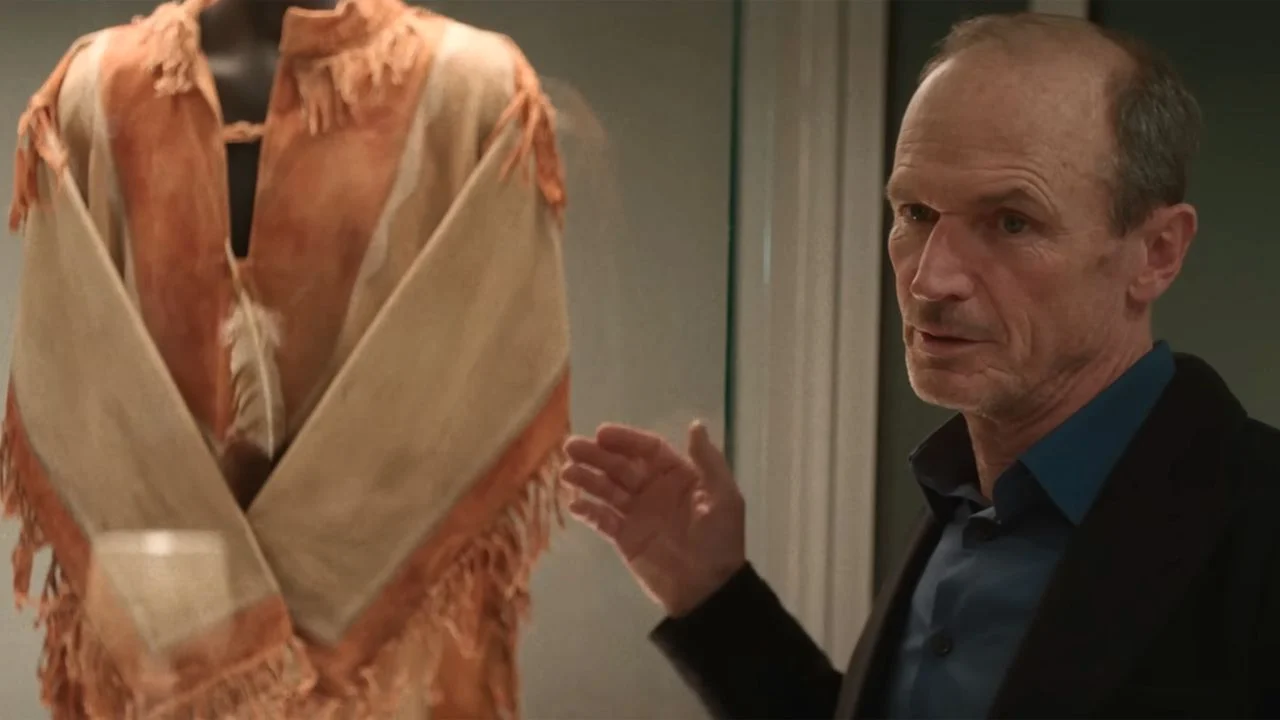
The object of desire in “Americana”: the ghost shirt
The real strength of the film lies in the cast, also because Tost initially demonstrates a pleasant gentleness and sensitivity in dealing with his protagonists. Apart from the fact that Sydney Sweeney's Penny Jo almost embodies the epitome of a worn-out male fantasy as a stuttering naive girl with a red hairband who has to be rescued from her small town, the interaction of the “Euphoria” star with Paul Walter Hauser develops an almost engaging naturalness. The gentle approaches of two people who actually have no perspective make the quiet moments of affection and intimacy seem sincere.
The same applies to pop singer Halsey, who recently proved to be a scene stealer in “MaXXXine”. Here she can now develop her charisma and intensity even more in a significantly larger role, while the hunt for the ghost shirt also becomes a confrontation with her own dark past. In contrast, the rest of the cast can hardly set any accents or create memorable moments. Child actor Gavin Maddox Bergman, whose Cal sees himself as the white reincarnation of the hero Sitting Bull, even directly bears the growing problem of the film.
Listen to your heart a little more!
Although it is undeniable that Sydney Sweeney, Halsey and Paul Walter Hauser form the emotional heart of “Americana”, Tony Tost is increasingly putting his elements, which are apparently trimmed to cult weirdness, into the foreground. This not only sounds like calculated script chatter, but also undermines the authenticity. Nowadays, no one really wants to see a killer complaining about blood spattering on his jacket after a murder.
The transparent surprise dramaturgy and a far too long siege finale with a bloody shootout further contribute to the fact that “Americana” noticeably loses pace, breath and appeal in the second half. The copied filmic set pieces consequently become much clearer and seem increasingly laborious – which is a shame, because there would actually be material for a multi-faceted discourse here.
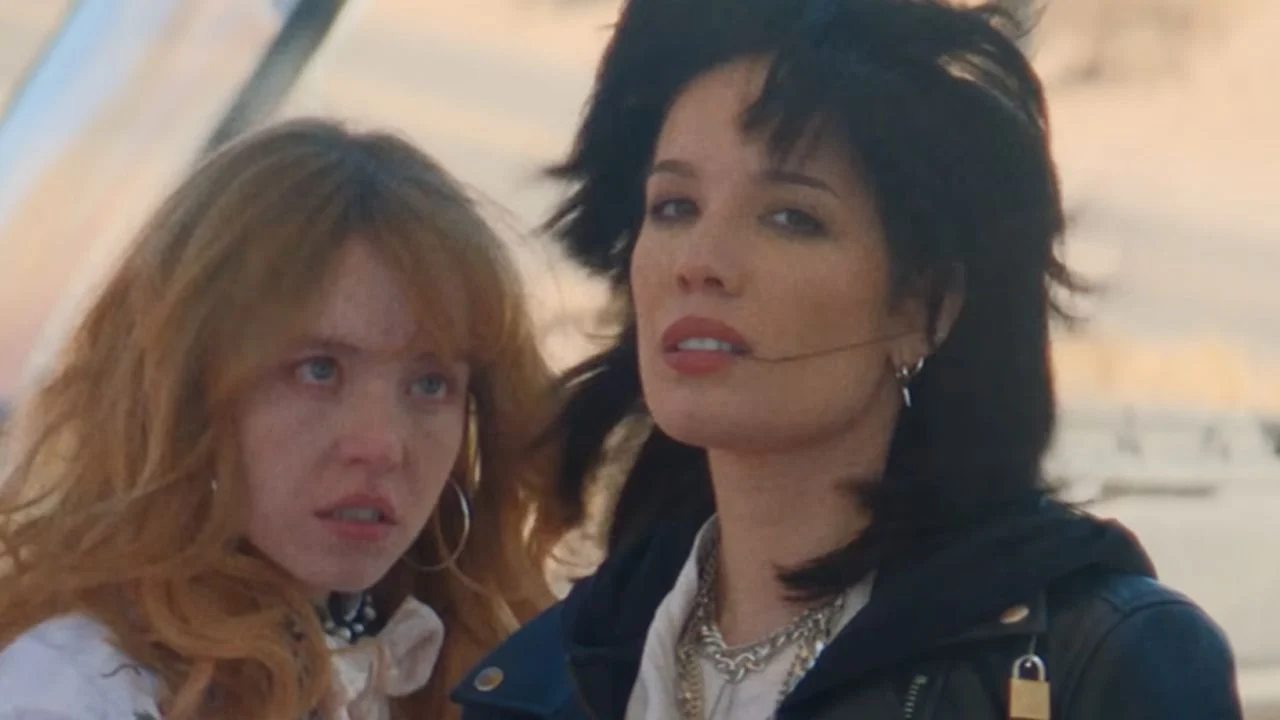
Mandy (Halsey) and Penny Jo (Sydney Sweeney) want to escape – even if that doesn't happen without violence.
The Ghost Shirt actually functions as a classic MacGuffin and is primarily used to initiate an extensive chase. At the same time, it provides impulses to at least begin to scratch at an actually complex storyline surrounding cultural appropriation practices, questions of identity and the shadow that lies over the legacy of the Wild West. Unfortunately, these very relevant topics are buried under the generalities typical of the genre. That's not really annoying, but it does take away from the sense of urgency.
Conclusion: “Americana” scores in the first half with atmospheric Wild West images, a strong ensemble and believable character relationships. However, the borrowings from Quentin Tarantino and the Coen brothers seem increasingly calculated and transparent. Despite good approaches, Tony Tost's feature film debut is ultimately generic.