
It's a bit embarrassing, but we're playing with open cards. In any case, my spontaneous reaction after “Allegro Pastel” was: “A noticeably super-precise insight into the worldview of a generation that still remains strangely alien to me.” However, when I did the math again, I was shocked to realize: “Wait a minute, the protagonists are exactly the same age as me, and we are only separated by a few hundred meters as the crow flies.” It's no wonder that the novel* by Leif Randt, who also wrote the screenplay, was published in 2020 and immediately became an absolute cult hit. Finally someone has taken a serious but unvarnished look at this hyper-reflective milieu, which in literature and cinema is usually simply dismissed as a hedonistic-mindful (Berlin) bubble.
Nevertheless, when it comes to the central love story – even if you approach the matter with the greatest possible openness – you can hardly avoid the question at first: What the hell kind of problem do they actually have? Until now, romances in the artistic world have generally been a simple affair: a searing love – and the existential question of where to get the next piece of bread. In “Allegro Pastel”, on the other hand, financial worries no longer seem to play a role for the creatives – and love is already called into question by a website that is designed a little too tidily. You have to take a closer look to get past the MDMA clichés and get to the core – and luckily Leif Randt and “Dead Girls Dancing” director Anna Roller are doing exactly that.
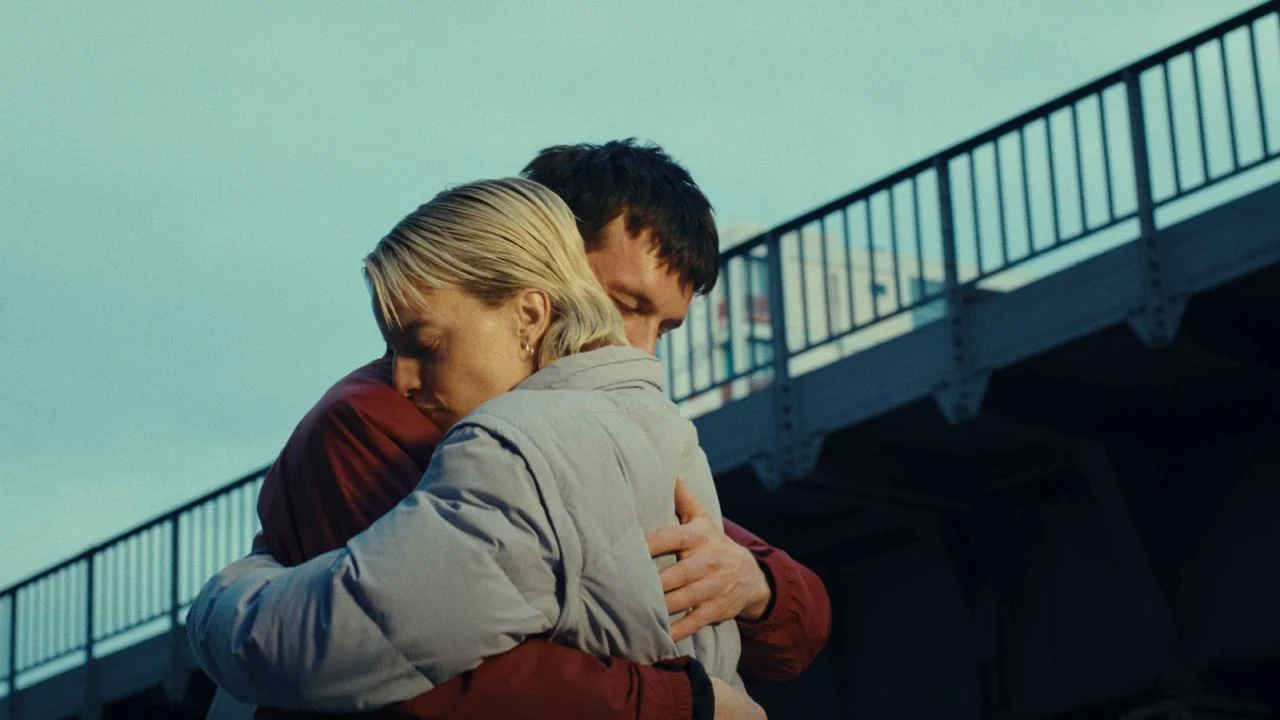
You keep your fingers crossed for Jerome (Jannis Niewöhner) and Tanja Arnheim (Sylvaine Faligant), but you also wonder what their problem actually is.
Spring 2018: The web designer Jerome Daimler (Jannis Niewöhner) hasn't read your book yet, but is still immediately fascinated. So he has it signed at a reading by the author Tanja Arnheim (Sylvaine Faligan), who grew up in Bremen but now lives in Neukölln. This is followed first by a one-night stand (“The sex (…) wasn't particularly good, but it was noticeable that it could be good one day, (…) so in the end it was good sex.”) and then a long-distance relationship between Berlin and the Main Valley, where Jerome still lives in the stuffy house of his parents, who have moved abroad.
However, no one really wants to commit – and then comes Tanja's 30th birthday, for which Jerome gives her a website that he designed: On it, her life is neatly divided into tiles, which is perhaps a nice gesture, but the recipient's tidiness scares the recipient so much that she pushes her boyfriend away…
A paradoxical generation
Tanja grew up in tranquil Bremen in the affluent household of a psychologist mother (played by Martina Gedeck), but in the film adaptation she is portrayed by the German-French actress Sylvaine Faligant (absolutely terrific in her first film role!). However, her barely hidden accent, which sounds completely different than that of her sister played by Luna Wedler (“Silent Friend”), is just another unresolved contradiction inherent in these difficult to pin down characters.
The central paradox of this new social milieu is: “Pleasure becomes work and work becomes enjoyment” when not only every job, but also every drug use and every sex is first thoroughly assessed for its potential for personal development. It's all too easy to dismiss it with a reference to self-centeredness and unworldliness. But like so many contradictions, these also prove to be extremely fruitful if you just get involved with them. A “typical” Millennial analysis based on time commitment and personal growth opportunities would come out: “Go to the cinema!”
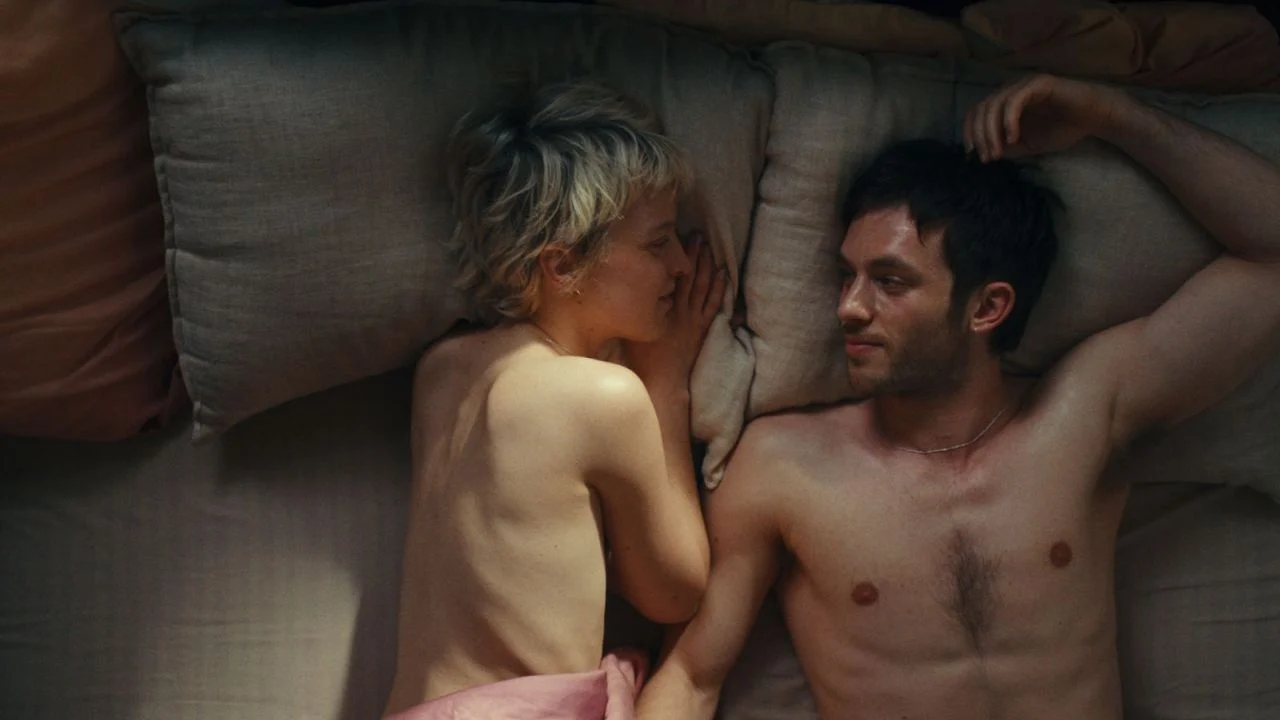
Self-optimization right into the bedroom: Even during sex, people always immediately analyze whether it was worth it.
At least in the first half, all of this is dealt with primarily in self-analytical comments that were taken almost verbatim from the novel, while the plot and images remain decidedly fragmentary for a long time. A beautifully designed, rough-cool superficiality that always repulses the audience to some extent, just as the romantic (?!) protagonists keep themselves at a distance – not just spatially. Anna Roller implements the specific feeling of the original in a visually congenial manner, which in no way removes the (entry) hurdles of the often almost clinically observational novel, even in the cinema.
Because you definitely have to leave that behind “Allegro Pastel”: Although the sales figures of the original suggest the idea of opening up more towards the mainstream in the film adaptation, there are no lazy compromises!
Conclusion: “Allegro Pastel” – the novel as well as the film adaptation – captures a very specific Millennial milieu between self-realization and non-commitment, which is otherwise often made fun of without understanding it (or in the vast majority of cases even wanting to understand it). Sylvaine Faligant is a revelation in the lead role, but for the uninitiated, the (supposed) lack of conflict in the love story (which only exists at second or even third glance) still has a not insignificant potential for frustration.
We saw “Allegro Pastel” at the Berlinale 2026, where the film celebrated its world premiere in the Berlinale Special section.