
When it comes to the Second World War and its direct effects on Germany, many people probably first think of Nazi terror, the persecution of Jews, nights of bombing, the long refugee treks from the eastern regions and the subsequent occupation by the Allies. What is less in the public eye, however, is that there was a veritable wave of suicides in the last days of the Third Reich. According to estimates, around 30,000 to 50,000 people committed suicide shortly before the end of the war. Filmmaker Tony Vahl now takes up this dark topic, which has little media presence, in her cinematic debut.
Its stylistic rigor is reminiscent of the black-and-white drama “The White Ribbon” (2009) by Michael Haneke, which is set on the eve of the First World War and, not least, asks about the roots of the National Socialism that emerged after the war. In “Krux,” however, this ideology – at least in its practiced form – is on the verge of extinction. Like Haneke’s masterpiece, Vahl’s film is set in a village in northeastern (modern-day) Germany. In terms of quality, “Krux,” which is told almost like a horror novel, can compete with “The White Ribbon.”
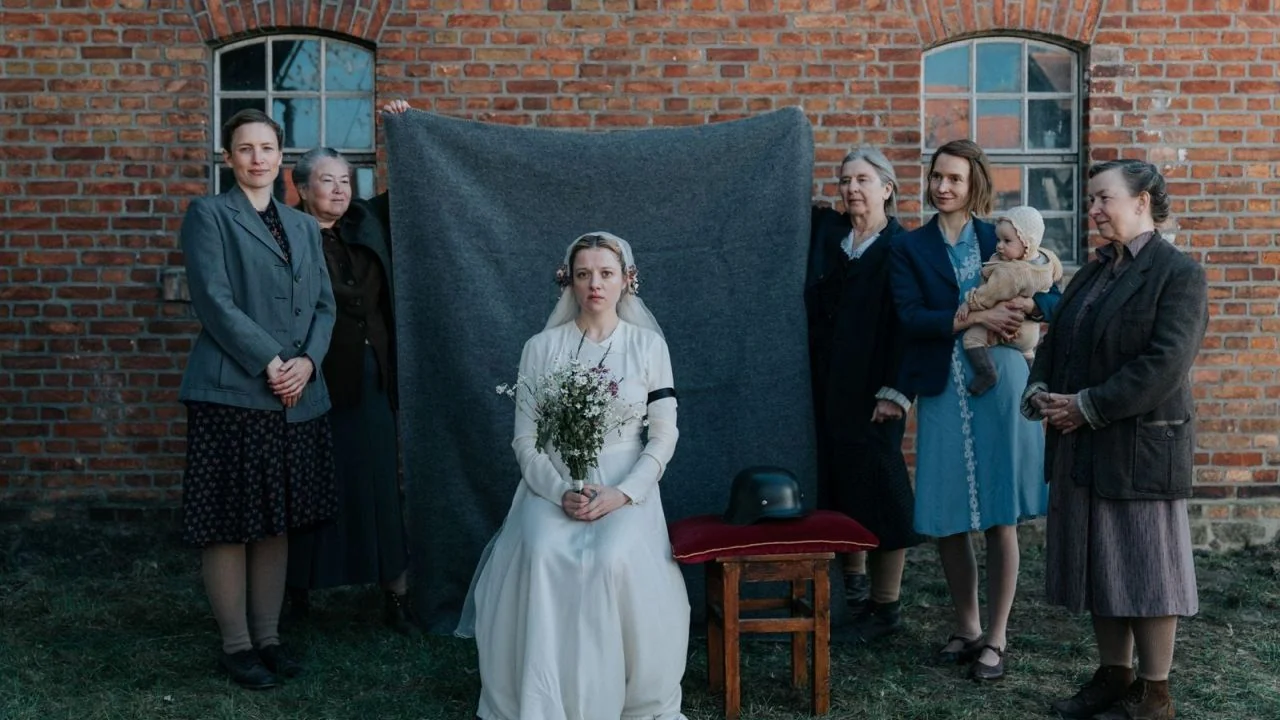
Greta Martens (Jella Haase) doesn’t marry a man, but a helmet.
The beginning is already scary: in the middle of the night, a man knocks on the door of Greta Martens (Jella Haase) and hands her a bundle with the words “I promised him.” As it turns out, it contains her fiancé’s heart. Shortly afterwards, she is married in church in a bizarre-looking ceremony with the dead soldier’s steel helmet at her side. From now on, Greta’s last name is Feldmann and is officially a war widow. Otherwise, everything in the village continues as usual for the time being. But soon there are increasing signs that war is getting closer.
First, more and more bloody sheets appear in the laundry where Greta and her colleague Anni (Frida-Lovisa Hamann) work. Then a fatally injured young soldier gets lost in the village, whose body is disposed of in the river out of fear of trouble. As more unknown bodies wash up, the mood of doom intensifies. Mayor Walter Grünberg (Lukas Miko) passes on the order from above that neither farm animals nor living Germans are allowed to fall into the enemy’s hands. Because the way to the west is already blocked, this is tantamount to an invitation to collective suicide…
From hero cult to victim myth
Even though numerous Nazi greats – above all Hitler, Goebbels, Himmler and Göring – committed suicide, there was no direct order to commit suicide in view of the impending defeat in the war. But the “Nero Order”, according to which everything useful that could fall into the enemy’s hands should be destroyed. They consciously accepted that this would also destroy the livelihoods of their own population. In addition, hero cult and the myth of sacrifice were particularly important in Nazi propaganda. This also had an impact on the civilian population.
Tony Vahl is primarily concerned with the mood that sets in when it becomes clear that all certainties will collapse. Many people were confronted with this at the end of National Socialism – especially those who, out of conviction or after years of indoctrination, actually believed in the Nazi ideology and in the promise of final victory. But also to the atrocity propaganda, which particularly warned of the vengeful, barbaric enemy from the East. How does everyone deal with the fear of uncertainty?
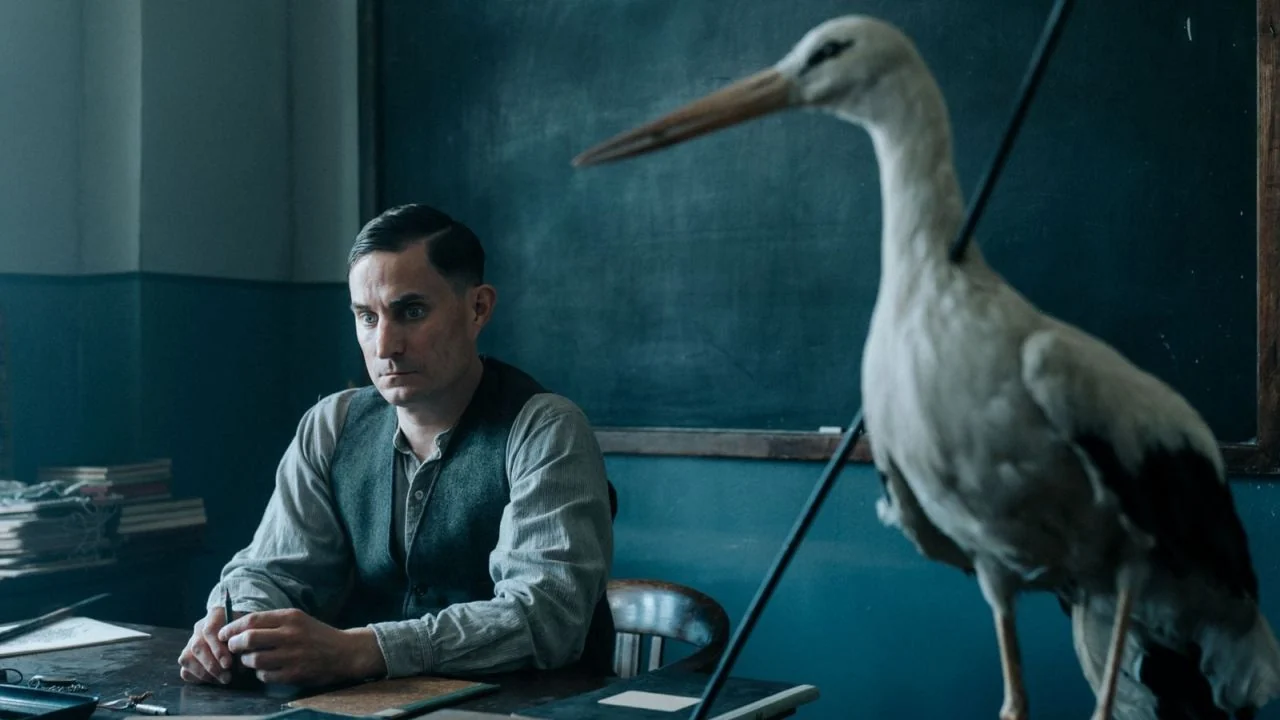
A pierced stork serves in school lessons as a symbol of the perseverance of the German people.
The director creates the appropriate mood picture with incredibly atmospheric images (camera: Piotr Sobociński, Jr.), while the events unfold almost like a chamber play and with a lot of symbolism. The characters themselves provide little information about what moves them. What makes them tick is revealed primarily by their actions or inactions – and last but not least by the precise playing of the ensemble (including the children), which embodies a wide variety of types.
As the highest-ranking representative of state power, the mayor tries to enforce the perfidious order and make the cyanide capsules palatable to his people. The internally torn teacher Fritz Berg, played by Clemens Schick (“The Investigation”), continues his ideologically influenced lessons, but secretly listens to a speech by Thomas Mann to the German people via an “enemy radio station”. Pastor Albert Loose (Martin Wuttke), who is morally strengthened in his faith, openly resists the call to suicide. After all, that is a sin.
Jella Haase is completely different – and really great
In addition to these three male village authorities, two female members of the local community are highlighted. Because most of the men in the village are still at war, already in captivity or already dead, in the end everything depends on the women anyway. In a role that could hardly be further removed from her Chantal from the “Fack ju Göhte” trilogy, Jella Haase gives her character Greta weight. The washerwoman doesn’t just want to submit and confronts the teacher, who has been practicing tying gallows ropes at school. “Maybe life goes on after all,” she says to her colleague.
Anni, on the other hand, is concerned with the bigger picture, entirely in the spirit of Nazi ideology. For better or for worse, she still has to say goodbye to her conviction that “the war is only over when we have won it”. The film is loaded with a lot of symbolism: the most obvious is a snake that snakes ominously through a model of the village. School lessons are also not without their problems. In front of an apiary, the teacher emphasizes that with these insects the individual animal is worth nothing, only the colony counts. Using a stuffed stork that just kept flying despite an arrow in its chest, he tells us about perseverance.
Obedience until (free) death
In this way, the audience can make their own connection to the heresies of National Socialism. In general, the principle of the film is to ask questions rather than spell everything out. Although it takes place at the end of Nazi rule, it can also be seen as an allegory for any kind of autocracy. He shows how simple slogans can become misleading if they are repeated often enough, and how tempting it can be to believe simple answers to complex problems, even if the trust gained is abused for manipulation purposes. For quite a few, this leads to cadaver obedience. Literally.
Conclusion: A remarkably well-thought-out debut work that effectively conjures up a ghostly apocalyptic atmosphere and invites you to think more than to sympathize.