
For everyone whose everyday life consists of hectic, hustle and bustle and walking through crowds of people, a remote, barely inhabited island off the Scottish coast probably seems like a place of longing that promises a time out: you can finally breathe deeply, feel the vastness and stare into a rough landscape. Scottish screenwriter and director Louis Paxton knows this kind of isolated environment very well: his maternal family comes from the Orkney Islands, where Paxton has also spent time since childhood.
In film terms, this wind-blown archipelago with its breathtaking cliffs, rocky beaches and green spaces was most recently used in Nora Fingscheidt’s drama “The Outrun” as a metaphor for the troubled mental landscape of the alcoholic protagonist. And in Werner Herzog’s “Bucking Fastard” the two twin protagonists even want to dig their way from the mainland to the Orkney Islands. Paxton has now chosen a similar setting for his feature film debut “The Mainlander”. Life on a remote island serves as a tragicomic story that is mostly worth seeing, but it doesn’t always find the desired tone between droll and strange weirdness.
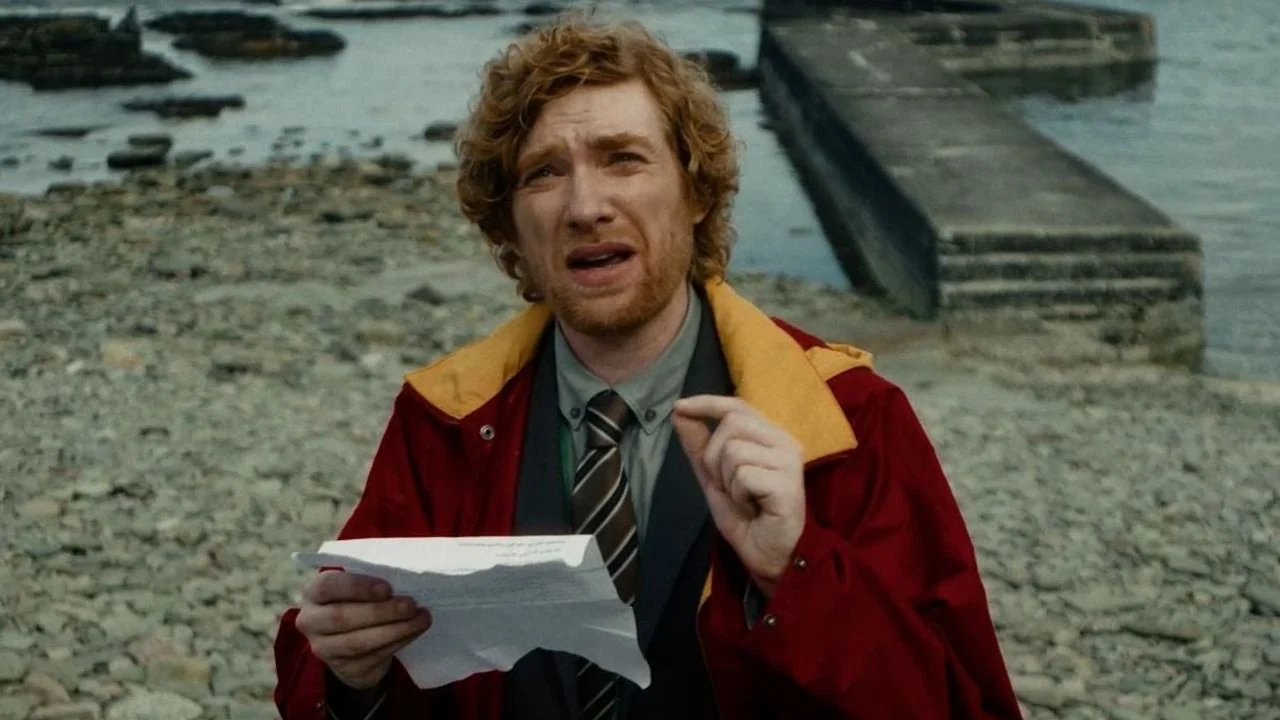
As a greeting, the officer Daniel (Domhnall Gleeson) is kidnapped by the only two island residents.
“The Mainlander” begins with a normal day in the life of Isla (Gayle Rankin) and Sandy (Grant O’Rourke): The adult siblings have been the only residents of a house on the inhospitable (and fictional) Auk Island off the north coast of Scotland for 30 years. While the hard-working Isla ensures their survival here every day, Sandy, with his childish, defiant disposition, is usually not of much help.
The siblings deal with their problems in courageous evening fights, and the day finally ends with a story told by Isla – about the island, its seagulls and the unspeakable mainlanders who want to lure them away from here. Daniel (Domhnall Gleeson), a land reclamation coordinator sent from the mainland, suddenly appears on the beach the next day. “The Mainlander” tells of this encounter and its consequences with a keen sense of the strange…
Outsiders among themselves
The friendly and wonderfully clumsy Daniel, portrayed by Domhnall Gleeson (“Ex Machina”), is threatened and taken hostage by the siblings in their feathered robes intended as battle gear. Louis Paxton’s script then works out very coherently the basis on which Daniel and the siblings gradually become closer: Isla and Sandy reveal themselves to Daniel and us as isolated, otherworldly and threatening.
But the government employee can definitely identify with their outsider status. In pointed flashbacks, “The Mainlander” shows how out of place Daniel seems among the ruthless officials in the land reclamation agency: the shy employee with his precise knowledge of paragraphs and a penchant for magic is already a thorn in the side of his boss Roz (Michelle Gomez). On the other hand, he can impress Sandy and Isla with his little magical tricks.
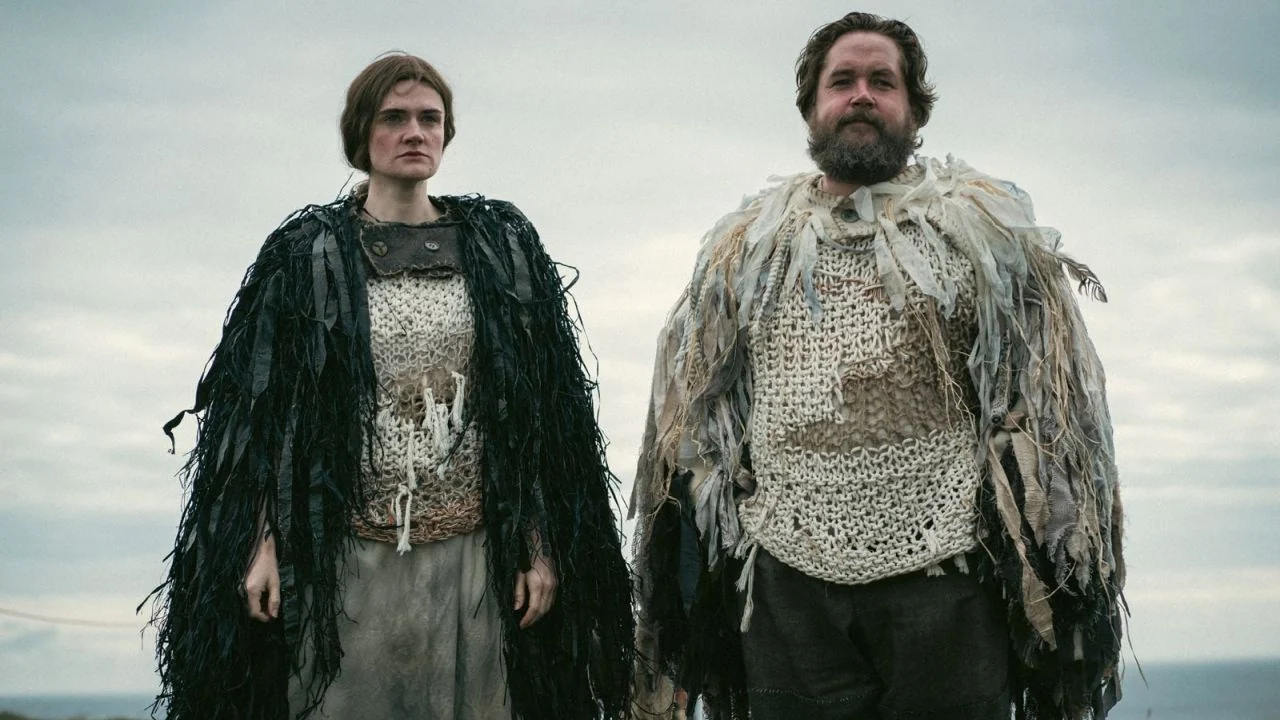
The siblings Isla (Gayle Rankin) and Sandy (Grant O’Rourke) have been on their own on the deserted island for 30 years.
Against the natural backdrop, captured in wonderfully wide shots and bright, warm colors, “The Mainlander” develops into a tragicomedy whose humor draws primarily from the quirkiness of the characters: the siblings, who have been isolated for decades with their stubborn customs and rituals, are supposed to seem strange, but also always delightful. But especially in the case of the simpleton Sandy, whose fascination with a dildo that has washed ashore is repeatedly used for laughs, the joke often falls flat and instead leaves me wondering about the devastating psychological consequences of isolation. Their tragedy is illuminated in “The Mainlander” especially with regard to Isla: her stories, which were thought up with a lot of imagination, are illustrated several times in delicate, graceful animations that express loneliness and loss.
Likewise, her encounters with the hallucinated seal-like creature “Finman” (John Hannah) serve to further explore the deep despair about her situation. The dark and tragic elements of this film show so much ingenuity that it is sometimes difficult to combine them with the somewhat clumsy funny moments. Accordingly, “The Mainlander” feels a bit unbalanced in its tone. But with a finale that is both credible and touching, the tragicomedy finally turns the corner so elegantly that one can only look forward to Louis Paxton’s further films.
Conclusion: Against an impressively filmed natural backdrop, “The Mainlander” tells of isolation, loneliness and the compulsion to leave. While the humor aimed at the characters’ quirkiness doesn’t always hit the mark, screenwriter and director Louis Paxton tackles the tragic elements with a lot of grace and empathy. A not always balanced, but still worth seeing tragicomedy.