
There are probably a lot of people who have never asked themselves what people used to string tennis rackets with – and what else could be used for it besides plastic. “The Bunker” director Nikias Chryssos, on the other hand, noticeably enjoys addressing this very question, among other things, in his horror film “Bloody Tennis”. And sometimes you wish you could erase some of the resulting images from your memory. Chryssos digs deep into the treasure trove of obscure legends and clichés and delivers a coming-of-age shocker at a tennis boarding school that demands a lot from the audience.
“Bloody Tennis” tells a story about radical ambition. There is a young woman named Sophie (Sandra Guldberg Kampp) who becomes part of the elite “Mary Tyrone Tennis Academy” somewhere in the middle of a dry wasteland in southern Europe. In the former monastery, Sophie meets several other young women who soon become her bitter competitors. Anyone who survives the drill and competition at the academy should receive a wild card for the Wimbledon tournament. Soon the situation on the secluded property escalates completely…
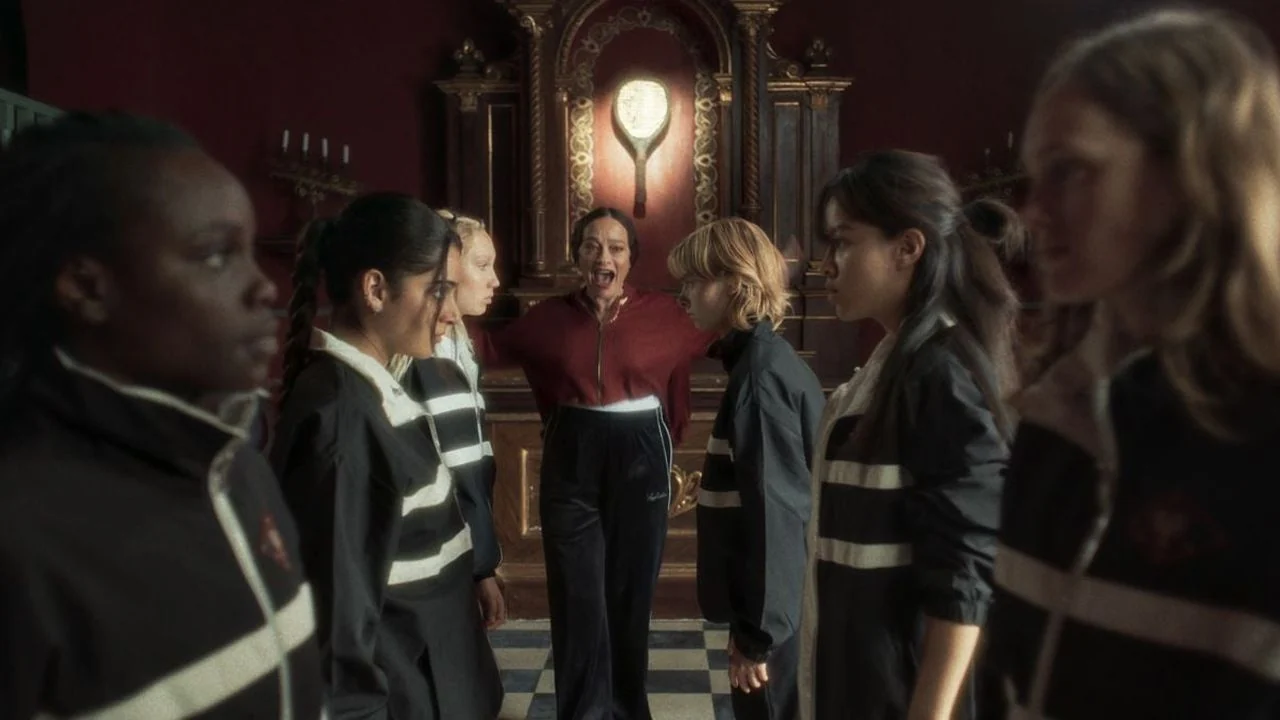
At first, the joy of being accepted into the venerable academy still prevails.
Nikias Chryssos doesn’t hesitate with the threat. It starts with the eerie opening sequence, which seems like a grotesque variation of a slasher and turns a ball cannon on the tennis court into a murder device. Even after that, the bad omens keep piling up: strange spots on the skin, leeches in the glass and a thumbtack in the shoe. Finally we get back to the production of the tennis rackets, which takes place here hidden as if in a dark ritual. Chryssos takes the term “catgut” literally. Certainly to the chagrin of many cat fans.
“Bloody Tennis” also plays with the iconography of occult horror cinema. The fact that the film is compared to Dario Argento’s classic “Suspiria” is obvious from a structural and motivic point of view. Right at the beginning, when the protagonist is greeted by the witchy, strict leader and you explore the locations with their blood-red walls. The tennis court is also surrounded by them like a fortress. The camera repeatedly chooses clever, claustrophobic shots that rob the images of their liberating horizon and sky. All you can see far and wide are those threatening walls and the stands, which are also painted red.
Nikias Chryssos remains true to himself
The color red in general! It runs through the film, in which the human (and animal) lifeblood flows in a drastic way. “System Sprenger” star Helena Zengel is also there in a supporting role. Zengel has long since outgrown the image of a child actress. Now she plunges fearlessly into the extreme scenario, which Nikias Chryssos also fuels with appropriate show values. However, it is not just fear and terror that rule. The director also impresses with his nasty humor and the weirdness that characterized “The Bunker” and “A Pure Place”. For example, when a telephone is suddenly brought onto the field during training to make a call on a seemingly endless line.
The German-Greek filmmaker has also remained true to himself in terms of material. Here Chryssos creates another experimental setup and a microcosm in which fatal ideological structures of the present are reflected. He explores both the utopias and the horror of closed communities and systems of order, somewhere between the longing for the collective, the cruelty of the individual and the question of when human interaction can become liberating or oppressive, cult-like, destructive.

A black eye is the least of the troubles that the students have to endure!
The filmmaker’s scenarios are always characterized by class struggles and hierarchies. It’s about the disciplining of people in capitalism and the problem of what scope you actually have to rebel against a power and structure. What price are you willing to pay to overcome it? In his previous work, “Rave On,” escapism from a rave party turned into a suffering and drug trip. A Berlin nightclub has become a hellish labyrinth in which someone strives for recognition and profit.
The fact that Chryssos is now drawn to the tennis court and into the grim world of professional sports is as unoriginal as it is consistent. A lot of things in “Bloody Tennis” have been seen many times before. In this respect, the film seems somewhat predictably constructed, even in its escalation spiral. Experienced horror fans will definitely recognize many of the borrowings and set pieces. As an examination of the dark side of constant drilling, training and self-conquest, the film also hardly contains any new impressions or insights. Nevertheless, it seems like the logical continuity and continuation of the director’s work to now also view sport as a mirror of social coldness and a permanent, systemically anchored competition between people.
One of the most spectacular screen kills of the year
It’s easy to get carried away by this horror trip simply because Chryssos has formally sharpened his genre cinema even further. “Rave On” was already aimed at sensual overwhelm and “Bloody Tennis” goes one step further. Deep sounds boom like machines. Life at the academy is like a noisy power plant. The film constantly wants to provoke a physical reaction from its audience and bodies are constantly being mistreated on the screen. They are kneaded, injured, opened. They drink the same old, flaky, red smoothies, the consistency and contents of which become suspicious once they’ve vomited them up.
“Bloody Tennis” shows little mercy in its body horror and at some point it takes on almost apocalyptic characteristics. As if this cynical world were inevitably heading towards its downfall when the success of individuals apparently depends on the degradation, destruction and incorporation of others. Romantic and erotic approaches are also consumed by this dynamic. Nikias Chryssos translates this criticism into some very effective horror scenes that don’t just test the limits of disgust. They also boast one of the most spectacular on-screen kills of the year in a match.
Conclusion: “Bloody Tennis” is unlikely to win an originality award. On the other hand, the social criticism and horror motifs of this sporting shocker remain somewhat predictable. Nevertheless, Nikias Chryssos manages to create a genre film that is as clever as it is wonderfully nasty and disgusting about what it means to grow up in a constant state of competition with others.