
When producing “The Canoe of Manitu,” Michael “Bully” Herbig invested a lot of budget not only in shooting the final scenes in the southwest of the USA, but also in hiring indigenous actors. Critics promptly saw this as a costly attempt to give the fictional character Abahachi – and thus Herbig himself – an absolution from the accusation of cultural appropriation. “Borat” mastermind Sacha Baron Cohen now deals with a comparable topic – depending on your point of view – in a much more confident or ignorant manner: In the Amazon production “Ali G: Who Iz I?” its titular fictional character, a pseudo-Jamaican suburban proletarian, turns to a black expert on cultural appropriation. He wants to clarify with her to what extent he, as a white man, is still allowed to adopt black cultural and language codes. The result: In order to behave correctly, he would have to work harder than ever before in his life – so he doesn’t do it.
Instead, in front of an uninitiated audience of religious representatives, there is a word-for-word repetition of Will Smith’s slapdash apology – complete with a subsequent AI slop video in which Ali G is absolved of all wrongdoing by Nelson Mandela, Tupac and a Black Jesus. But if it’s not about questioning your own role, what relevance does the character still have 22 years after the end of “Da Ali G Show” on HBO and 24 years after the feature film “Ali G In Da House”? The sobering answer after “Ali G: Who Iz I?” is: if there is one at all, then at least not a significant one. The iconic slang may elicit a brief nostalgic giggle from superfans, but beyond that the skull cap-wearing Jamaican wannabe proves to be more of a nuisance in his own film – but that doesn’t mean that Sacha Baron Cohen’s fearless cringe qualities don’t still come through elsewhere.
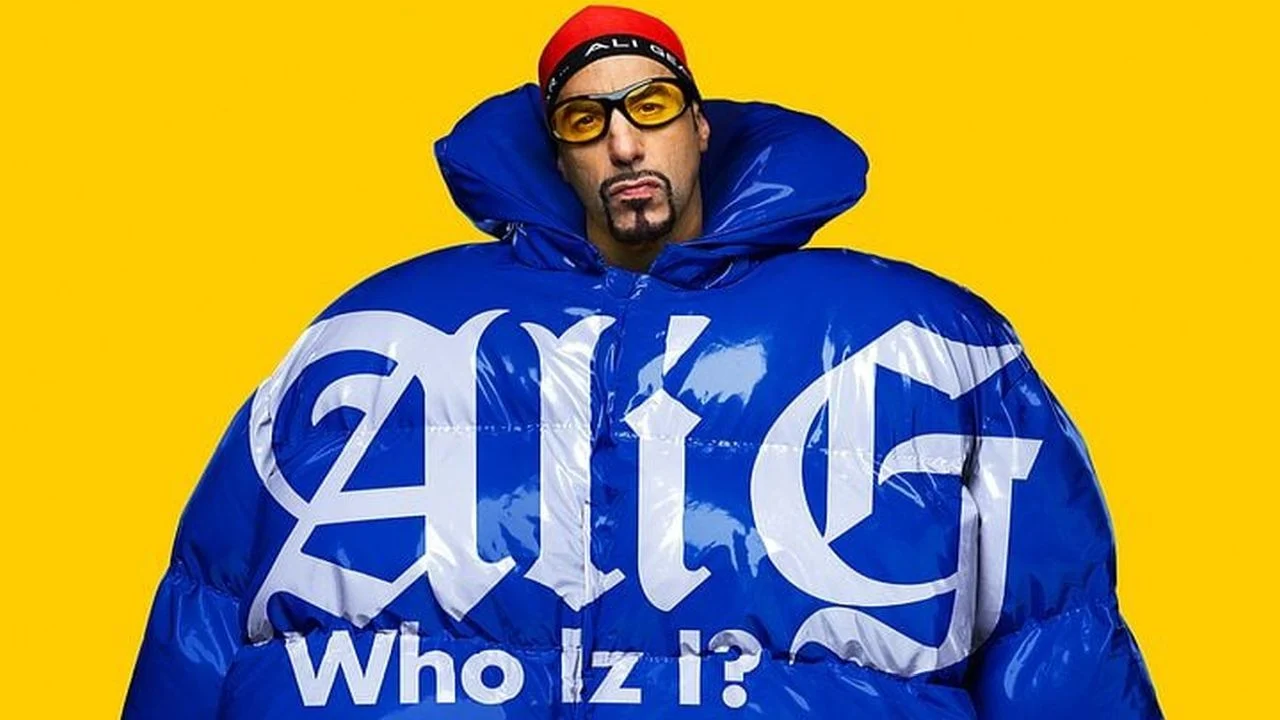
Ali G (Sacha Baron Cohen) returns after more than 20 years! But has the world actually been waiting for this?
In addition to the AI video, at the end of which only a single viewer remained in the hall, there are actually only two scenes in which the character Ali G really shines – once in dealing with a completely overwhelmed million-dollar mansion agent who gets involved in a can-he-get-him-up-or-not silent post game between Ali G and his heavily pregnant girlfriend Julie (Morgana Robinson replaces Kellie Bright), and once in an actually touching one Potency drug fraternization in a liquor store. Otherwise, even many elaborately prepared punchlines run out of steam prematurely: Ali G has already assembled an entire – also unknowing – crew from agents to bodyguards for the production of a third season of “Da Ali G Show”, but he then leaves them sitting in the lobster restaurant with a $12,400 bill when he realizes, to his shock, that the million-dollar offer from HBO received by fax is already 22 years old and therefore no longer valid. That sounds like a spectacular prank, but it fizzles out with almost no effect.
Even his first attempts at standing as a social media star, in which he brings a Nobel Prize winner in astrophysics to a try-on haul, a political expert to a noodle mukbang and an Iran veteran to an ASMR glitter stream, are nowhere near the bite of the celebrity interviews from “Da Ali G Show”, when he made Donald Trump stop after just a minute and questioned the moon traveler Buzz Aldrin about when the first people would walk on the sun. So the first 50 minutes of “Ali G: Who Iz I?” – fans will find enough to still enjoy themselves, and the uninitiated will wonder why there was ever such a hype about the fictional character. But then Sacha Baron Cohen and his team turn it up a notch on the home stretch and celebrate an elaborate hidden camera scenario in which one can no longer help but be amazed by the seemingly limitless and vicious stupidity of those shown.
The moral of the story: It’s best to put the babies first!
It’s not so much about the producer who, after the collapse of his HBO deal, put together an obviously highly racist TV format called “The Free Speech Show” for Ali G – complete with an Elon Musk memorial Hitler salute that was frantically celebrated by the audience: the South African ex-arms dealer is so open about his misanthropic views that there’s nothing left to expose. But when George Santos stacks Mexican immigrants and left-wing activists in a shower in the studio game in order to gasse the dolls with Zyklon B at the push of a button before the time limit expires, you really just scratch your head – especially because the embarrassedly giggling ex-congressman uses his winning tactic of choosing the babies first because then more can fit in, and then also brings the ICE agents along.
But even that is a joke compared to what Sacha Baron Cohen, as a Mossad agent, starts with a group of anti-immigrants during a supposed self-defense course. I don’t want to spoil the madness on top of the madness any more than necessary. But apparently in this bubble it is now the most normal thing in the world that the best way to fight homophobic ISIS terrorists is with a newly developed weapon that involves rubbing a prosthetic penis until you eliminate the opponent with a shot from his asshole. And while George Santos only puts baby dolls into the gas chamber without resistance, these days it seems to be only slightly more difficult to get people to actually kill newborn babies for their MAGA ideology. Suddenly the urge to laugh and the urge to vomit are very close together.
Conclusion: More than 20 years after “Da Ali G Show”, Ali G has obviously had his day as a central figure in pop culture – but when it comes to revealing, satirical hidden camera pranks, Sacha Baron Cohen still takes it further than anyone else. It’s definitely worth taking a look just for what bitterly unbelievable things he delivers in the final third.