
One thing is certain: Although they are allowed to keep their jobs (for now) despite Paramount’s takeover of Warner Bros., DC bosses James Gunn and Peter Safran urgently need a win after the flop of “Supergirl”! The second film in the DC Universe (DCU), which was rebooted with “Superman”, only grossed around $125 million worldwide with a budget of at least $170 million. Not only from the trade press (2.5 stars at FILMSTARTS), but also from the fans there was little more than a shrug of the shoulders. After all, “Lanterns” has recently made a really strong comeback, at least in streaming…
… and the comic franchise is now getting back on track in the cinema, albeit with a particularly unusual representative of the genre: “Clayface” is the best DCU film to date – even though it explores dark, scary areas and can’t even begin to keep up with “Superman” or “Supergirl” in terms of budget. But “Clayface” emphatically shows that a certain economy doesn’t have to be a disadvantage, quite the opposite: based on a draft by horror guru Mike Flanagan (“The Haunting of Hill House”) and a script by Hossein Amini (“Drive”), “Speak No Evil” director James Watkins has created a small but fine and, above all, really nasty body horror trip about the eponymous Batman villain.

The future Clayface Matt Hagen (Tom Rhys Harries) is about to have his big breakthrough as an actor.
The actor Matt Hagen (Tom Rhys Harries), who comes from Gotham City, already thinks he has reached the goal of his dreams: He has just received his first Oscar nomination – and anyway he seems to have a steep career ahead of him in the DC Hollywood equivalent of Coast City. But then, while partying in a nightclub, he gets involved with Mia (Joana Ribeiro), the lover of gang boss Markos Szabo (David Dencik), – and the next morning he gets a rude awakening: Szabo cuts Matt’s face and leaves him disfigured.
Because Szabo also has the media and the justice system in Gotham in his pocket, Matt also loses his reputation and his fortune when he tries to demand justice. But then Matt meets the scientist Dr. Meet Caitlyn Corr (Naomi Ackie), who has developed a revolutionary regenerative healing process. Matt makes himself available as a test subject, but the initially successful treatment soon has unexpected side effects: Matt, who acts increasingly inhumane, can change his appearance and shape as if his body were made of clay – which comes in handy on his quest for revenge…
The best DCU film – and the most brutal!
“Clayface” is the first DCU film to receive an R rating in the USA and thus an adult rating. Director James Watkins makes full use of the freedom that comes with it – so not just comic fans, but especially horror aficionados get their money’s worth here. In “Clayface” there is swearing, there is sex and nudity, but above all Watkins is not the least bit squeamish about the body horror and depiction of violence. Faces and other body parts are cut up in close-up, strips of skin are peeled off and heads are squished. And when Matt cuts open his overgrown eyelids after a transformation, with nail scissors (!) in the airplane toilet (!!) in turbulence (!!!), you can really squirm back and forth in the cinema seat.
While the revenge plot provides such splatter and disgusting scenes with regularity, “Clayface” also doesn’t forget the psychological horror: One of the highlight scenes, perhaps even of the entire 2026 cinema year, is a moment in which Caitlyn watches her patient Matt sleep. Matt half-transforms into Caitlyn, caresses his transformed (i.e. her) face with his arm, and rolls around in bed in a kind of out-two-make-one sex scene. A fascinating and disturbing moment – especially because it is bathed in the pale green light of a night vision camera and is then even rounded off by a final jump scare.
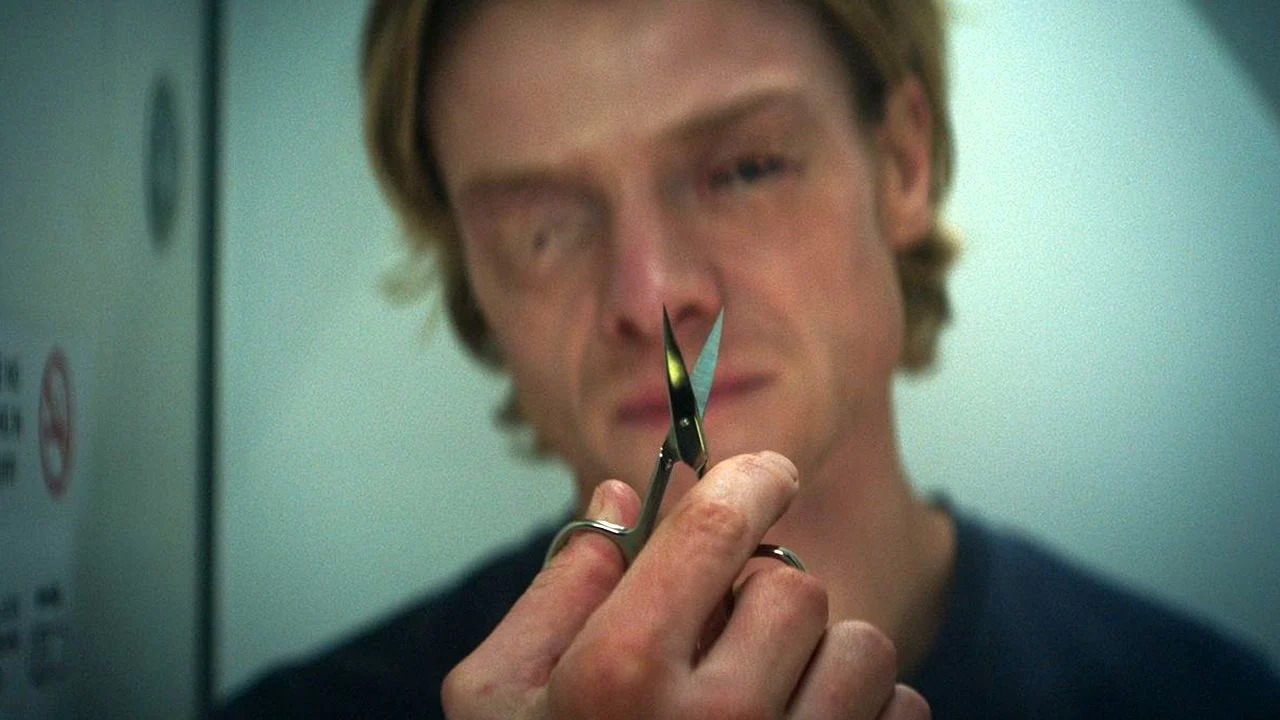
The nail scissors scene is definitely one of the body horror highlights of “Clayface”.
In addition to such dramatic highlights, another aspect of “Clayface” is noticeably noticeable: the film begins with an upbeat opening, in which the DC metropolis Coast City stands in for the dream factory and even has a counterpart to the (former) DC parent company Warner Bros. However, Watkins and Co. have nothing more to say about it other than that in the shark tank of Hollywood, everyone is next to themselves – so far, so known. There have definitely been more biting and sharper accounts in recent years, such as the award-winning Apple TV series “The Studio”.
In contrast to this somewhat tired Hollywood satire, the live-action premiere of the new Gotham City in “Clayface” is completely successful (after there was already a first animated impression of it in the DCU series “Creature Commandos”): James Watkins and his cameraman Rob Hardy (“Ex Machina”) capture Batman’s hometown in dirty and atmospheric, because not (!) dark, color-saturated images – and at the same time stand out clearly from previous Gotham versions.

Garbage everywhere, graffiti and atmospheric lighting: the new Gotham is a real eye-catcher!
In “Clayface,” Gotham is not a comically exaggerated setting like Tim Burton or Joel Schumacher or a glossy metropolis like Christopher Nolan, but a nightmarish image of New York City, in which garbage piles up on the streets and fire-breathing factory chimneys rise up everywhere. The look is most reminiscent of Matt Reeves’ “The Batman” – no wonder, after all, both films were shot in Liverpool. In any case, after “Clayface,” we can’t wait until Batman roams this version of Gotham in the already announced DCU film “The Brave And The Bold.”
Conclusion: “Clayface” is the best DCU film to date because director James Watkins skillfully exploits the possibilities of a supervillain body horror film with scenes that are as brutal as they are disturbing. In addition, the DCU debut of Gotham City is also convincing, while the built-in Hollywood satire comes across as disappointingly tame.