
One of the most famous bridges in Berlin is probably the Weidendammer Bridge in Berlin-Mitte. It leads Friedrichstrasse over the Spree – and in the middle of the bridge railing there are two wrought iron imperial eagles on either side. The poet and songwriter Wolf Biermann had himself photographed in front of one of these eagles around 1973 – in a pose that looks as if the eagle’s wings were growing from his shoulders. After Wolf Biermann’s expatriation, the photo went around the world – and Biermann’s ballad “The Prussian Icarus” became synonymous with the artist. Just in time for the singer and poet’s 90th birthday, a documentary about him is coming to cinemas. This was directed by Jens Meurer, who was recently able to show with “Seaside Special” about the last British end-of-the-pier variety show how well he can shape politics – at the time it was about Brexit – with art, eccentricity and humor into a very entertaining film. These ingredients are now also integral parts of the entertaining, two-hour cinema biography “Biermann”.
The director relies on a classic chronology with many contemporary documents in the form of photos, TV images and film excerpts, which is repeatedly lightened up by current recordings. Preparations are then made for a concert and there are discussions with colleagues like Campino or Wolfgang Niedecken. In addition to Wolf Biermann, many contemporary witnesses, friends and companions have their say, including the acting icon Armin Müller-Stahl, the writer Barbara Honigmann and the former Federal President Joachim Gauck. One of the best things – and at the same time the greatest challenge – about “Biermann” is that Wolf leads Biermann himself through his life.
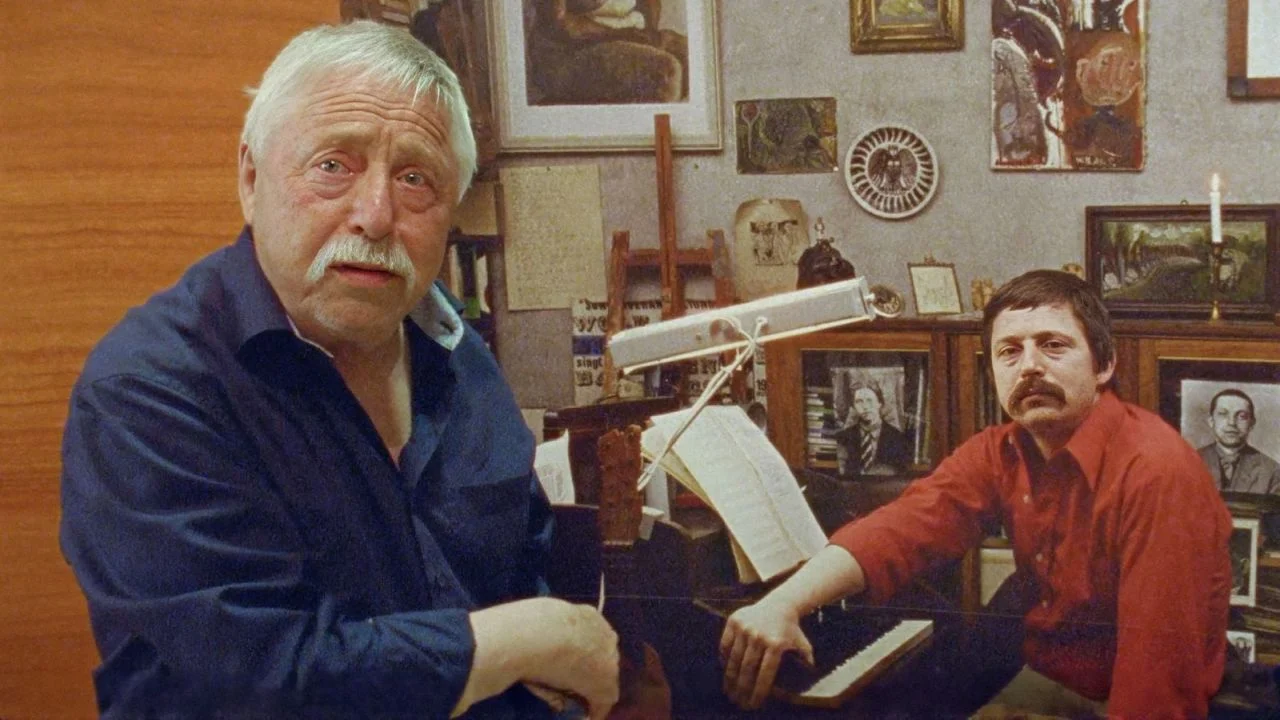
Wolf Biermann – almost 90, but certainly not the least bit quiet!
Nobody would imagine that this agile old gentleman, who at the beginning is walking barefoot across the lawn of his garden in Hamburg-Ottensen in a bright red bathrobe, could be almost 90 years old. As soon as he is in the picture, he immediately becomes subtle. His wife Pamela says how beautiful it is here and how easy it is to relax here away from all the people – and Biermann replies quickly: “I prefer to relax from this idyll with all the people here.” In doing so, he positions himself as what he is: a stage animal, i.e. a stage pig in the best and most positive sense. The relaxed beginning says it all, and there are even more kaleidoscopic images including cool sayings.
And while Wolf Biermann reviews his entire life in words, images and song, something very beautiful, very rare emerges: you not only get to know this person who has experienced so much, but also understand him – a leftist, a communist, practically from birth or, as he himself says, even before that, in the womb of his mother Emma. Together they survived the terrible bombing raids in Hamburg, when their father, a Jewish communist and rebel against the Nazi regime, had just been murdered in Auschwitz. Wolf Biermann was a child who saw far too much in his burning hometown, and he became “a burned child who curiously looks for the fire,” as he says today.
A brilliant coddler’s snout
At the age of 16 he went alone from Hamburg to the GDR. He graduated from high school, studied a little and became an assistant director at the Berliner Ensemble. Biermann’s typical language comes from this time, which was able to expose and question political conditions with surgical precision, blunt provocation and sharp-tongued wit. That was not welcome in the GDR. Biermann was banned from performing, finally in 1965. The powerful feared him because of his attacks on their authority, and perhaps also because of the quality of his texts, which secretly became public property. In 1976, his GDR citizenship was revoked on the occasion of a long-planned concert in Cologne. There was no return for him to the country that he wanted to help build and make a better Germany. A catastrophe for him – had the Prussian Icarus ventured too far up? Wolf Biermann talks about this crisis, about his fears and doubts and about the fact that he just kept going. When the time finally came for him to perform in the GDR again, in the winter of 89/90, all he could think of was to snap at the assembled masses: “You weren’t heroes at all.”
He also repeated this when he was allowed to speak in the Bundestag on the 25th anniversary of the fall of the Berlin Wall and immediately used the opportunity to attack the members of the Die Linke party. They are “the miserable remnant of what was fortunately overcome.” He remained and remains querulous, but with so much wit and insight that you enjoy listening to him. Again and again he spontaneously expresses elegant, almost streamlined formulations, showing what his eloquent coddler is still capable of. But it’s not just his rhetorical and poetic talent that becomes clear, but also his love for life and the many ups and downs he has had behind him. He treats himself quite self-critically, even with a little flirtatiousness – and always somehow funny. He sees it as a “very flattering disproportion” that “as a little asshole” he has so much space in the Berlin State Library – there are 120 boxes including his diaries.
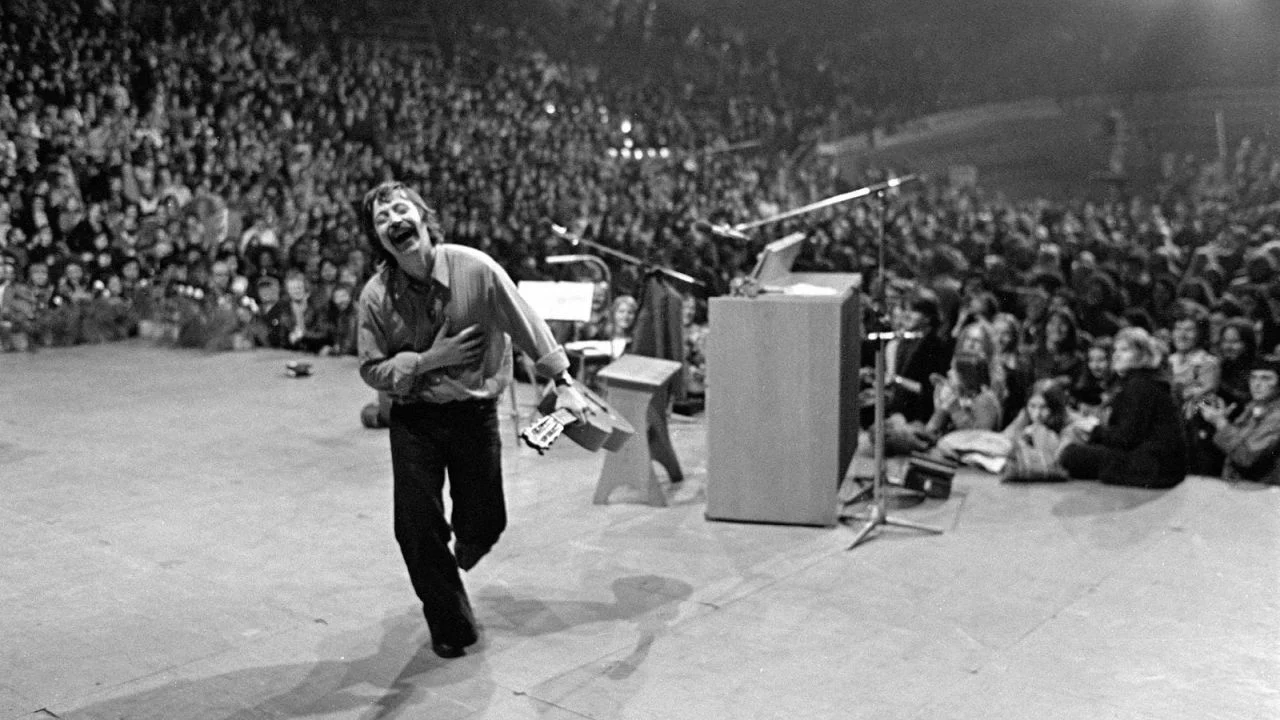
At the Cologne concert in 1976, Wolf Biermann appeared on a stage again for the first time after being banned from performing for many years – as if he had never been away.
Even those who don’t know him from the time before reunification will recognize him. A little wisdom of old age has been added, but he is still argumentative, curious and provocative. The fact that Biermann becomes more and more likeable despite this resistance in the film is thanks to Jens Meurer, who gives Biermann and his charismatic personality as much space as he needs – and that’s a lot. It makes the father of ten even more likeable that he also gives so much space to the women in his life. They shaped him, made him what he became, he says: his mother Emma, his first partner Brigitte Soubeyran, Eva-Maria Hagen, a completely fearless woman, as he says, and finally Pamela, the first person he wanted to live with forever.
It is becoming increasingly clear: Wolf Biermann is a complicated person, a musician, lyricist and storyteller, often annoying, a bit flirtatious, with a certain clumsy charm – someone who wears his heart on his sleeve and can’t keep his mouth shut. And who gets involved wherever possible. He stole a railway sleeper from the former freight yard in Hamburg, a huge piece that now stands in the garden. The transport trains rattled over this threshold towards Auschwitz, Theresienstadt and Minsk. Thousands of people, including Biermann’s relatives, drove over this threshold to their deaths. The case against Biermann for the theft of the railway sleeper was dropped. “Because of insignificance!” he shouts into the camera – twice, as if he doesn’t want to believe it. For him, the death trains were everything, but certainly not “minor.” The Prussian Icarus is not giving up yet, it may not fly quite as high anymore, but it is flying.
Conclusion: A very entertaining journey through an entire artist’s life and through 90 years of German history. Wolf Biermann presents himself as a still very awake and curious contemporary who, due to his age, also deals with death, but is not afraid of it. He wants to go to the Dorotheenstädtischer Friedhof in Berlin, near Hegel and Brecht, whose grave the first thing that comes to mind is: “What kind of stuffy flowers are those?”