
After around a dozen attempts had already failed – some with fatal consequences – a milestone in high-altitude mountaineering was achieved on May 29, 1953. A British-led expedition climbed the 8,848 meter high summit of Mount Everest for the first time – making it the highest point on earth. Although Edmund Hillary, who was even knighted by the Queen for his triumph, received most of the laurels, he himself always highlighted the brilliant performance of his technically adept teammate Tenzing Norgay, who was neglected in the (Western) media coverage – and not least because the Nepalese-Indian mountaineer had previously saved his life when he fell into a crevasse.
For her first feature film, the Australian documentary filmmaker Jennifer Peedom (“Sherpa”) decided to finally make Tenzing Norgay the protagonist of his own fate – and not just have him appear as a sidekick in another man’s heroic story. She fully lives up to this claim in her emotionally charged biography “Tenzing,” even if she leaves out the later years of her life as a still successful mountain guide. With its dramatic mountaineering scenes, spectacular mountain panoramas and prominent cast members such as Tom Hiddleston (“Avengers: Endgame”) or Willem Dafoe (“Nosferatu – The Undead”), the film absolutely deserves a theatrical release in addition to being released on the Apple TV streaming service.
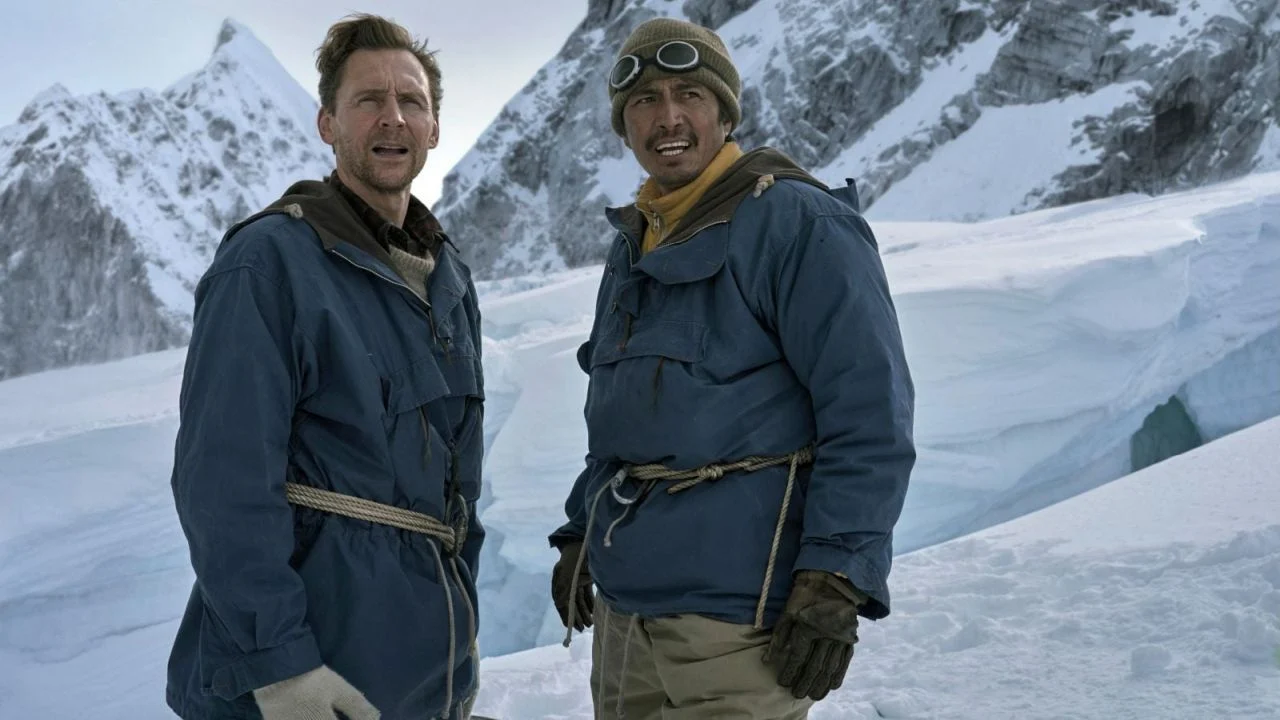
Tom Hiddleston as Edmund Hillary is the biggest star of the film – but the focus is still on Genden Phuntsok as Tenzing Norgay.
In 1953, shortly before the upcoming coronation of Queen Elizabeth II, a British expedition led by military officer John Hunt (Willem Dafoe) travels to Kathmandu, Nepal, to make another attempt to climb Mount Everest. A number of extremely accomplished mountaineers are there, including the Brits Tom Bourdillon (Thomas M. Wright) and Charles Evans (Harry Greenwood), the New Zealander Edmund Hillary (Tom Hiddleston) and his Nepalese-Indian Sherpa Tenzing Norgay (Genden Phuntsok), who had already failed a year earlier with a Swiss expedition just a few hundred meters below the summit.
However, the time window is narrow: with several camps set up at different altitudes for acclimatization, the summit should be successfully climbed by mid-May, before monsoon winds and storms make the undertaking impossible. But the expedition made slow progress for a long time…
New Zealand is surprisingly credible as Nepal
Although some of the flashback shots were actually shot in Nepal, in the mountaineering scenes the New Zealand Alps mostly doubled the mountain panorama around Mount Everest – and yet the majestic mountain shots alone would have justified a theatrical release. Even if Jennifer Peedom and her co-author Luke Davies (“Lion”) are aware of these show values and also build their plot around them to a certain extent, the exploration of the title character is never lost sight of. Flashbacks with Tenzing Norgay repeatedly interrupt the film in order to get to grips with the complex inner life of the title character, who is always as humble as he is pragmatic.
His early encounter with the British mountaineer George Mallory (a cameo appearance by Johnny Flynn) or his childhood in poor conditions in the Kharta Valley, where while herding yaks he repeatedly looks over in awe and fascination at the mountain he spiritually revered, are given adequate space without slowing down the dramaturgy of the first ascent too much – even if the ethno and string score often seems very thick.
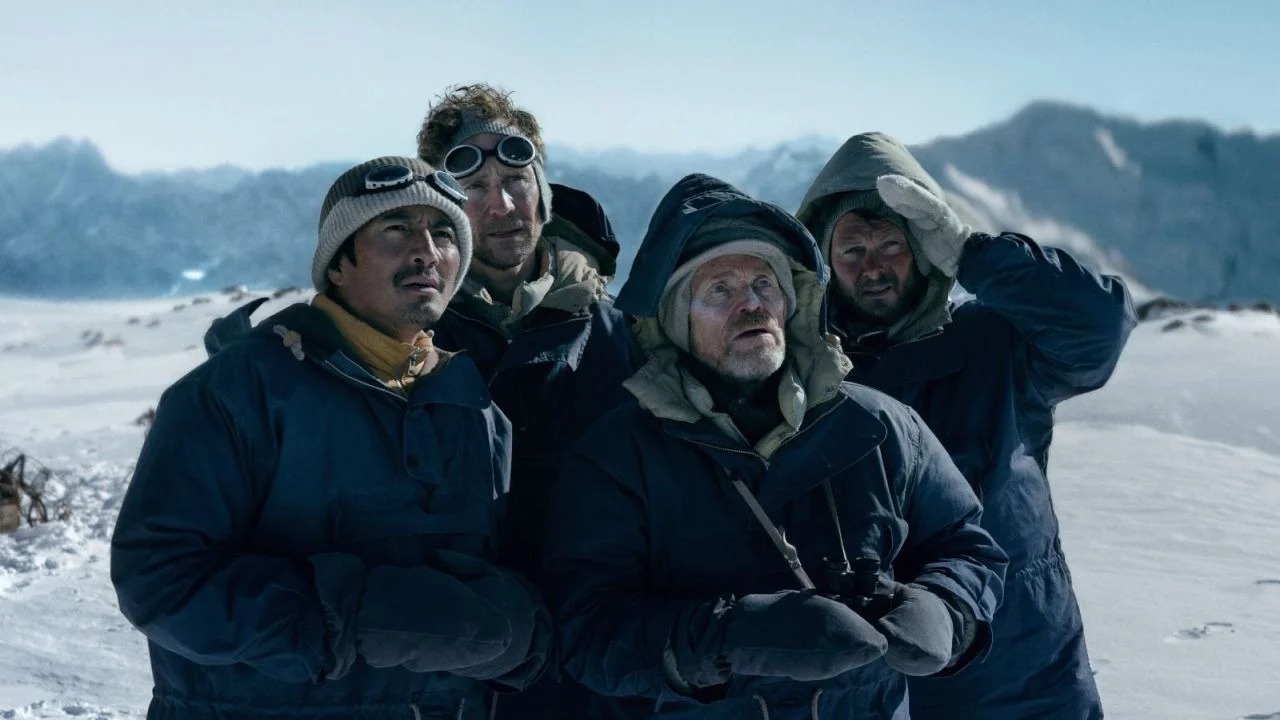
Military officer John Hunt (Willem Dafoe) leads the expedition – but Tenzing Norgay is still far ahead of him in terms of know-how.
Hallucinations about and memories of Norgay’s wife Dawa (Thinley Lhamo), who died early, have to serve, although somewhat uninspired, as an emotionally charged motivational boost, especially for the final climb to the summit. But “Tenzing” does not skimp on critical nuances in its perspective, which has so far been untold in big-budget Hollywood productions. Hostilities within various ethnic groups in Tibet or the tense relationship between the British, who act condescendingly as colonial rulers, and Sherpas, who threaten to refuse to work because they are not valued enough, come into play. The racism that was widespread at the time is also taken up when Norgay ridicules himself in the 1930s for his first engagement as a Sherpa with the British with a sentence he learned by heart but then botched out of excitement – and only receives laughter as “Mr. Amazing”.
The mountaineering scenes are staged as exciting as they are gripping. Jennifer Peedom confidently portrays her own (mountain) experiences from her documentaries. Wind and snow actually sweep over the Alpine filming locations and CGI was only used very subtly every now and then. Peedom also relies on her far-reaching realism concept when casting the main actor. In Genden Phuntsok (“Jinpa – A Story from Tibet”), she found an actor who grew up in Nepal, who knows Norgay’s personal experiences with exclusion and embodies the title character with both reserve and modesty. After his parts as the cunning MCU Loki, Tom Hiddleston also embodies the remarkably shirtless Edmund Hillary, who, as a great pragmatist, cares little about ethnic differences in the expedition team.
Conclusion: Even if “Tenzing” sometimes lays it on a bit thick, Jennifer Peedom has managed to create a biography that is as gripping as it is rousing, which finally gives the main character the recognition that was probably denied to her out of sheer ignorance in view of this accomplished pioneering achievement in Western media. In her first feature film, the director also delivers some of the most believable mountaineering scenes in a long time.