
A human is swallowed by a whale – and then has to somehow survive in the sea giant’s digestive tract (and in the best case even make it out again). When “Whalefall” was first announced last year, the biblically insane premise spread like wildfire: Is this just going to be complete trash or is this really a serious film project? The first published scene image, which shows the head of the main actor Austin Abrams in an oversized jaw, fired the viewer’s imagination once again: one immediately instinctively asks oneself whether anyone in reality could survive such a deep-sea nightmare scenario.
And at least among film fans, the question immediately follows how such a chamber play inside an animal can maintain the dramaturgy over a full feature length. But we can reassure you straight away: “Whalefall” by “No One Will Save You” director Brian Duffield is, against all odds, actually an astonishingly “realistic” survival thriller – only those who suffer from claustrophobia should probably think twice about whether they really want to be stuck in the intestines of a whale for an hour and a half in the cinema.
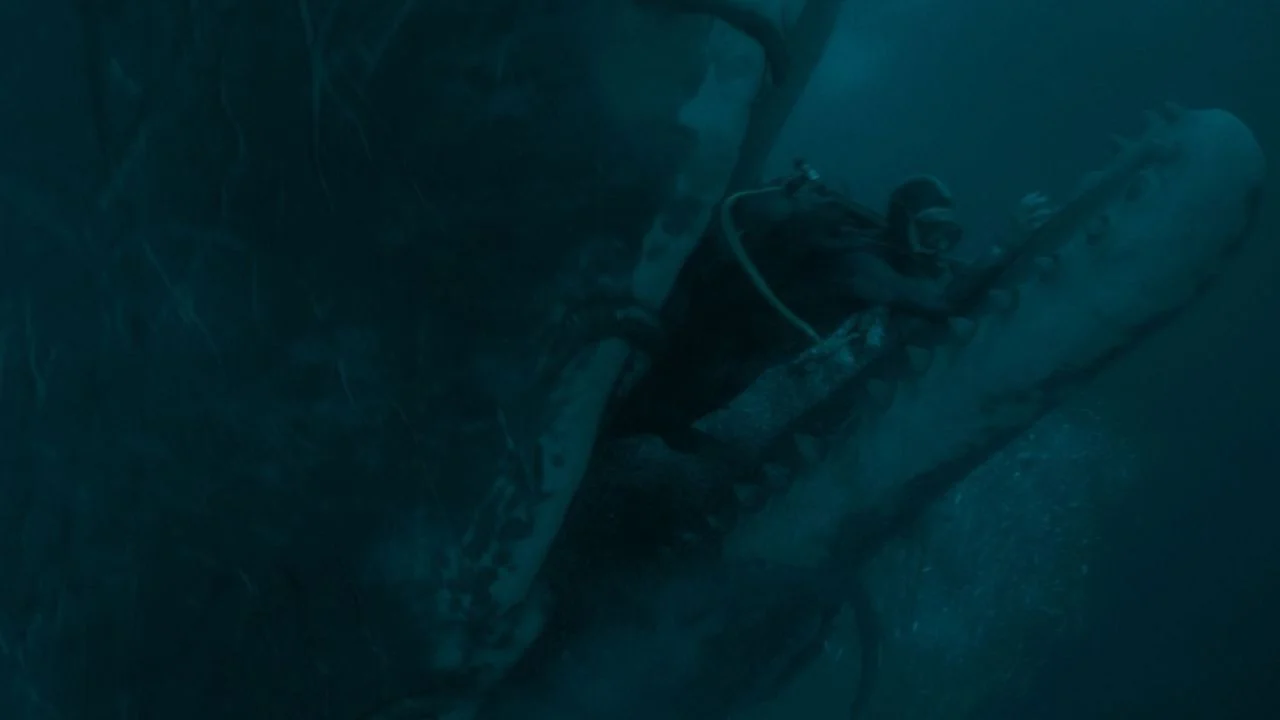
One had already hoped for it from the trailer: Brian Duffield stages the crazy premise as believably as possible.
The film begins with rasping breaths and a wheezing, weak cough. Former professional diver Mitt Gardiner (Josh Brolin) is visibly emaciated and close to the end when he falls from the boat into the ocean with suicidal intent. He only leaves his family a handful of personalized letters. But instead of opening the envelope and facing his father’s last words, student Jay (Austin Abrams) decides to look for the remains because so far only an empty coffin has been able to be buried. He ignores the approaching coast guard as well as the casual warning from the diving equipment rental company that whales have been spotted near the beach.
But that is exactly what becomes his downfall when he suddenly finds himself underwater in the middle of a self-preservation battle between the octopus and the sperm whale – and is ultimately sucked into the marine mammal’s huge maw along with the hopeless mollusk. Jay’s chances of survival are dwindling with every breath because he only has oxygen for a maximum of an hour to free himself from inside the 60-ton truck…
Has there really been a case like this before?
In the Stephen King adaptation “The Game,” the protagonist Jessie is handcuffed to a bed after a sex game accident – an extreme spatial restriction that is only broken through flashbacks. These explain why the increasingly desperate Jessie acts the way she does. This is a very similar dramaturgical structure to the Oscar winner “Slumdog Millionaire”, where the main character Jamal actually only sits in the candidate chair of “Who Wants to Be a Millionaire?” squats, but it is revealed in flashbacks which events in his life happened to make him know all the answers – and that’s exactly how “Whalefall” works: cause and effect are directly linked with each other in this conscious dosage of information – memories influence which decisions the protagonist makes in his supposedly hopeless situation. During his lifetime, Mitt did everything he could to prepare his son for a future as a deep-sea diver with relentless drills – and these reluctantly learned lessons could now potentially save Jay’s life.
“Whalefall” is based on a scientifically astonishingly extensively researched novel by Daniel Kraus, who also wrote the screenplay for the film together with director Brian Duffield. In fact, the scenario seems extremely well thought out, even if it also refers to all sorts of myths and legends. As early as the 19th century, US newspapers reported on a man who was devoured alive by a whale – and although James Bartley’s case is now considered disproven, the haunting descriptions of the sailor’s skin being burned by stomach acid remained permanently in the collective memory. Even Jay, who neglected to put on diving gloves, now has to experience firsthand what corrosive effects a whale’s digestive secretions can have – you can feel the phantom pains in his hands even in the cinema.
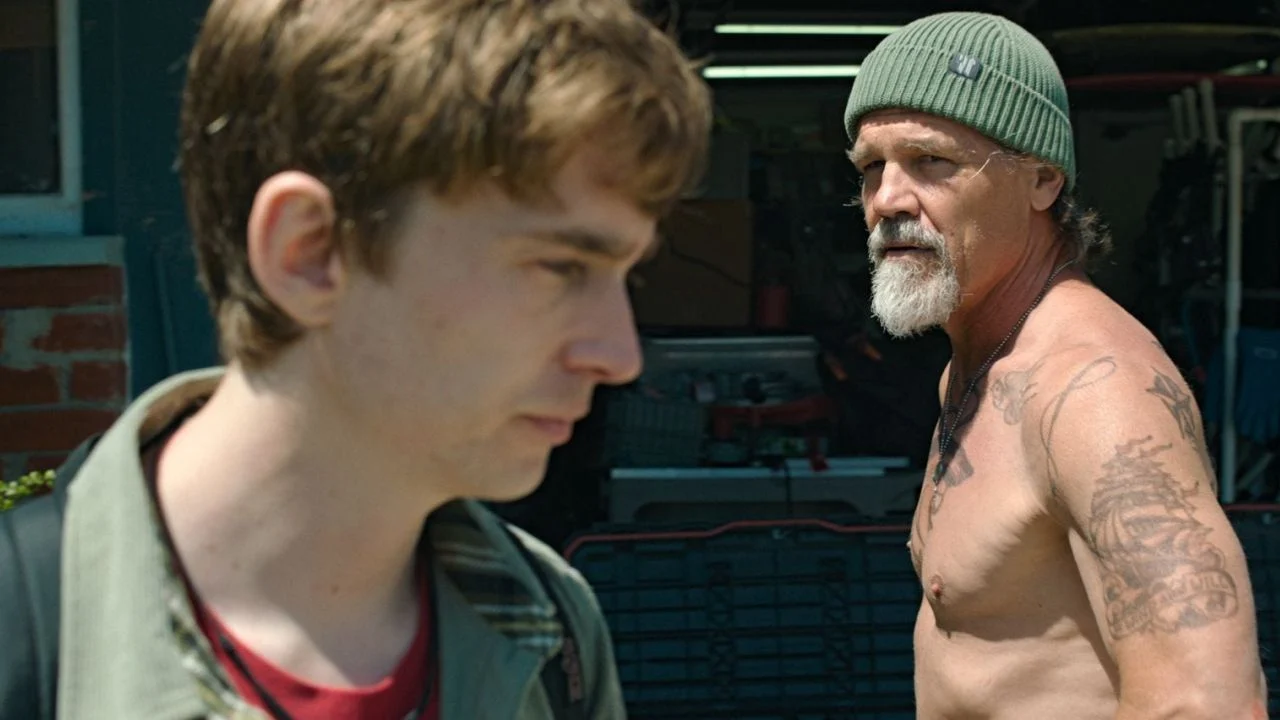
Jay (Austin Abrams) didn’t want to learn anything from his father Mitt (Josh Brolin) back then – but now those same lessons could save his life.
And it’s even taken a step further when the other animals eaten by the whale turn against Jay in their own need for survival – one of the most unpleasant scenes (in the best sense) of the 2026 cinema year, which can compete with any body horror flick, revolves around the scalpel-sharp beak of an octopus. While the opening panoramic shots of a rough stone bay off the coast of California are almost generic in their beauty, “Whalefall” is particularly convincing in the design of its main backdrop, which here turns out to be a slippery labyrinth of pulsating tissue. Only very few people will have ever taken a closer look at the digestive system of a sperm whale, but the pictures still convey a tactile, authentic impression. Their confinement and anxiety create an overwhelmingly suffocating feeling that takes the breath away not only from Jay, but also from the audience in the most powerful moments.
It’s fascinating how director Duffield keeps finding sources of light (otherwise we’d just be sitting in front of a black screen) that still feel completely organic and maintain immersion. In the depths of the sea there are scars of the whale that glow white in the darkness – and you can find your way around its intestines using the bright details on Jay’s wetsuit and the conveniently entwined glow jellyfish. After “Resident Evil,” Austin Abrams proves once again that he is the ideal choice for the role of everyman in particularly difficult situations. Although his filmography also includes lighter fare like “Dash & Lily,” the Floridian plunges into extremes with daring joy and seems to thrive especially when he is pushed to his limits. Entire lists and rankings are now doing the rounds on the Internet in which his previous film challenges are measured against each other.
A particularly crazy birth metaphor
Although his facial expressions are temporarily limited by the swimming goggles and the oxygen mouthpiece, the “Euphoria” actor manages to specifically express Jay’s fear, pain and slowly dwindling cognitive abilities. His performance is so engaging that it’s always a bit of a shame when the next flashback pulls you out of the cinematic maelstrom. The flashbacks are – as already explained – not just an accessory, but an elementary part of the story, but it still feels like there is too much reference to Jay’s past, because every insertion inevitably slows down the urgency of the whale’s escape. After “Gangster Squad” and “Weapons”, this is the third collaboration between Josh Brolin and Austin Abrams – but although the two easily embody a believable father-son dynamic, individual moments of their tense relationship do not always achieve the hoped-for pathos.
In view of the painstaking, detailed work that Duffield put into staging the attempts at liberation, it is noticeable in direct comparison that the family segments seem to be left behind. They tend to rely on familiar motifs and emotional shortcuts instead of taking an equally innovative approach. If Jonah’s story in the Bible is intended to teach us that we cannot escape God’s plan, the underlying idea of ”Whalefall” is probably the inevitability of our family inheritance. The father becomes a divine figure who hovers above everything – and, despite communication difficulties, is still able to direct the child’s steps even after his death. It is certainly not a coincidence that the struggle through fleshly walls towards the light reminds us of the process of birth.
Conclusion: A claustrophobically gripping survival thriller that manages to make the completely crazy scenario on paper physically tangible and intense for the audience. Unfortunately, the constantly interspersed father-son flashbacks aren’t as effective as Jay’s attempts to escape from the stomach of a whale. The plea for a respectful treatment of nature also comes to the fore in the novel it is based on.