
Since 1995, “Sense and Sensibility” by Ang Lee has been the benchmark for future Jane Austen film adaptations – based on an Oscar-winning script by Emma Thompson, who also played one of the leading roles alongside Kate Winslet, Hugh Grant and Alan Rickman. Amazingly, after two TV versions of the iconic novel, this was actually the first cinema version – and it immediately became a screen legend: winning multiple awards with an Academy Award, several British Film Awards, two Golden Globes and, not to forget, the Golden Bear at the 1996 Berlinale. FILMSTARTS gave it a sensational 4.5 stars. And so every new film adaptation of the material has to be measured against the opulent, romantic (and very entertaining) costume drama that has now become a classic.
The big question is: What is different and in what respects is the new “Sense and Sensibility” from “Blue Jean” director Georgia Oakley possibly even superior to the 1995 version? The story is still about three sisters who, after the death of their father, have to leave their beautiful country house in Sussex with their mother to move to a shabby cottage in the deepest province. The reason: Women in Regency-era England had no inheritance rights. That’s why the son from the deceased’s first marriage inherited everything. This son John (Tom Brooke) is a greedy, spineless bastard in both the literary source and both films; his wife Fanny (Stacy Martin) is intellectually superior to him: a self-centered, highly manipulative woman. Mrs. Dashwood (Caitríona Balfe) and her daughters are left penniless and homeless, relying on alms from relatives.
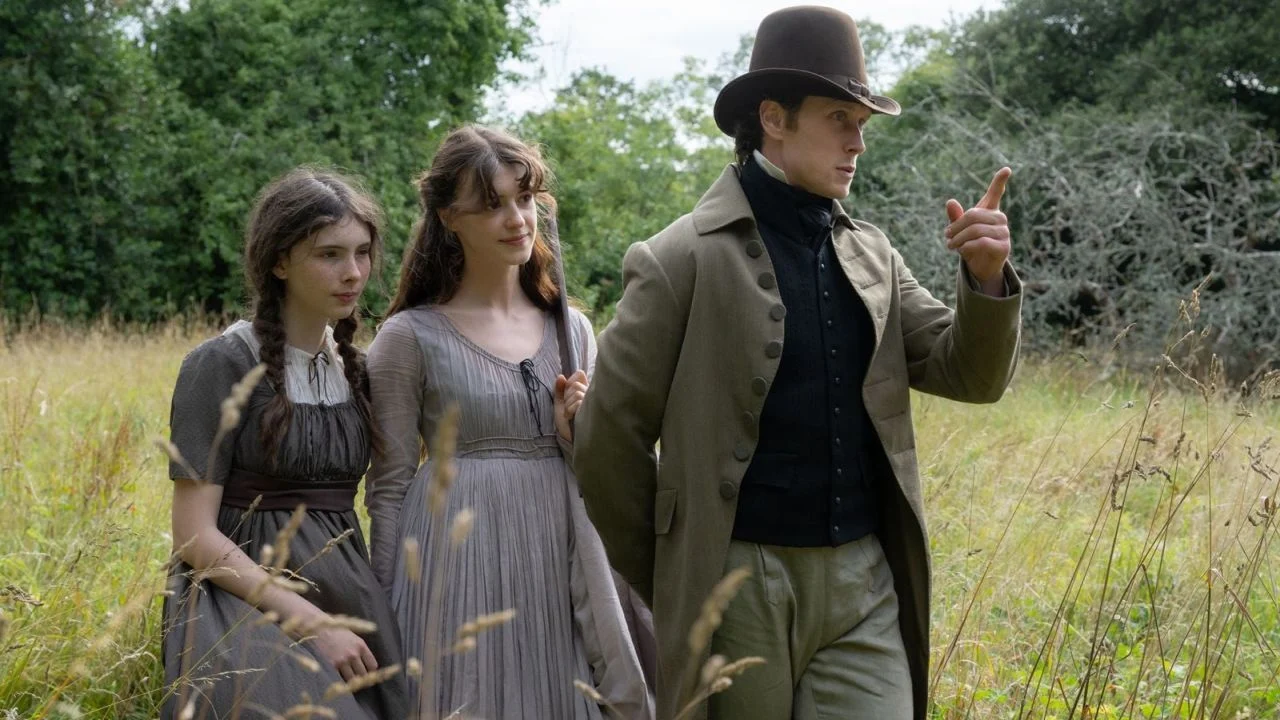
Edward Ferrars (George MacKay) is the love of life for Elinor Dashwood (Daisy Edgar-Jones) – only unfortunately he is already engaged to another woman.
The surest way for the sisters to escape poverty at this time is to marry a man who is as wealthy as possible. So it’s actually not about love, it’s about getting married. The eldest sister Elinor (Daisy Edgar-Jones, “The Song of the Crayfish”) is pragmatic, meeting all of life’s challenges with self-control and emotional restraint. But Elinor falls in love, and of all people with the endearingly shy Edward Ferrars (George MacKay), who is already committed to something else, although he also feels attracted to Elinor. Elinor comes to terms with this and hides her heartache behind her usual controlled facade.
Her sister Marianne (Esmé Creed-Miles, known for the title role in the Amazon series “Hanna”) is completely different: she is impulsive and enthusiastic, but she openly rejects the conventions of her time. So she falls head over heels for the charming Willoughby (Frank Dillane), a real Hallodri, whom she prefers to the boring Colonel Brandon (Herbert Nordrum), who is obviously interested in her. The original title is “Sense And Sensibility,” which doesn’t mean “Sense and Sensibility,” but rather “Intellect and Feeling.” The two protagonists Elinor and Marianne represent exactly that: Elinor the mind and Marianne the feeling. The third sister Margaret (Bodhi Rae Breathnach, “Hamnet”) plays a minor role. She is only 13 and therefore too young for the marriage market.
Less stars, more naturalism
Reason and feeling are also confronted as contradictory dimensions of human action in the new film, but not as offensively as with Ang Lee. The “Life Of Pi” director played even more with the opposites – Elinor and Marianne, Sussex and Derbyshire, country house and cottage. Georgia Oakley has opted for less Hollywood and more realism. This starts with the color scheme in soft earth tones and the girls’ clothes, which sometimes look shabby. Nature is not just decoration here either, but is shown in a close relationship with the two girls. A look at the cast list also shows that the big stars are missing here; instead, Georgia Oakley relies on less well-known faces from the British film scene. Overall, the cast is significantly younger than Ang Lee – at the time, Emma Thompson played the nineteen-year-old Elinor in her mid-30s, and Alan Rickman as Colonel Brandon was already approaching 50. But the cast does a good job: Daisy Edgar-Jones and Esmé Creed-Miles are each very present in their own right – and they play fantastically well together as lovable sisters who harmonize despite all their differences.
The world of men is also worthy of representation: George MacKay actually looks similar to Hugh Grant in some shades – and he reinforces this impression with a charming frown here and a crooked smile there; a lovable, somewhat inhibited guy. The Norwegian actor Herbert Nordrum plays the Colonel in a much less authoritarian manner than Alan Rickman, but has a similarly virile charisma. The director and her screenwriter Diana Reid (unfortunately) forego the dynamic, humorous lightness of the character portrayal like Ang Lee’s, instead relying on the authentic portrayal of women’s roles, which repeatedly clash with the social customs of the Regency era. Elinor and Marianne often walk around in a very nonconformist manner with their long hair loose, which gives them a nice, wild look, but is not only impractical, but also at least unusual for the time.
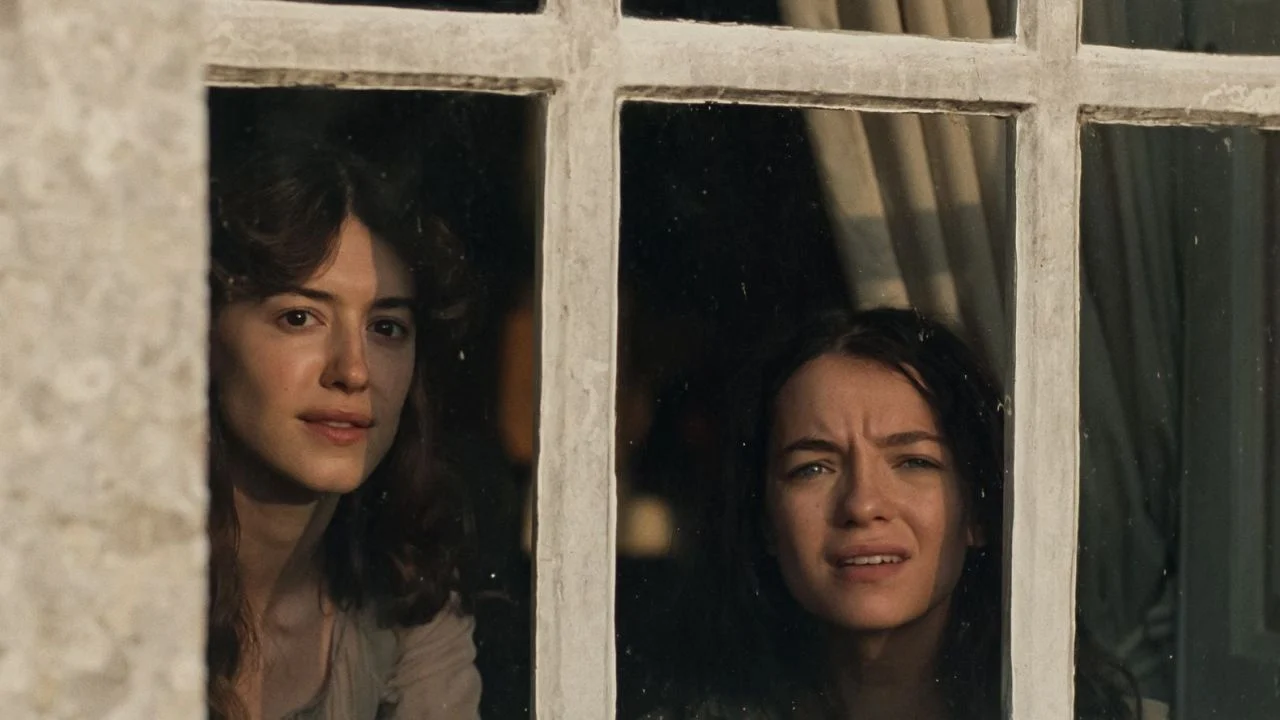
It is no coincidence that Elinor and Marianne Dashwood (Esmé Creed-Miles), invented by Jane Austen, are among the most famous sisters in literary history.
Here the sisters are on equal terms, where in Ang Lee the older one dominates. Elinor’s suppressed heartache seems less dutiful this time – you can actually see how she’s suffering. The modern, perhaps also contemporary staging of the female characters with their always slightly rebellious ideas and at the same time romantic longing for deep feelings and real devotion, also known as “Yearning”, corresponds to the spirit of the times. But with Ang Lee the height of the fall is more extreme: the women’s outbursts seem stronger and more surprising because they break the tight corset of social constraints, while with Georgia Oakley they are allowed to show right from the start that they have a mind of their own and don’t give in so easily. But the biggest difference between the films, which is ultimately responsible for the weaker rating of the remake, lies in the overall impression.
Where Ang Lee paints a self-contained, if romantically transfigured picture with British humor and stylish understatement – see the incredibly decorative landscape shots and the opulent costumes – Georgia Oakley is much less elegant and distinguished. The dances are very rustic, people clash with one another, the men even lift the women into the air, hopping around happily and unabashedly showing off their ankles and calves. This can easily be interpreted as passion, but at the time it was absolutely taboo. And the appeal of such an event for unmarried women was not to show off a lot, but rather to hold back and use very small, discreet hints to ensure that the men were turned on. Georgia Oakley seems to either reject this principle or not even understand it. The sophistication is missing here. And that gives the film as a whole a somewhat heavy-handed obviousness that is perhaps contemporary, but not particularly romantic.
Conclusion: Georgia Oakley’s remake cannot compete with Ang Lee’s iconic film, but at least it offers a certain naturalism that is less characterized by British elegance than by the absolute will to offer the most contemporary interpretation of the material.