
Christian Kracht may have provided the founding manifesto for German-language pop literature with his cult book “Faserland” in the mid-nineties, but for many critics his road movie novel “Eurotrash,” published in 2021, is still considered his most mature and strongest work. And in fact, after the Corona restrictions were lifted, it only took a few months for “Eurotrash” to be staged as a two-person play at several major theaters. The film adaptation didn’t take long to arrive: “Finsterworld” director Frauke Finsterwalder, known for her dry, dramatic humor, seemed to be exactly the right person for “Eurotrash” – and not just because she is married to Christian Kracht and worked on the script with him.
But anyone hoping that Frauke Finsterwalder will follow on directly from “Sisi & Me” – her idiosyncratic and brilliant reinterpretation of the eternal Sisi myth – will unfortunately be somewhat disappointed. “Eurotrash” is a multi-layered novel, and that may be why the Finsterwalder/Kracht couple decided to focus on only one of the two central elements of the autofictional original in the script: Instead of Christian Kracht, the protagonist is now called Philipp – and the entire part in which the author takes issue with his own pop culture persona is almost completely omitted. Instead, the film focuses entirely on the story of an (im)possible – and perhaps even only imagined in the dream of death – reconciliation. But this part only really comes into its own in the last third.
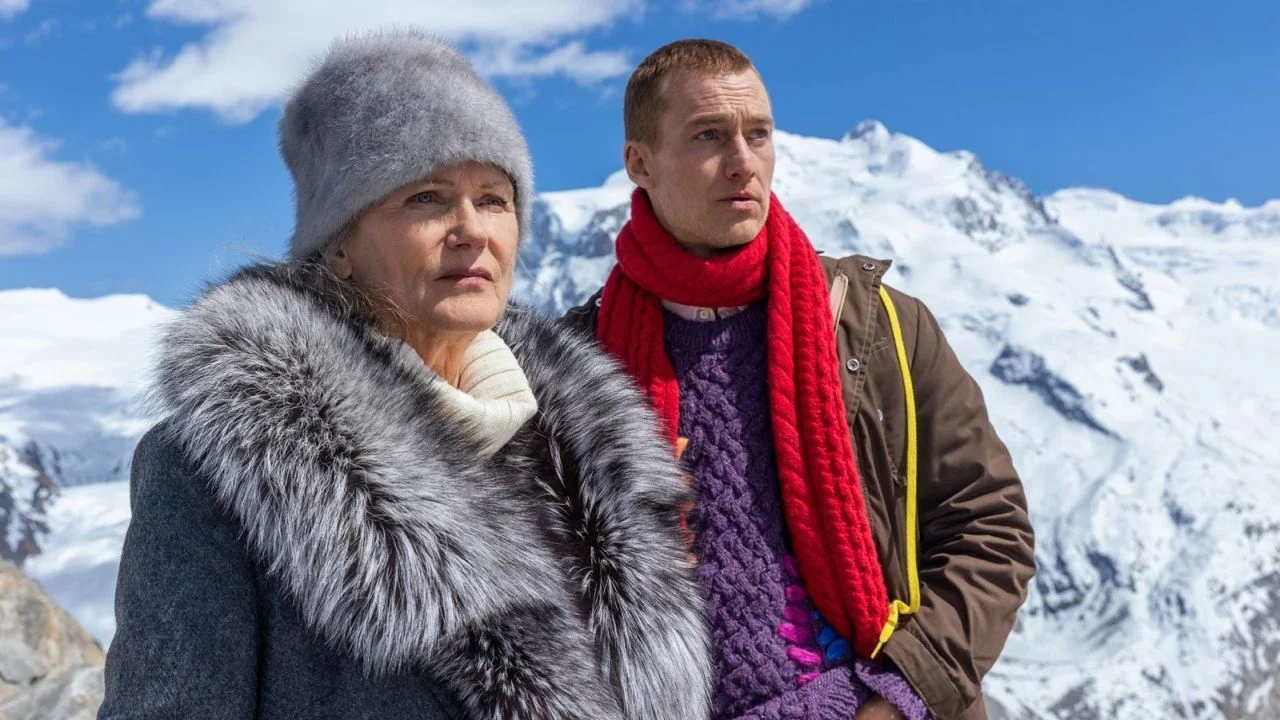
Philipp (Alexander Fehling) accompanies his mother (Barbara Sukowa) on an increasingly absurd road trip with the intention of giving away the family fortune.
Bestselling author Philipp (Alexander Fehling) recently lived in Nepal and completed his current novel there. Now he returned to Switzerland shortly before his father’s death. Here he has to take care of his alcoholic and pill-addicted mother Helene (Barbara Sukowa) after she was released – once again – from the closed psychiatric ward. In the car of a nameless taxi driver (Luna Wedler), mother and son set off on a road trip across Switzerland: Helene withdraws 900,000 francs from the bank in order to give it away as indiscriminately as possible.
But the sweater-knitting eco-commune that Philipp identified as a possible fundraising target turns out to be a group of neo-Nazis who, although they describe themselves as vegetarian-Germanic, still garnish their salad with slices of ham. In any case, it turns out to be much more difficult than expected to get rid of the money – perhaps because it’s not really about the 1,000 franc notes, but about the (Nazi) debt that has accumulated in the family over generations and which is supposed to be stripped away here. But if the destruction of assets doesn’t work, it could at least work with the late reconciliation between mother and son…
Motion Dazzle in the Swiss hinterland
A common reading of the novel is that the protagonist, in the initial description of his mother’s potentially fatal pill cocktail, actually commits suicide – and the subsequent road trip is just a death dream triggered by the longing for family reconciliation. In the film adaptation, this interpretation is even closer, simply because the tone of the road trip is so full of mood swings that it actually only makes sense in a certain dream logic: Luna Wedler advances as a philosophizing taxi driver into a mythical ferrywoman figure – and everyone who is after the plastic bag with the coal, from the top eco-Nazi (Michael Maertens) to spontaneous airport gangsters (Stefan Kurt, Philippe Graber), seem like villain characters from a slapstick film.
Especially when Philipp’s initially liberally used, melancholic, reckoning voice-over is gradually reduced, it seems tonally rather arbitrary – even for a grotesque. A longer zoological-philosophical detour is about zebras in the steppe, which can actually be spotted from afar by predators because of their black and white stripes – before the hunters fail to focus on a single animal in the moving herd. In technical language this phenomenon is Motion Dazzle called – and you feel a little like that when watching “Eurotrash”, when the different tonal moods don’t seem to come together to form a coherent whole.
The final third is the strongest
In contrast to his mercilessly ironic earlier works, Christian Kracht at least allows the remote possibility of reconciliation to shine through in “Eurotrash” – and in fact the film adaptation is at its best precisely in these empathetic inserts at the home stretch: Of course, Fassbinder legend Barbara Sukowa (“Lola”) is also an event beforehand when she portrays Helene as a human shotgun that can never be calculated and is always sharply loaded, while Alexander Fehling (“In the labyrinth of silence”) the disillusioned keynote speaker is somewhat monotonous with slumped shoulders. But when mother and son discover between the white wine-rich trout and blue test dinners that they were abused as children at exactly the same age, a hope suddenly shines through that one would never have thought possible from Christian Kracht before, but which is once again deeply touching in the cinema.
Conclusion: On the pages of the novel, Christian Kracht’s “Eurotrash” is and remains a multi-layered masterpiece – but when translated to the big screen, too much is lost without anything new being added to a comparable extent.
We saw “Eurotrash” at the Hamburg Film Festival 2026, where the film celebrated its German premiere.