
Four-time Oscar winner Alejandro González Iñárritu (“Birdman,” “The Revenant”) is considered an extremely self-critical filmmaker. When his Netflix film “Bardo” celebrated its world premiere at the Venice Film Festival in 2022, he then returned to the cutting room again. He cut a total of 22 minutes, changed the rhythm, rearranged scenes and even added new material. According to his own statement, the reason was not the predominantly negative reactions, but rather his own realization at the premiere that the film did not yet have the right narrative flow. In the end, there was still a work that few liked and which was a great disappointment for many.
The fact that Iñárritu’s films divide is nothing new. This will also be the case with “Digger”. But this time it’s pretty obvious that further visits to the cutting room won’t save anything. While “Bardo” was so overloaded with strange ideas that at least something was always happening, the next crazy idea was always around the corner and ultimately there was a huge heart beating behind it all, “Digger” is the exact opposite. The hotly anticipated Oscar candidate, largely due to the performance of a barely recognizable Tom Cruise with a lot of make-up and a fat suit, is a decidedly sluggish and surprisingly lifeless affair that one quickly gets fed up with.

Tom Cruise as Digger Rockwell in one of the few scenes with a lot of energy.
For Digger Rockwell (Tom Cruise) there are actually only two things in life that are really important: his beloved, terminally ill cat should live forever. But above all, its oil sources must be exploited as mercilessly as possible as long as the incumbent US President (John Goodman) is still in office and no environmentally conscious successor can thwart his plans. But now Digger has gone overboard to squeeze every last drop out of the earth during his drilling. Because of this, a huge iceberg has broken loose and is now drifting towards Europe. If a collision occurs, there is a risk of devastating floods, millions of deaths and possibly the end of the world.
So action has to be taken – and because of course only the Americans with Digger himself at the helm can do that, first there are big speeches and finally a military operation. But you shouldn’t expect epic doomsday images or big action. The fact that Digger’s beloved cat so obviously turns out to be a mechanical stage prop in the first scene is certainly not due to the film’s budget, which is at least $125 million (some sources even say up to $200 million).
Warning: SPOILER warning
It is impossible to write a truly well-founded review without at least addressing a central twist in the work, which has several twists. If you want to watch “Digger” without this prior knowledge, we recommend that you jump straight to the conclusion and read the rest of the review after you have gone to the cinema!
After about half an hour, Iñárritu pulls back the curtain. What we have seen so far is the dress rehearsal for a theater performance. Tom Cruise not only plays Digger, but also an actor who in turn embodies Digger. The reveal itself is one of the film’s stronger moments. Not only is it visually strong, but it also offers a very successful joke about a tree and the artificial world of the production design. Even later, the transitions from the play to the actual production behind it are always the more successful moments. But that’s it.
Because the surprise effect of this second level quickly evaporates and “Digger” gains surprisingly little from it in terms of content. Although Iñárritu wrote the script not only with his long-time companions Nicolás Giacobone and Alexander Dinelaris, but also with the Mexican playwright and theater director Sabina Berman, the entire construction remains limited to the initial aha moment. There is hardly any productive friction or interaction between the two narrative levels. Even the fact that Cruise plays a second character doesn’t enrich the film because the cocky oil tycoon and the man who embodies him on stage are hardly different.
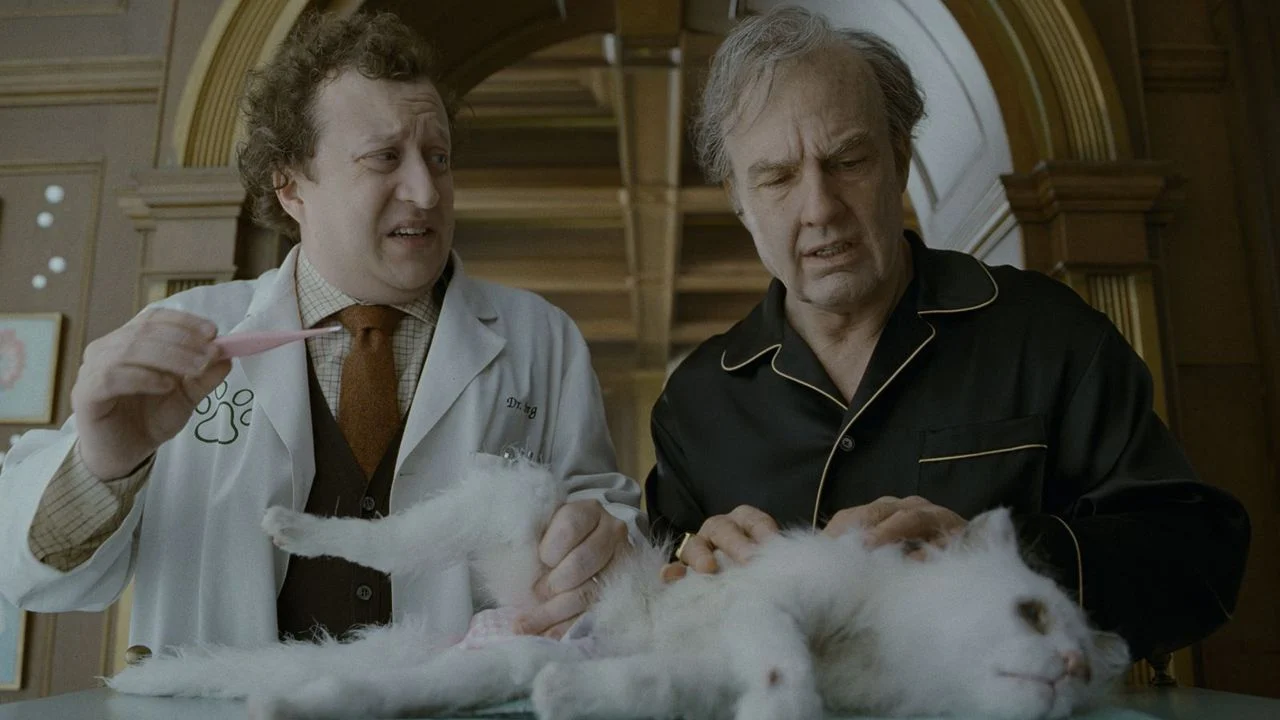
It’s no coincidence that Digger’s beloved cat isn’t real.
The deliberately artificial stage worlds can at least impress with their equipment. The production design is one of the clear highlights of “Digger,” but surprisingly little happens visually within these rooms. In the end it is literally filmed theater. And in terms of content, the long moments are often extremely sparse. Far too often, scenes start in a certain tone and then stay there for minutes. Digger orders those around him around, and after a short time it becomes completely clear what the scene is going for. Still, she goes on and on.
There is a lack of developments, breaks, surprising changes of direction and, above all, energy. The few moments in which movement suddenly appears only make it all the more clear how painfully missing this is in the rest of the film. In one scene, Digger is allowed to show off his man-catcher qualities in front of an angry parliament of pale figures. Things get heated, there is bullying and finally the scene escalates completely. But that is the absolute exception.
Tom Cruise asks himself: Is this supposed to be funny?
This is all the more disappointing because “Digger” is actually designed as a bitter satire. John Goodman’s president is accompanied at every turn by a religiously zealous priest who speaks in Bible verses, and all other political figures are grotesque caricatures. But reality itself has long since become so absurd that it is difficult to exaggerate. This is even discussed on the meta level of the film. At one point, Tom Cruise as the Digger actor even asks his director (Sophie Wilde): “Is this scene supposed to be funny?” It’s a question that you unfortunately constantly ask yourself during “Digger”.
Because the self-reflexivity that your own satire and humor don’t work doesn’t automatically make what’s happening funny or at least clever. Rather, it is the self-anticipated admission of failure. Iñárritu and his team recognize what the problem is, but do nothing about it. Instead of creating a new perspective or a particularly sharp point, simply naming your own dilemma remains the whole idea. This alone causes the entire meta level to fail.
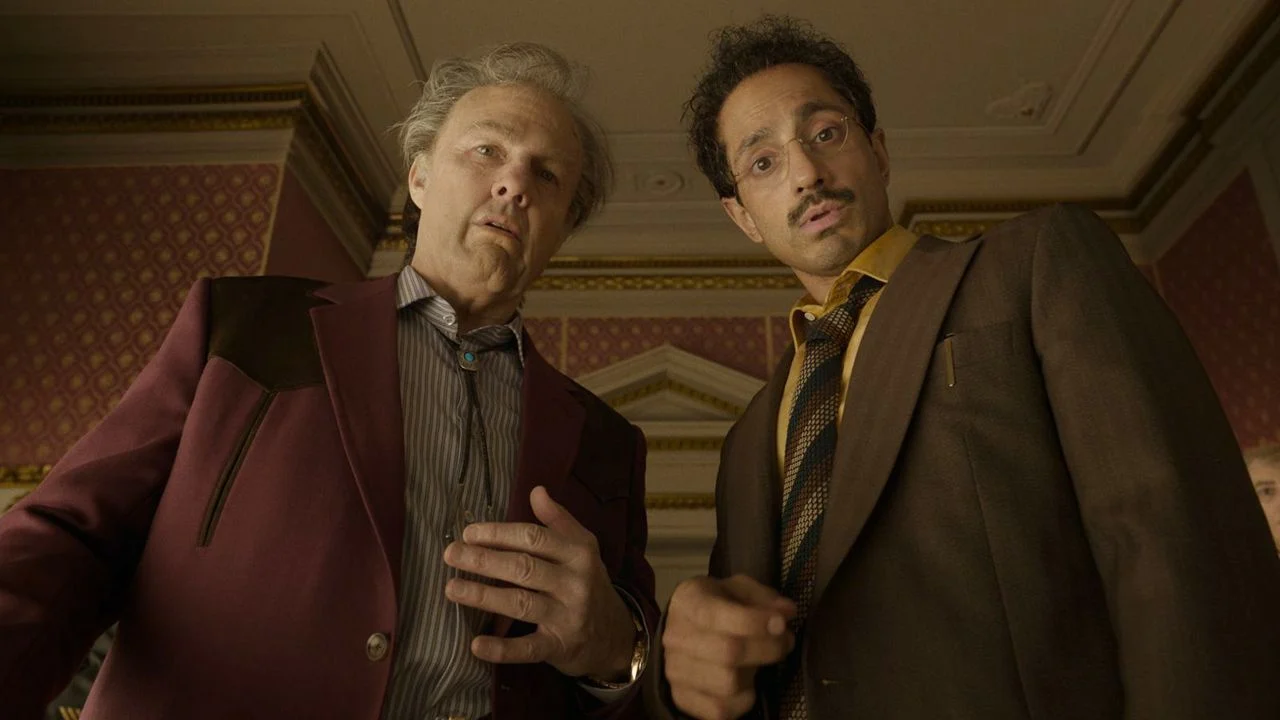
Riz Ahmed is another highlight as a scene stealer.
But even the play about Digger Rockwell, which makes up the majority of the plot, has little appeal. The fact that humanity wants to solve a catastrophe caused by unrestrained environmental exploitation by attacking nature once again with military force remains unfounded. Unsurprisingly, a bomb labeled “Fuck Nature” is then supposed to stop the approaching iceberg. Stanley Kubrick’s “Dr. Strange or: How I Learned to Love the Bomb” is explicitly quoted, although in the end this reference to one of the great classics of film satire makes us painfully aware of how much more precise, evil and, above all, funnier it has been told before.
The prominent ensemble can do little to change this, also because only Riz Ahmed (“The Negotiator”), as a scientist, has the opportunity to develop a character with a variety of nuances and not always operate in a loud tone. Sandra Hülser (“The Astronaut”) and Jesse Plemons (“Bugonia”) at least get their big individual moments, but the majority of them are accessories for the Tom Cruise show. Seeing the mega star outside his action hero comfort zone again after a very, very long time is initially the biggest appeal of “Digger”. With make-up, accent and deliberately exalted acting, he visibly throws himself into this egomaniacal oil tycoon with relish. The first scenes with his mechanical cat, which is bathed and blow-dried after waking up together in a luxury bed, are actually quite amusing. But people also got tired of this transformation surprisingly quickly. What seems fascinating in the trailer and in the first few minutes becomes repetitive afterwards. This is what Cruise has in common with the film: Even if a scene starts promisingly, you can usually be sure that it will drag on for a while without any further ideas.
And in the end that is probably the biggest disappointment in a film by Iñárritu. None of the director’s films are without controversy. From “Amores Perros” to “21 Grams” and “Babel” to “Birdman” and “The Revenant”, many accusations can be made. You can’t just celebrate these films as masterpieces, you can also accuse them of being pretentious, self-indulgent, annoying and taking pleasure in the suffering of the main characters. But at least they have wild ideas that you can see as failures, absurd humor that makes you shake your head, and a production that you can take exception to. So far, Iñárritu hasn’t been accused of being boring – until “Digger”. Because this isn’t even a complete failure, it’s just a dreary and dragging affair that only has a single punch line and is over two hours long.
Conclusion: How can a satire exaggerate the already absurd reality in a funny way? Alejandro González Iñárritus recognizes and addresses this problem in “Digger”, but leaves it at the mere naming. The result has little bite, hardly any humor and no heart. But above all, despite the elaborate production design, prominent cast and Tom Cruise playing against his image, it is a surprisingly lifeless, dull affair, whose endless scenes roll out the few ideas for far too long.