You can’t create a utopia with someone like Zora (Jella Haase). But probably not without someone like Zora – and so things start to get complicated with the commune under the Greek sun. Because when Zora, Klara (Lena Urzendowsky), Alexandros (Andronikos Korakas) and Junis (Joshua Hupfauer) decide to spend their summer with Alexandros’ family on a beautiful Greek island, they initially arrive as two very classic heteronormative couples. People of their generation, clearly: climate-conscious, more or less vegetarian – and divided about how bad a lack of consistency when it comes to dietary rules actually is, when the pig on the host family’s table was personally stroked to death by the organic farmer. At least everyone agrees that everyone is pretty fucked up by the capitalist oppression system.
However, movement in the conservative, monogamous couple constellations of “Children of the Sun” only comes when Zora takes the initiative because she would actually like to sleep with her friend’s lover. Free love and open relationships – everyone actually thinks that’s a good thing. But the impulse to do so was not born from the spirit of freedom, trust and the voluntary renunciation of possessiveness. Instead, Zora simply takes what she desires at the moment, without considering whether she might hurt anyone with it. Not the most stable base, one might think, but one on which the four friends can build a kind of hippie community from now on.
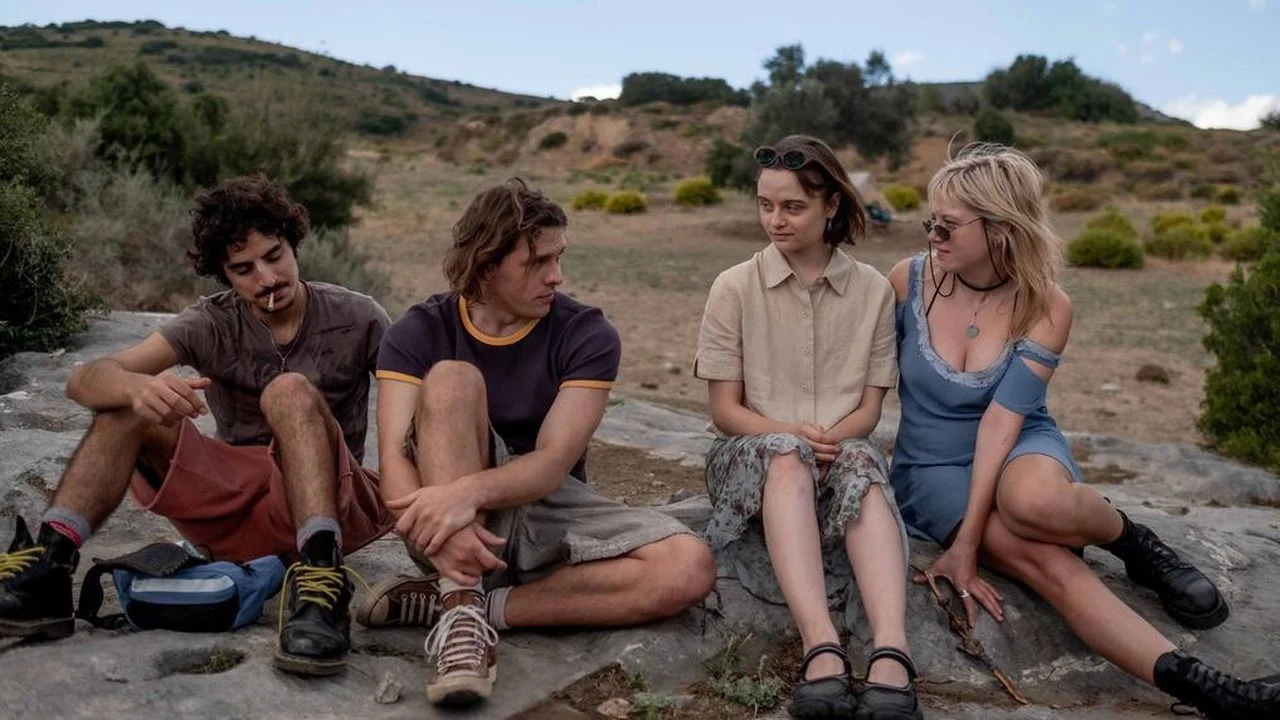
The four protagonists of “Children of the Sun” don’t quite agree on how being a dropout is actually going to work in the long term.
In any case, none of them want to go back to the capitalist society of exploitation – and so the four of them decide to simply continue camping in Greece, throw away their cell phones and from then on live there from the fruits of the country as well as from air and love. Above all, about love, because the most astonishing element of the new film from “Kokon” director Leonie Krippendorff is actually its impressive (and surprisingly uninhibited) generosity. The first half of “Children of the Sun” in particular is essentially a wonderfully hedonistic soft sex film under the Mediterranean sun. Of course, one suspects from the outset that the utopia will not last. But the best thing about this already visually intoxicating film is how unreservedly it initially throws itself into all the dreams of free love and alternative lives.
Well, the protagonists sometimes make themselves a bit ridiculous, but the film knows that too. At least at first. Because statements like those that they no longer feel like tourists in their supposed dropout paradise are definitely met with the appropriate mocking sideways glances from the locals. At some point, however, the film’s initially enchanting lightness slips away, and from that point on very important topics are debated up and down with a little too pinched gravitas. It’s about cobalt mining instead of non-monogamous love, and more and more about the capitalist pig system and what you can actually do about it.
If not utopia, then at least revolution
Unfortunately, “Children of the Sun” doesn’t really recover from that, and so what started out as one of the most surprising German films in what feels like an eternity ends up being a rather ponderous and overly intentional thematic film. But there is still a small bang effect – and that’s where Zora comes into play again. Because it may not be possible to create a utopia with someone like Zora, or at least not one in which trust, mindfulness and mutual consideration play a role.
But if you want to make a revolution, you can’t make it without a Zora (or many). And the question that the four dropouts ultimately face in “Children of the Sun” is a very existential one: retreat into the private sphere? Or set the system on fire? The Klaras and the Zoras represent different answers to this conflict, which Leonie Krippendorff ultimately puts at the center of the film.
Conclusion: A great first half – and an all too topic-heavy second half. Unfortunately, “Children of the Sun” falls apart a bit, but you have to watch Leonie Krippendorff’s film based on the first hour alone! Because literally no German film has been so sexually liberated – and completely uninhibited and unforced – in decades. The sexual revolution in cinema – it could start here.
We saw “Children of the Sun” at the Hamburg Film Festival, where it celebrated its world premiere in the Great Freedom section.