
It’s not even half over yet, but it’s already clear that Juli Zeh demonstrated truly astonishing ingenuity back then. Back in 2007, the best-selling author wrote the play “Corpus Delicti” about a health dictatorship called “the method” that prevailed 50 years later. The novel version “Corpus Delicti: A Trial”* followed two years later. But in the shadow of state overreach during the corona pandemic and in the full sprint towards AI omnipotence, the material takes on a completely different urgency – and only a good third of the time until 2057 has now passed. So it’s no wonder that the director and author Lena Stahl (“My Son”) is now releasing a cinema version.
Now the original version mainly consists of two court hearings and the protagonist’s dialogues with an AI voice in her apartment. This reduced setup is an excellent way to negotiate the major themes of the material: What if an entire society is based solely on the (false) agreement that an AI system is “infallible”? And how far can the state go to ensure the health of its population – for example with mandatory blood tests or mandated training programs? But the chamber play-like original is not particularly cinematic – and so Stahl focuses on a criminal investigation in her script, which, in terms of suspense, hardly goes beyond an average “crime scene”.
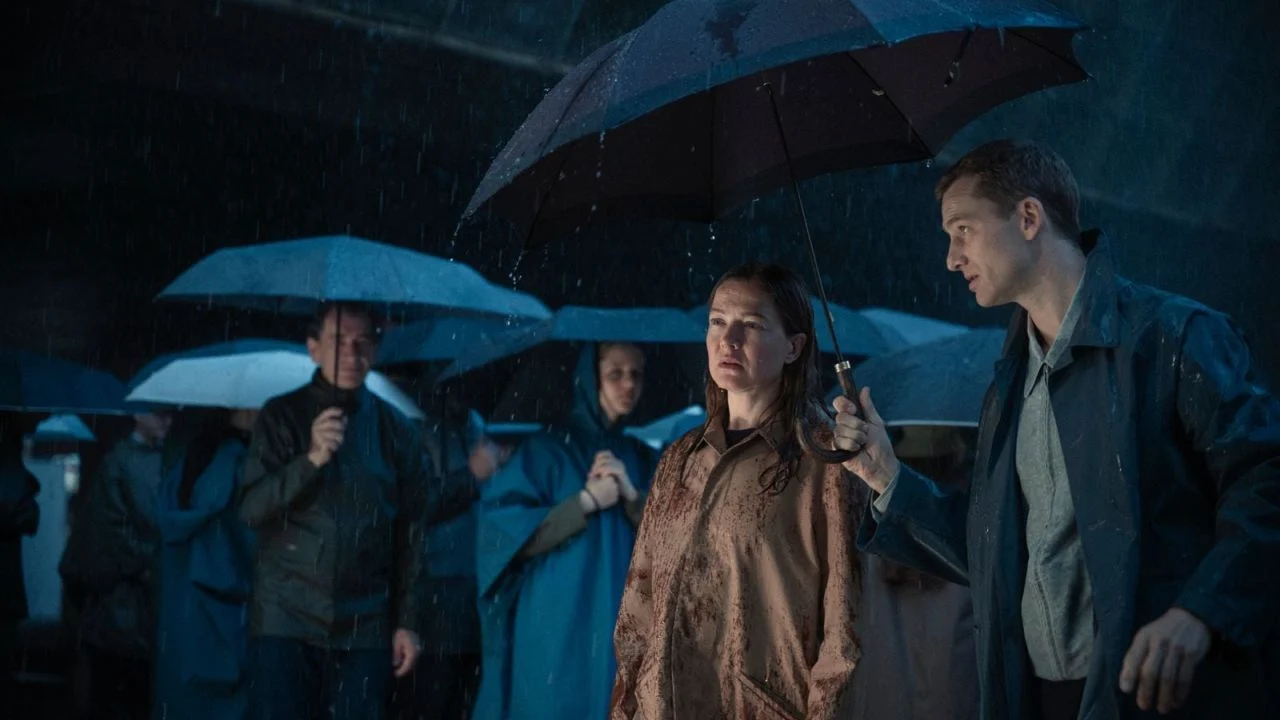
Mia Holl (Hannah Herzsprung) has to decide whether she should trust the shady journalist Heinrich Kramer (Alexander Fehling) or not.
Neurologist Mia Holl (Hannah Herzsprung) and her colleague Christiane Bülow (Haley Louise Jones) have managed to read the memories and thoughts from a patient’s brain. The next step: Now they want to get to the subconscious. But before that happens, Mia first has to deal with a private catastrophe: her system-critical brother Moritz (Damian Hardung) is arrested for rape and murder. If convicted, the defendant faces being frozen indefinitely – and the DNA evidence on the victim seems to clearly point to him as the perpetrator.
There will still be court hearings in this future, but they actually only have a representative character. After all, “the method”, an AI with comprehensive data access, is considered “infallible” – and the accusation that it could still have been wrong about the accusation would not only contain enormous social explosives, it would also be tantamount to high treason. Nevertheless, Mia carries out her own investigation with the help of the initially unmotivated public defender Lutz Rosentreter (Christian Friedel) – and in the process she also meets the journalist Heinrich Kramer, whose intentions are difficult to understand…
Combative instead of depressed
At the beginning of the novel, Moritz has already committed suicide in his cell – and Mia is torn apart in her apartment by the conflict that, as a rational scientist, she continues to believe in “the method” but still cannot imagine that her brother is actually guilty. In the film, however, the protagonist has a much more active, heroic role: Mia does everything to save her brother – and relies, among other things, on Lutz Rosentreter, whose office and outfit are less reminiscent of that of a lawyer and more of that of a private detective from 100-year-old crime novels.
In any case, the film team did a great job on the sets: Instead of computer effects, “Corpus Delicti” relies primarily on the clever use of rooms and buildings that already have a certain futuristic appearance. This budget-friendly approach has been tried many times – and almost as often the results just seemed disappointingly cheap (most recently, for example, in the office scenes of the Matthias Schweighöfer flop “The Life of Wishes”). But in “Corpus Delicti” Lena Stahl and her colleagues actually create a visually astonishingly coherent vision of the future – even if there wasn’t enough money for spectacular set pieces or something similar.
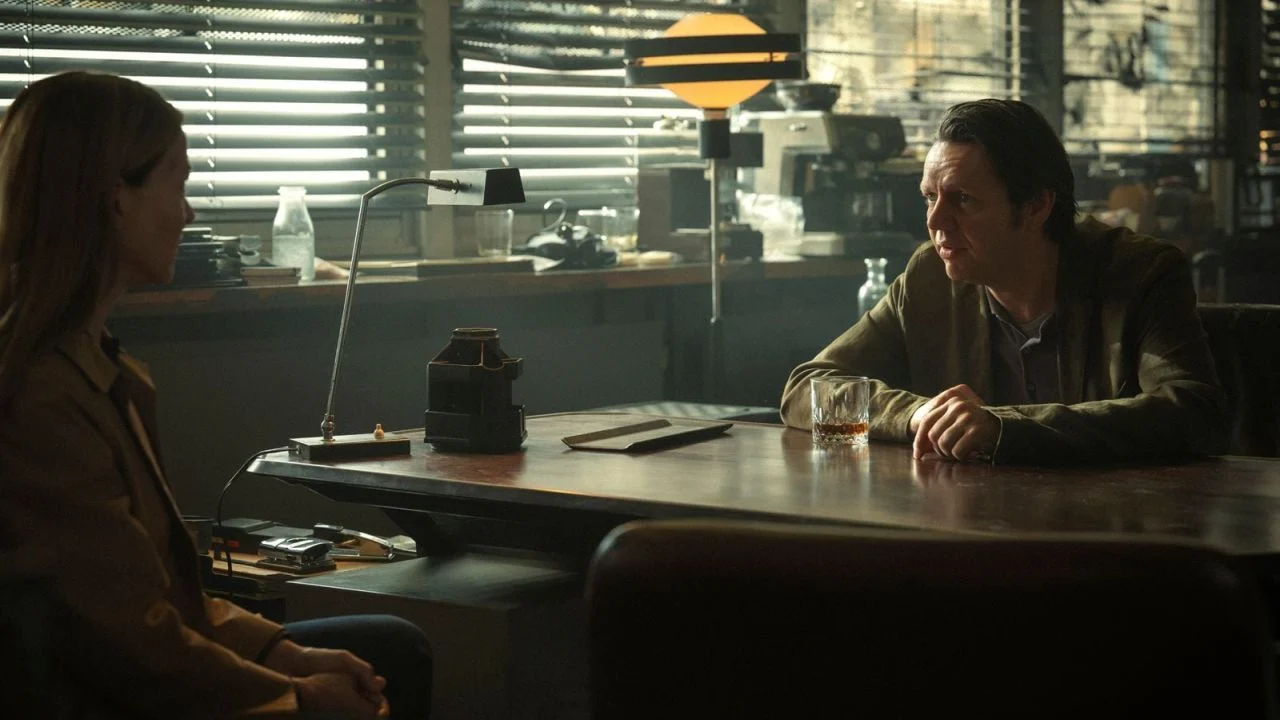
Almost every room looks similar. Only in Lutz Rosentreter’s (Christian Friedel) office do you suddenly feel like you’ve been transported back to a detective novel from the 1920s.
While Mia’s private investigations, which were invented for the film, largely run according to formula, it is primarily the small scenes and observations on the sidelines that develop the greatest bite in this dystopia: for example, when the previously loving, solidarity-based neighborhood suddenly turns into a mob that drives Mia out of her apartment – or when Mia blackmails her pathology colleague with the knowledge that he snacks on chocolate every now and then, which is under the circumstances The strict, health-promoting supervision of “the method” is of course absolutely not permitted.
At the time, some critics criticized the piece for being too focused on providing students with a template for essays. That’s a bit harsh, because many details of the central health fascist system are simply very well and precisely observed. But the fact that one or two teaching staff are inspired by the “Corpus Delicti” film adaptation to write a further essay does not seem completely unreasonable.
Conclusion: A (sometimes somewhat didactic) dystopia that is now even more relevant as a film than it was 19 years ago as a stage play and 17 years ago as a novel. However, author and director Lena Stahl squanders some of the thematic potential by shifting the content towards a moderately nerve-wracking future crime thriller.