
In contrast to the Academy Awards, where “Ben-Hur,” “Titanic” and “The Lord of the Rings: The Return of the King” share the record with eleven Oscars each, film festivals aim to divide the awards as much as possible. That’s why there are usually rules that no film can win more than two trophies – and whoever gets the main prize shouldn’t get anything else. Sometimes juries definitely want to honor certain people involved in addition to the film: the Cannes jury led by Steven Spielberg did not award the Palme d’Or for “Blue is a Warm Color” as usual to director Abdellatif Kechiche, but also explicitly to the two leading actresses Léa Seydoux and Adèle Exarchopoulos. Apparently this year’s Venice jury under President Maggie Gyllenhaal (“The Bride”) thought something similar…
… and used a special rule for the double award for the Danish historical drama “Woman Unknown”: It is possible to award another prize in addition to the Golden Lion to the same film as long as the decision is unanimous – and so the seven jury members jointly awarded the Coppa Volpi for best actress to Mathilde Arcel Fock. At least this second prize is certainly well deserved – the film IS its protagonist, and she is played absolutely brilliantly. Beyond that, there would have been more deserving Lions winners – and for this assessment you don’t even have to get into the misogynistic conspiracy theory that “Woman Unknown” by May el-Toukhy HAD to win because it was the only film by a (solo) female director.
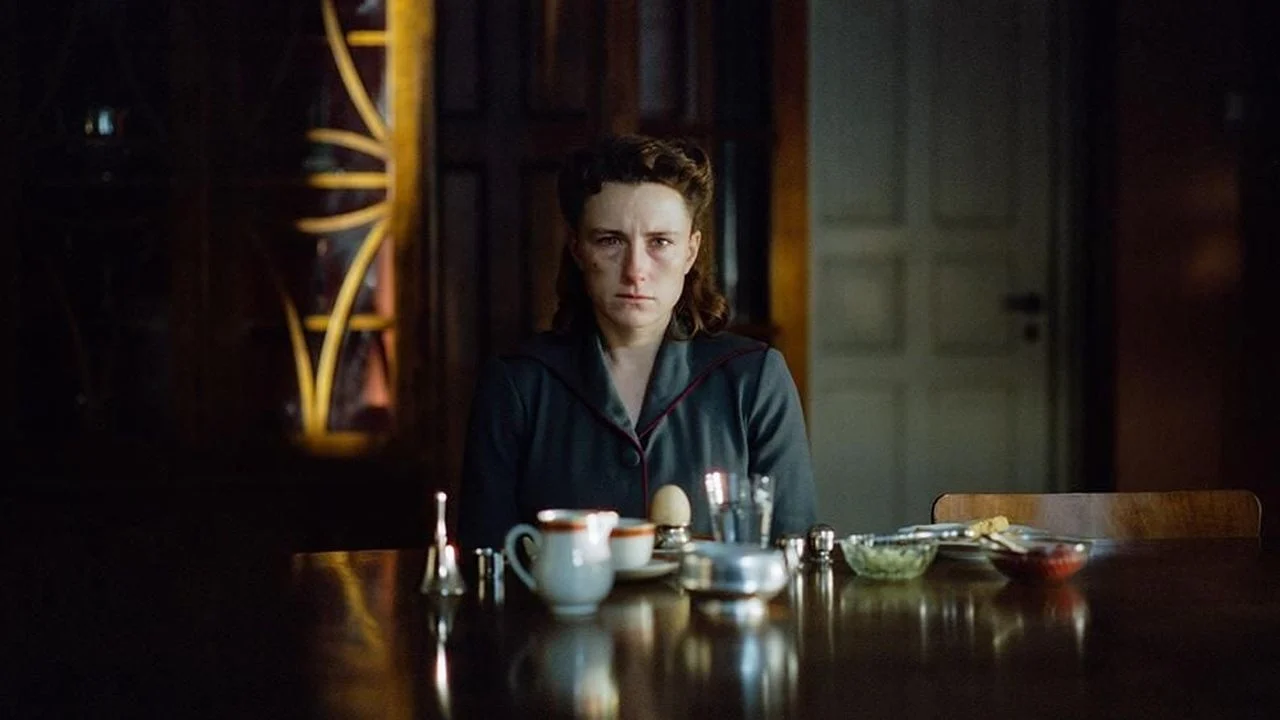
Marie (Mathilde Arcel Fock) has learned the hard way to take it.
“Woman Unknown” takes place in Denmark after the end of the Second World War: Marie (Mathilde Arcel Fock) was until recently a maid and nanny, but is now engaged to her widowed boss, the wealthy textile manufacturer Christian (Carsten Bjørnlund), who is very careful about his reputation. You can feel how much Marie clings to her social position, which she has achieved but is far from secure, when she discovers a photo of her dead mother under the pillow of Christian’s little daughter Leonora (Flora Yde Sander) – and immediately tears it up.
But her position really starts to falter when she happens to meet an old acquaintance from her hometown on the tram: the soldier Karl (Thorbjørn Hedegaard) used to be in love with Marie before she had something with one of the Nazi occupiers instead. Now he threatens to expose her – and shortly afterwards a swastika painted in red actually appears on the front door. This means that the agents of the resistance are on the scene – and Marie urgently has to find a way to divert suspicion from herself…
Punching bag of world history
May el-Toukhy apparently has no interest in protagonists who are clearly on the right side of morality. That was already the case in “Queen,” in which Trine Dyrholm, a lawyer, begins an affair with her underage stepson. In Marie’s case, a woman’s body once again becomes a plaything or a fitting punching bag in world history: we never find out how voluntary or forced her affair with the Nazi was. But it is clear that because of her badly scarred internal wounds, she has to take morphine drops every evening before she prepares herself for the – literally mechanical – intercourse in her future husband’s bed.
There are also several scenes in which the resistance exposes women on the street because of (alleged) Nazi relationships and cuts off their hair – a particularly pornographic form of humiliation, certainly not by chance. Nevertheless, Marie is not just a victim. On the one hand, she has learned to endure everything quietly in order to be exactly the woman Christian wants at his side. But when pushed into a corner, she doesn’t hesitate to sacrifice others – even if it’s a completely innocent single-parent neighbor. In the end, it is difficult to decide what is right and wrong in this paranoid, misogynistic climate of a post-war witch hunt – but in the best case scenario, we have understood that we are simply not entitled to make this judgment from the cozy darkness of the cinema.
A great protagonist alone does not make a masterpiece
Mathilde Arcel Fock (“Aftershock”) embodies this fantastically – not just as a battered victim who is constantly being beaten, but as a person who is, in her quiet way, highly vigilant and who immediately examines everyone and everything when she enters a room. Before you even know what it’s about, these nervous, searching looks alone are enough to be able to imagine Marie’s past in broad strokes. A fascinating main character – congenially played and worth the price of admission alone. However, the same care was unfortunately not given to the other figures; they usually fulfill little more than one function. And May el-Toukhy ultimately comes up with (too) little in terms of staging for “Woman Unknown” to stand out from the rest of the historical arthouse monotony.
Conclusion: Mathilde Arcel Fock is a well-deserved winner of the award for best actress in the Venice Film Festival 2026. For the Golden Lion, however, there would have been more deserving representatives such as “Possible Love” or “NAZA”.
We saw “Woman Unknown” at the Venice Film Festival, where it had its world premiere as part of the official competition.