One could easily have fallen into the trap the autobiographical novel* by Daniela Dröscher, who made it onto the shortlist for the German Book Prize in 2022, as a gray-gray everyday drama. But you shouldn’t forget: The story is told from the perspective of the author’s alter ego, who was only six years old at the beginning – and only much later, looking back, did she understand what actually happened back then. Instead, “Lies About My Mother” begins on a harmonious Italian vacation from a child’s perspective – and “The Most Beautiful Girl in the World” director Aron Lehmann then simply takes the Mediterranean sun with him to the Rhineland-Palatinate province of the 1980s.
The adult cinema audience, on the other hand, immediately notices that something is wrong in this relationship. The passive-aggressive comments of the father Werner (Golo Euler) about the weight of his wife Cornelia (Rosalie Thomass) do not seem loving and concerned, but rather invasive and controlling – and it is particularly painful to see how daughter Ela (Elise Lindner), without even being able to classify or reflect on it herself, becomes his accomplice. After all the not-so-subtle tips and titular lies, at some point she herself becomes so afraid of her mother’s health that she, too, becomes a complaining watchdog over her parents’ eating habits. In the end, of course, it’s not about kilos, but about power.
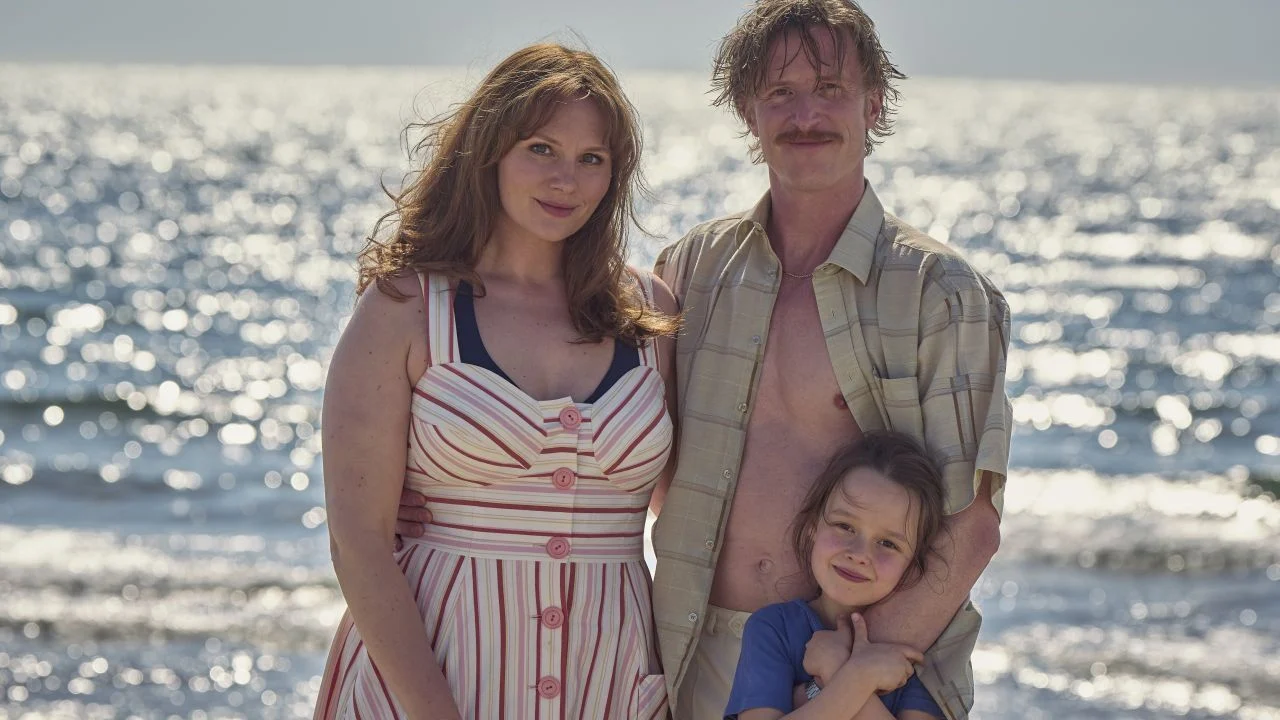
On a sunny vacation in Italy, it just seems as if everything is fine between Cornelia (Rosalie Thomass) and Werner (Golo Euler).
Werner is a complete asshole, but at the same time he is also driven by the promise of prosperity of the 1980s that was sold as universal – and if that doesn’t come true always and everywhere, then there has to be someone to blame, or even better, someone to blame. “I’ll never get a high position without a presentable woman,” he says, exposing his own inability; But Cornelia still has to suffer because she has to get on the scales every morning under his supervision. In the film’s only sex scene, he seems to be getting his money’s worth, but even that doesn’t mean that he stands by his wife on the outside.
“Lies about my mother” always refers beyond the specific childhood memories to a society-wide reality that is particularly oppressive from a female perspective. Juliane Köhler, on the other hand, allows for less ambivalence as Grandma Martha – the “Nowhere in Africa” star instead secures a place in the cinema pantheon of absolute horror mothers-in-law! Already with her first sentence – “and was it worth it, the big trip, it was expensive enough for my Werner” – she practically played through the passive-aggressiveness; and with the best will in the world you couldn’t imagine having a single coffee chat with her (let alone living under a farm roof with her like Cornelia).
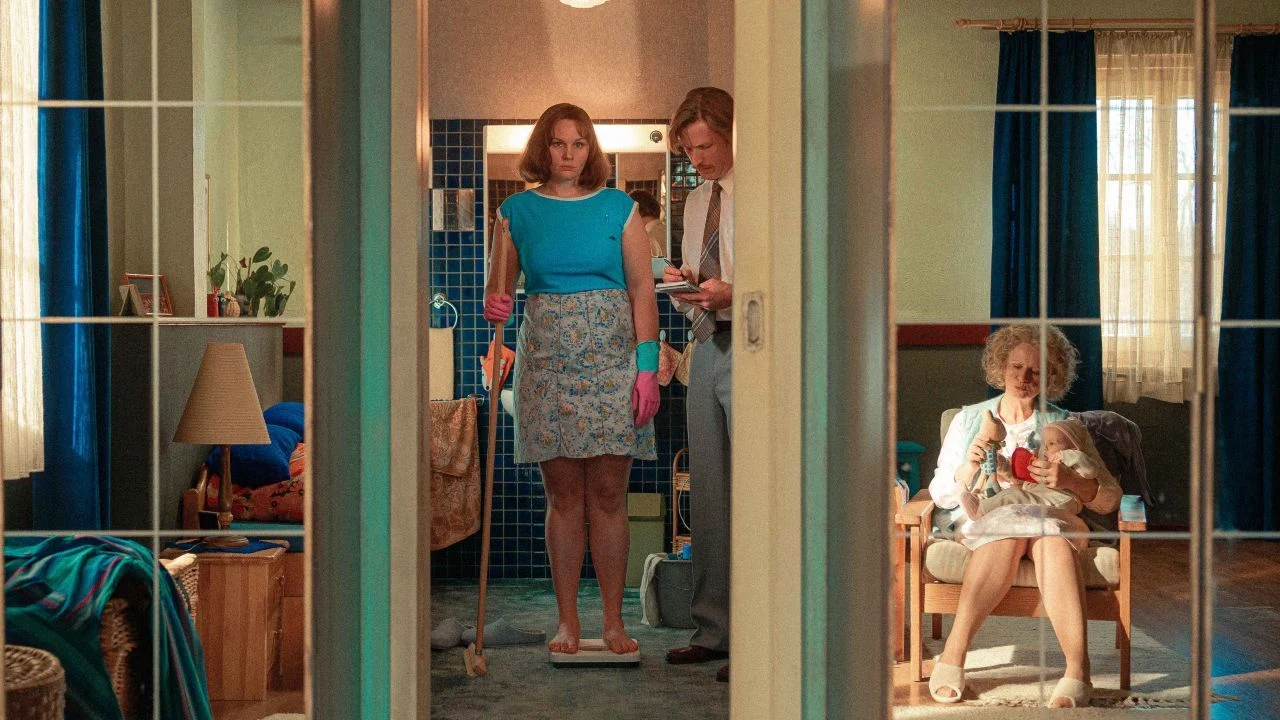
In a single shot, Aron Lehmann sums up all the oppression of the 1980s!
The most controversial role – in the novel and in the film – is actually daughter Ela. She repeatedly breaks the fourth wall and quotes information or statistics about the role of women in the eighties to the audience. It should be clear from the pages of the book that we are looking at the events from the eyes of a child, but at the same time the adult author is also speaking to us with her current knowledge and reflections. Aron Lehmann and his leading actress Rosalie Thomass, who was responsible for the script, have scaled back this device, but it still occurs – and opens up an exciting second level on the screen, even if it sometimes sounds a bit dry when Ela suddenly thinks about the Latin origin of the word “family” (the man’s entire household including all slaves).
Rosalie Thomass (“Best Time”) is probably THE driving force behind “Lies About My Mother” not only because of her second screenplay work after “Hunting Season” – as an actress she also takes great care to ensure that her character is neither reduced to a mere victim nor that her definitely existing weaknesses are glossed over (in a particular moment of overwhelm she even threatens to commit suicide in front of her daughter). I almost fell into the old film criticism trap again of automatically describing Nicole Kidman’s larger nose in “The Hours” or Charlize Theron’s paler, wrinkled skin in “Monster” as “courageous” performances. The fact that it at least occurs to you that it requires a certain amount of courage to show yourself on the screen with “that many kilos” may also reveal at the same time that we as a society have not come nearly as far as we might like to believe in the past 40 years.
Conclusion: “Lies about my mother” is, even as a film, an often painful but all the more powerful liberation.