
Who can look at the sun the longest? How long can you stand it when someone else sinks their teeth into your skin or shoots paintball balls into your bare torso? In “Oasis” Jannis Lenz shows a series of disturbing tests of courage, rituals and children’s games. That means: you can hardly talk about children anymore. They are teenagers plagued by insecurity, anger and lack of support. So they test in new ways how they can push their existence to the limits. Somewhere between compensatory behavior and the desire for ecstasy. What is the body? What does it mean to exist in this world? Such fundamental philosophical questions resonate.
But the characters in “Oasis” don’t chew through dry, academic discourses; they want one thing first and foremost: to feel. And this works best in your own little kingdom, far away from other people who either wish them harm or restrict their freedom. So the nearby forest beckons: Lukas (Florian Geißelmann), Andi (Anton Petzold) and Maja (Mathilda Smidt) meet there regularly to hang out and let off steam. Playing war with paintball guns is just one of their pastimes. They record their physical and psychological experiments with a camcorder. The rush and pain, but also their mutual affection, are captured on film.
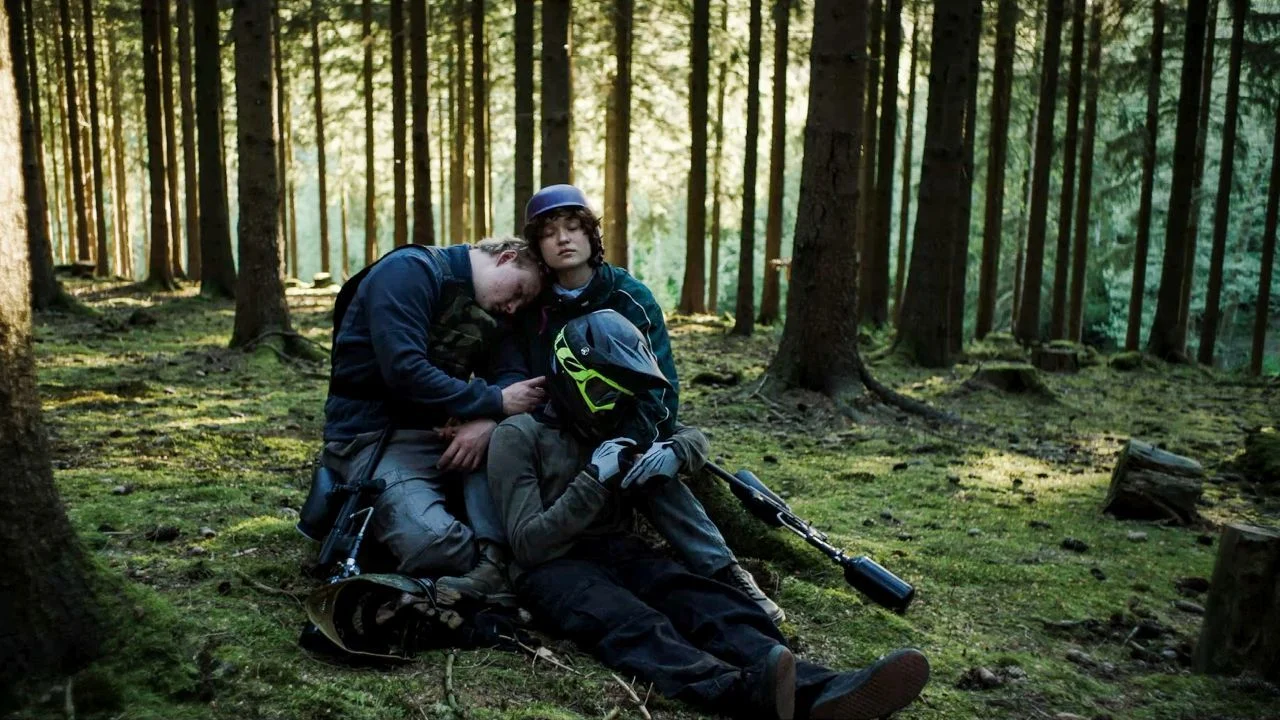
They support each other and they shoot at each other: Lukas (Florian Geißelmann), Andi (Anton Petzold) and Maja (Mathilda Smidt).
Jannis Lenz stages such scenes in haunting images. Even if the characters are just sitting on the edge of the forest and a few wind turbines cast threatening shadows on nature. “Oasis” tells of a transition. In a kind of in-between world, the characters try out how to become part of a society. At the same time, people are obviously also practicing revenge fantasies. Do you even want to belong? Why should one care about conformity and reputation when there is so much mendacity and violence out there? Especially since this violence also pushes into the protected zone of the forest.
“Oasis” tells a story of bullying that takes on ever greater proportions. The script by Jannis Lenz and Alexander Dirninger doesn’t just create a psychogram of the young people. Parents are also targeted. Andi, or Andrew, as his real name is, is new at the school. Something bad seems to have happened before he moved. Now a secret nude photo of him is circulating. But that’s not all: In a counterattack, he threatened his classmates with death in front of a mobile phone camera. Now the parents are really going crazy. They are worried about their children and would like to throw the troublemaker out of the class themselves.
A viral video and its consequences
In this respect, Lukas and Maja become the only confidants for the newcomer. But things are boiling and seething in them too. In Lukas’ home, there are tensions with his father Martin (Godehard Giese), who works as a teacher at his son’s school. After their mother’s death, all sorts of repressed feelings stand between them. And it is quite astonishing how well “Oasis” manages to develop a universal parable from individual psychology. In addition to dealing with emotions in private life and toxic gender images that become particularly visible in the locker room after sports, “Oasis” is generally about how society deals with violence.
At school, protocol is followed. You get the authorities involved and organize coaching sessions and courses. You talk and talk and yet you don’t dare to put your own dark facets into words. You are constantly working on the consequences and enemy images, but less on the causes and roots. So how can a friendship or even just a simple coexistence between (young) people exist if it is constantly subject to a taboo? When you are constantly told what to think about others? Regardless of whether it is due to legacy issues from the past or a failed mediation in the present. How can you get through to the person and form your own opinion?
Brutal and sensitive at the same time
The narrative could perhaps have used a little tightening up here and there so that the escalation spiral actually seems as intense as the film would like. There is no question that Jannis Lenz has managed to create a moving, resonant film about a school dispute that gets out of hand. It’s especially moving because he shows such sensitivity in his brutal scenes. Wounds are touched carefully. You feel each other in pain. You acquire it in a playful way in order to experience the controlled loss of control. Acts of hurt are followed by hugs and caring gestures. It is precisely this exposed vulnerability and tenderness in violence that remains in the memory of “Oase”.
Conclusion: There are many films about violence among young people. But the way “Oasis” unfolds its conflict between the generations and delves further into the question of how people can meet each other without reservation is great and an uncomfortable film experience in the best sense of the word.
We saw “Oasis” at the Venice Film Festival, where it had its world premiere in the official competition of the Orizzonti section.