
After “The Father” and “The Son” there is not “The Holy Spirit” or “The Mother” – although the latter was even part of the trilogy of plays on which Florian Zeller’s first two films are based. His feature film debut “The Father” allowed viewers to experience the symptoms of dementia directly from the perspective of the main character. (A concept realized in the Netflix schizophrenic thriller “Horse Girl,” which, excitingly, had its world premiere at Sundance on the same day as “The Father” in 2020, but failed to achieve comparable success despite a stellar performance from Alison Brie.)
After Florian Zeller was rewarded with the Oscar for Best Adapted Screenplay and Anthony Hopkins as Best Actor in 2021, “The Son” followed the following year, which premiered at the Venice Festival but failed to score particularly well with either critics or audiences. While the title of the film suggested that it would deal with the depression of the teenage son of a blended family, it instead focused on the father’s completely misguided reactions. And so instead of “The Mother” comes “Bunker” as the Frenchman’s third feature film, this time dealing with social rather than neuropsychiatric illnesses.
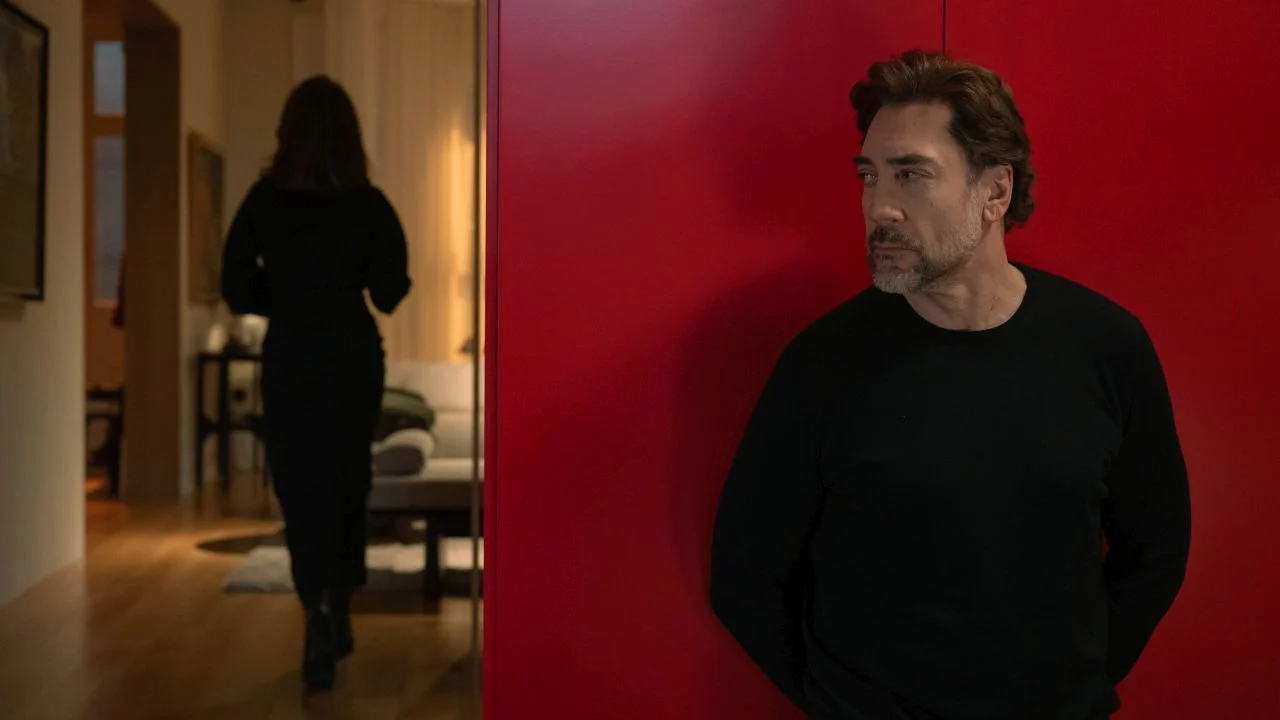
It’s only at first glance that things are rosy between Miguel (Javier Bardem) and Sofía (Penélope Cruz).
Miguel Moreno (Javier Bardem) is a respected Spanish architect who now lives in London with his wife Sofía (Penélope Cruz) and two daughters. When his neighbor Toby (Stephen Graham) punches a hole in the wall that separates their properties one day, a small war threatens to break out. It could make your heart bleed when Toby is bombarded with arguments as to why his request for a window in his studio doesn’t comply with planning regulations. Only when the angry architect takes a breath does the neighbor finally get the chance to explain himself.
The obviously working-class man would just like some natural light in the dim garage he has to convert into his home. Doesn’t the sun belong to all of us? Unfortunately, the newly minted BAFTA winner (for the Netflix sensation “Adolescence”) is given little opportunity to further develop his character. Instead, like so much of the script, it all serves as a rather clumsy metaphor for the predicament Moreno is currently in.
Bunkers are the new pyramids
After extensive confidentiality agreements, the architect is made an offer for a profitable project: he is supposed to build a huge survival bunker in Hawaii for the tech billionaire Andrew (Paul Dano). After a lengthy back and forth, driven primarily by Moreno’s wife, who acts as a moral authority, there is a Zoom meeting with the Silicon Valley entrepreneur. In this one, Moreno is also cut off when he tries to voice his objections – exactly as he had done to his neighbor shortly before.
It’s not about listening, it’s just about convincing the other side; communication characterized by a clear power imbalance and thus a hierarchy, such as that seen in a pyramid. Shortly before, Moreno had described these influential tech bros as modern-day pharaohs, the god-kings of ancient Egypt who not only wanted to rule, but also wanted to become immortal. The analogy works, at least for the press audience in Venice, where “Bunker” was shown the day after the 4-hour documentary “Musk” about Elon Musk.
Penélope Cruz with little space
Depending on how closely you count, “Bunker” is at least the ninth on-camera collaboration between the Cruz/Bardem couple. Zeller benefits from the genuine intimacy of the two, whose years of familiarity with each other are evident in every casual touch. At first, Moreno and Sofía form an intellectual dream couple, laughing at the same things in an art gallery with matching angular glasses. However, Sofía’s character remains so underdeveloped overall that she could almost become part of Miguel’s carefully curated interior design – if it weren’t for the conflict over the bunker.
While her husband is offered big projects in London, her own professional development opportunities are limited. Despite years of experience as an editor and head of the fiction department in Madrid, in England she is only trusted with world literature. Instead of working with authors, she works with translators. Only a 30-year-old writer (Patrick Schwarzenegger) from the USA, whom she looks after during his stay in London, breaks her monotonous everyday life.
It’s a little frustrating that Miguel gets an interview scene where he gets to talk about the relationship between light and space in his work, while his wife’s professional life is fobbed off with a portrayal that barely rises above the level of publishing work in the “Fifty Shades” sequels. “Yes, this version is much better” – the dialogue in the office of a publication house doesn’t go into any further detail. And that despite the fact that Penélope Cruz is currently considered a hot candidate for the coming Oscar season thanks to her appearances in “La Bola Negra” and “The Invite”.
Play with expectations
In addition to family drama and theoretical discussions about a possible impending apocalypse, “Bunker” – especially in comparison to “The Father” and “The Son” – also has a surprising amount of humor, which is expressed, for example, through absurdities in the alarm system industry. At times elements of a thriller emerge. When the Morenos’ cat disappears – which gets a fantastic shot right at the beginning in which its pensive look rivals the current reigning film cat queen Tonic (“Caught Stealing”) – Miguel assumes the worst. The neighbor becomes the main suspect; after all, people from simpler backgrounds apparently have nothing else in mind than resentment towards the rich.
The film music also takes up the game with the unknown and thus contributes to an increasingly paranoid atmosphere. The acoustic accompaniment by Oscar winner Volker Bertelmann (“All Quiet in the West”) is reminiscent of the score from David Fincher’s “Gone Girl”. There, too, there is an ambivalence between calm, warm tones and an underlying darker atmosphere. A melodic warning that something is probably very wrong beneath the idyllic surface.
Conclusion: Although the film’s metaphors and foreshadowing are sometimes a bit clunky, it is not unexciting to follow the developments in “Bunker”. At a time when social mistrust is greater than ever, there is a need for films that convey their message of building bridges not through flowers, but with a wooden hammer.
We saw “Bunker” at the Venice Film Festival, where it had its world premiere as part of the official competition.