
When the Netflix logo appeared on the screen at the Venice Film Festival, a number of journalists present briefly booed. This has become common practice at major festivals around the world for several years now, as a statement against streaming and in favor of cinema. Of course, this is a rather hollow gesture, after all, a film is shown afterwards that probably wouldn’t have existed without the Netflix money – and it’s better that way than not at all. But in this case it still hurt quite a bit when, as the credits rolled, I remembered that it will “only” appear on Netflix (only two months after its world premiere). After all, “Possible Love” is one of those films where, as soon as you leave the house, you start writing to your good friends back home that they absolutely have to see it…
… on the big screen! After all, eight years after “Burning”, for my FILMSTARTS colleague Daniel Fabian no less than the best film of the last 15 years, the South Korean master director Lee Chang-dong (“Poetry”) once again delivers a work that, with its running time of 165 minutes, requires a certain stamina and concentration that may not be quite as easy to muster on the couch at home as in the silence of the dark cinema. But I can’t do more than beg you at this point: “Please do it anyway!”
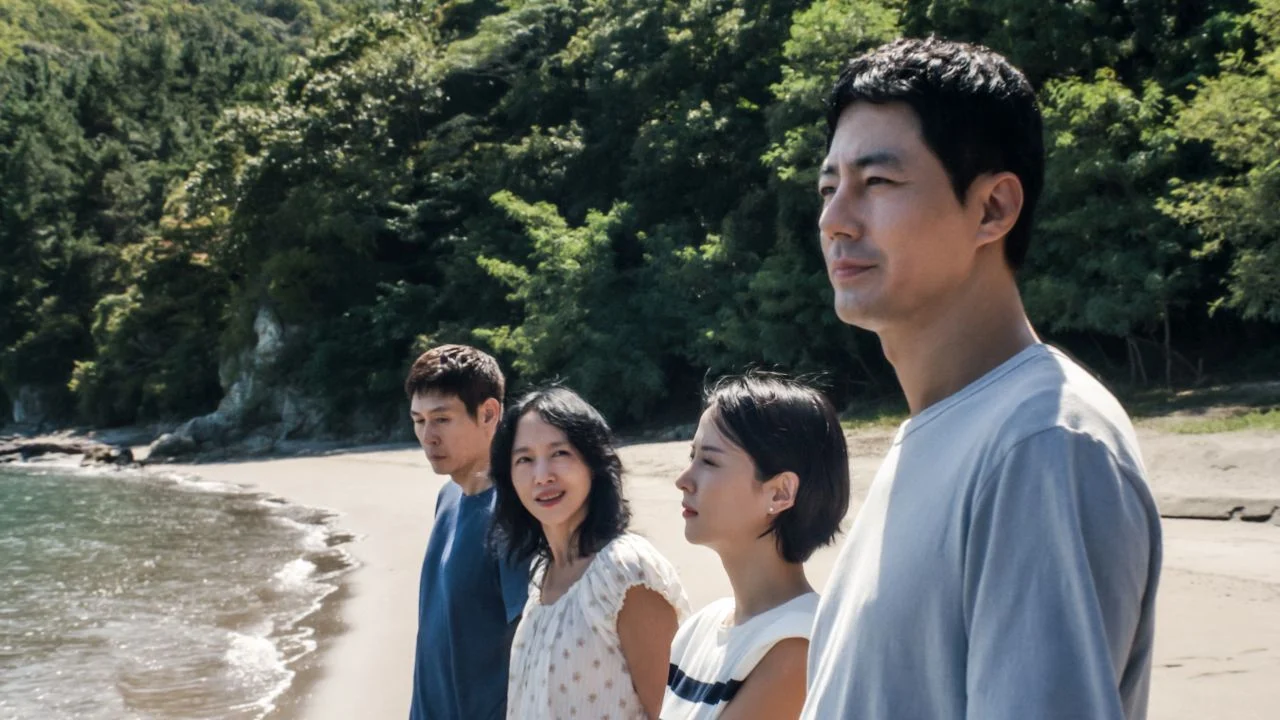
Two couples on a short vacation by the sea together – but the gap between them still seems insurmountable.
The worker Mi-ok (Jeon Do-yeon) does everything for her husband Ho-seok (Sul Kyung-gu), who not only lost his job as a welder in a large company two years ago, but was brutally beaten and imprisoned by the police in response to a strike that was simply declared illegal. The taciturn Ho-seok refuses therapy – and in the evenings he needs a lot of alcohol in order to be able to at least get some sleep with his remaining pain. Then Ye-ji (Cho Yeo-jeong), who is around the same age, becomes aware of the couple:
The independent documentary director, who is married to the very rich Sang-woo (Zo In-sung), is planning a film about the problems of the working class – and has found a willing protagonist in Mi-ok, even if Ho-seok initially resists. The two couples also do more and more things together outside of filming; dinner is eventually followed by a short vacation in Sang-woo’s family villa by the sea. But how far can friendship and solidarity really go if at the end of the day only one of the couples drives home in a super expensive Porsche sports car…
Neither “Burning” nor “Parasite” – and that’s a good thing!
When Ye-ji briefly leaves her bag behind at the first meeting in a café, Mi-ok immediately grabs her cell phone to use an app to check the purchase price of the luxury brand leather item. Without any malicious ulterior motives, but simply out of pure curiosity. It’s just a world she didn’t know before. So she keeps taking photos of the fancy food – even the “simple” breakfast that Sang-woo and Ye-ji probably get served every morning by their private chef. Ye-ji, on the other hand, explains to her husband at one point in the car that, as a good documentary director, “she has to love the people in her films.” A strange formulation, but at least the title speaks of a “Possible Love”.
So something is brewing here between the rich and the poor – and anyone who has seen “Burning” could definitely get the (wrong) ideas: after all, it also began as a calm, elegiac study of everyday life, only to suddenly turn out to be a highly exciting and incredibly intense psychological thriller halfway through the running time. And then “Parasite” star Cho Yeo-jeong is also on board. But Lee Chang-dong doesn’t need a big bang with his relentless reckoning with the estates, quite the opposite. His feel for details and dialogue is so mercilessly precise throughout the film that even in the finale it only takes a few small gestures to get to the heart of everything that is still needed.
Funny, touching, exciting, rousing
In any case, despite the impressive running time, no moment is superfluous. Even if you initially naively want to believe that it must be possible for a friendship to develop between people with different bank accounts, Lee Chang-dong explains with incomparable precision why this is probably not the case. By the way, he shows exactly the unconditional love for his working-class protagonists that you might never really believe in Ye-ji. The flashbacks to the time of the strike and the police operation that ended everything, after which Ho-seok despises his colleagues who let him down even more than the thugging state power, speak a clear language here.
Nevertheless, “Possible Love”, which is played brilliantly across the board, is anything but a dry drama. Lee Chang-dong always lets a wonderfully playful, dry sense of humor shine through – and in some scenes, he unpacks absolutely crazy ideas that you wouldn’t expect from anyone else: These include even seemingly banal moments like a quick swim in the sea – or the (admittedly rather unsuccessful) attempt to hit the toilet while standing up to pee. You’ll definitely never be able to get sequences like this out of your head for a long time afterwards. Like the catchy characters, they would certainly stay there until 2034 if Lee Chang-dong takes that long again with his next film. But maybe there’s still some of the Netflix money left.
Conclusion: The masterpiece of the century “Burning” is one of those films that leaves you wondering what the hell is supposed to happen next. With “Possible Love” and his second absolutely brilliant five-star masterpiece in a row, Lee Chang-dong delivers an impressive answer.
We saw “Possible Love” at the Venice Film Festival, where it had its world premiere as part of the official competition.