

Wim Wenders (“Perfect Days”) is one of the few filmmakers who still knows how to do something interesting with 3D. The spirit of optimism sparked by the “Avatar” boom has now died down a bit, and 3D often functions as just a mediocre gimmick to add a hefty premium to ticket prices. But there is another way! Wenders’ 3D films show that the Palme d’Or winner (for “Paris, Texas”) has carefully considered how to use stereoscopy as an essential part of the film experience. In the documentary area, “From Inside Out – The Architecture of Peter Zumthor” is Wenders’ third full-length 3D film – and even if you could theoretically watch it in 2D, the magic would probably be lost.
After “Pina” and “Anselm”, this is again about art about art, a hybrid essay that allows the medium of film to enter into dialogue with other formal languages. This time, as the title suggests, Wenders is dealing with the Swiss architect Peter Zumthor, who was born in 1943, with whom he was able to work together on the short film “Notes From A Day In The Life Of An Architect” for the Venice Biennale in 2013. Zumthor has designed numerous impressive buildings and rooms in his long career, including the thermal baths in Val, the Brother Klaus field chapel in Wachendorf in North Rhine-Westphalia and the David Geffen Gallery at the Los Angeles County Museum of Art. Their construction and new building now forms the final highlight in this film, which is not short on outstanding points.
Rooms upon rooms, inside and outside
So Wim Wenders has set out on a journey again and is staying true to his brand. He moves curiously from place to place and through different countries to look at all the buildings between art and functionality, explore their appeal and stage them on film. As in the director’s previous 3D documentaries, he achieves an incredibly impressive play with the sheer presence and aura of the objects, facades, components, the draped people and landscapes. These are three-dimensional, tactile photographs that focus on the materiality of things, including the typical layers in the architect’s buildings, which Zumthor himself compares to a fabric.
“From Inside Out” would also be an interesting name for the cinema, which Wenders questions about its spatial characteristics. The surface of the screen becomes space, the space becomes a surface, perception is turned inside out and recombined. Wenders lets his audience look through architectural openings and the window of the screen and at the same time exposes them to the illusion of becoming part of these foreign spaces and of being able to enter them. Particularly enhanced by the 3D effect.
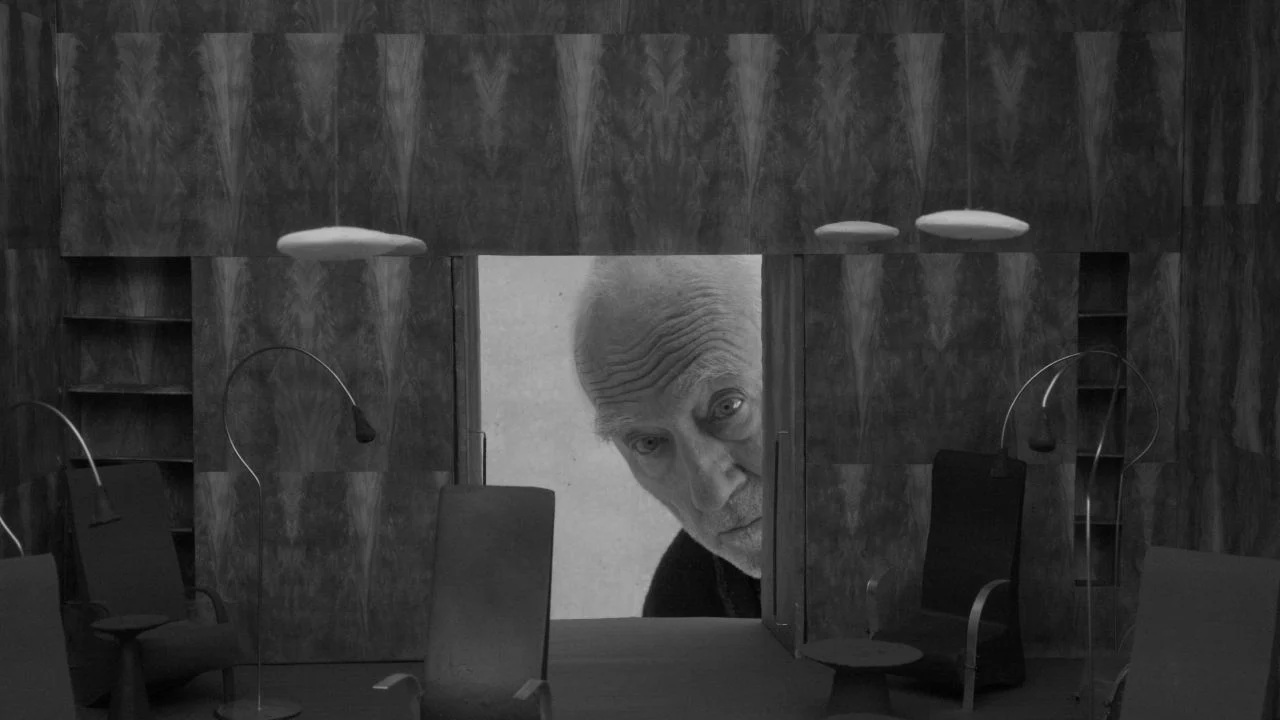
Peter Zumthor looks into one of his buildings – and the transitions from real buildings to paper models are particularly spectacular in 3D.
There are no hasty cuts or quick movements here, as can often be seen in post-converted Hollywood blockbusters today. Instead, Wenders and his camera supervisors Franz Lustig and Sebastian Cramer give the audience enough time to immerse themselves in these spatial images, to savor the width and depths, to look at the mountains and valleys as well as the gigantic buildings. Or you can lose yourself in fascinating shots such as a glass facade behind which you can see the architect, while trees are reflected in the window front and make the hidden space appear.
This is visually extremely impressive! Even as the camera floats in the thermal water just above the surface, face to face with the floating guests, while the overwhelming, stacked walls behind them rise into the sky. Or when the camera, together with the author Siri Hustvedt, enters the interior of the Norwegian witch memorial in Vardø, where the wind howls eerily through the openings and the walls wobble and vibrate menacingly.
In the museum with Werner Herzog
However, “From Inside Out” always weakens when the film no longer relies solely on such contemplative moments and impressions. He doesn’t seem to quite be sure whether his architectural visits and the shots of the inside and outside are in themselves full-length and carry the film. So he tries transitions and interludes. Old archive images and prominent guest appearances are included. In addition to Siri Hustvedt, the filmmaker Werner Herzog (“Bucking Fastard”) will appear at the art museum. A charming surprise!
There are always scenes that oscillate somewhere at the interface between documentary and feature film. They theatricalize the space, filling it with human life, for example with songs, musical instruments or even a dance performance in front of a pane of glass. There is also a repeated babble of voices, often in a mysterious whisper.
Wim Wenders is haunted again
As in his earlier works, Wenders is also interested in the ghostliness of these spaces in which he fades over time. Once, an old family photo from the early 20th century graphically shows semi-transparent ghosts haunting a house. One could say charitably: There is always something going on at Wenders. One can rarely say what he will show next, what ideas he will unpack to embellish his Zumthor study and let people and buildings communicate and perform with each other. Even away from the living spaces and houses he visits.
As playful as it seems, it unfortunately also often contains a certain involuntary humor in its gravity and pathetic dreaminess – especially in the fragmentary character, which neither allows a closer connection to the characters and realities of life that appear nor enough space for a real aesthetic stubbornness in these short scenes. Wenders seems to be searching not only for the elemental and innermost, but also for the enchanted and strange that resists or evades pure matter, human structure and talent. His scurrying human protagonists become mirrors of this search, but he too often distracts from the real star of his film.
Peter Zumthor’s biography is very brief
It is therefore a particular shame when one sometimes gets the impression that “From Inside Out” explores Peter Zumthor as a person quite superficially. For example, you hardly learn anything about his life. In his Anselm Kiefer portrait, Wenders recently succeeded comparatively better in mediating between the appreciation of art and the artist’s biography, thus creating access to his life’s work. Although this film also struggled a bit with all of its directorial digressions. This time the sight of the buildings seems too overwhelming and the abundance of stations too great to not get bogged down at some point.
Conclusion: Wim Wenders once again produces impressive 3D images that make the power and atmosphere of Peter Zumthor’s architectural spaces tangible. Afterwards, you’ll want to travel to these places yourself, which is probably the biggest compliment you can give the film. Even if “From Inside Out” ultimately remains too erratic as an artist portrait.
We saw “From Inside Out – The Architecture of Peter Zumthor” at the Venice Film Festival, where it celebrated its world premiere out of competition as part of the official program.