Before writing the rest of the review of Danny Boyle’s “Ink”, I just wanted to take a quick look at how the film was otherwise received after the press screening here at the Venice Film Festival – and three of the first five comments all contained the same “The Wolf Of Fleet Street” joke. But now I’m just stubborn and say: “The headline above this article remains as it is!” Yes, the reference to “The Wolf Of Wall Street” is anything but original, but it fits like a glove. It’s no coincidence that in an article we named Martin Scorsese’s stock market criminal biopic the most entertaining 3-hour film of all time, because despite all the moral scruples, it’s simply incredibly fun to accompany Leonardo DiCaprio in his tour-de-force performance as a stock trader asshole.
It’s a similar story with “28 Years Later 2” star Jack O’Connell as Larry Lamb, the legendary editor-in-chief who turned the struggling British tabloid The Sun into the best-selling newspaper in the world within just a year of taking over from the infamous Rupert Murdoch (Guy Pearce). His method: Finally give the working people what they really want to read – and absolute infamy at that. Following him as he rises from ridiculed outsider to undisputed king of Fleet Street (the historic center of the British newspaper industry) between November 1969 and November 1970 is like a classic underdog story on steroids – and in the whirlwind of success it would be easy to miss what was actually done on the way to the top.
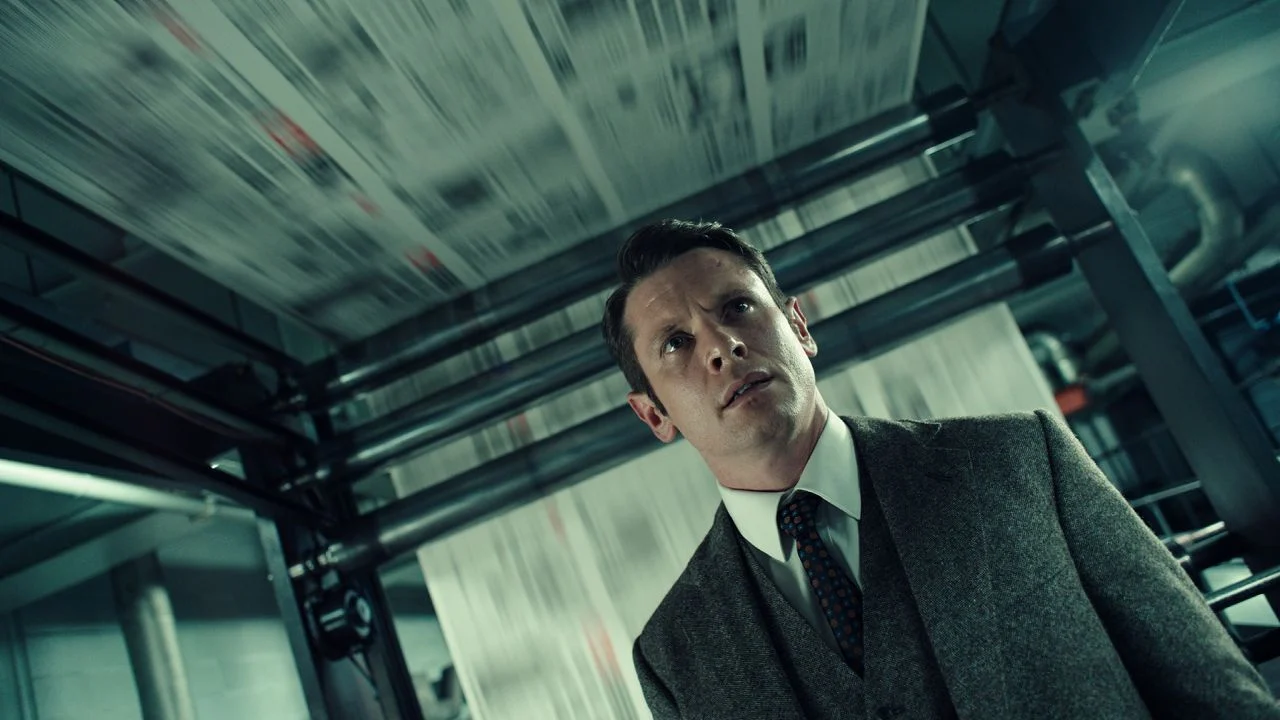
After being appointed editor-in-chief of The Sun, Larry Lamb (Jack O’Connell) has only one goal – to become the absolute number 1 best-selling newspaper.
First of all, there is Rupert Murdoch, who has been branded the grave bearer of journalism since Fox News was founded in the USA (1996), who is pushing the team to go even further – right down to the angle of inclination of the title lettering, which in his opinion should lean as far forward as possible in order to radiate additional dynamism. An aesthetic gimmick that Danny Boyle, who is never at a loss for another visual detail – from “Trainspotting” to “28 Days Later” to “Slumdog Millionaire” – also adopts in his film: the camera repeatedly leans to the side and almost gives the audience the feeling of standing on the planks of a boat on a choppy sea…
… and that’s just one of many stylistic devices that the director uses to consistently keep the tempo up to speed. You really wouldn’t think of it as a filmed play. But that is exactly the case. James Graham not only wrote the award-winning play in 2017, but now also wrote the script for the film adaptation – and his straightforward, pointed dialogue fits perfectly into Boyle’s usual hyperactive production style. Like Lamb, you get carried away by the pace, by the success, by pushing the boundaries, just a little bit further. It’s hard to resist rooting for The Sun team, which works in a shabby office, to show the established, self-righteous editorial teams at The Daily Mirror & Co. where the hell is.
Even Rupert Murdoch is overwhelmed
Surprisingly, Rupert Murdoch is not exposed as the mastermind. Instead, the Australian mogul starts out as a thoroughly convinced disruptor who eventually loses control of what he has set in motion here. After all, it was initially about doing things differently – daring to do something new, no matter in which direction. This is how Lamb’s lover Jules Davies (Claire Foy as a fictional character based on the real Joyce Hopkirk) ended up at The Sun to create a women’s page – not one with cooking and crocheting, but with sex tips on how SHE can get her way in bed. Compared to the competition, it’s downright feminist – but when it turns out that naked breasts on page 3 are even more attractive, then that’s it for the progressive attitude. The revolution eats its children, and this obviously also applies to the newspaper market.
In this respect, “Ink” is also an astonishingly apt lesson in how the desire for success destroys all conceivable ideals. When the wife of Murdoch’s assistant is kidnapped, The Sun breaks all standards of active crime reporting at the time – and even prints her personal, handwritten letter from captivity for the whole nation to read. Murdoch, visibly shaken, tries once again to whistle Lamb back – but he only points again to the chart, which was not yet electronic at the time but was hand-stitched with knitting needles, which records the paper’s unstoppable rise to the top. Then, as a spectator, you slowly start to loosen your fingers. After all, it’s already rumbling in your stomach that a development is being set in motion that will lead to a global flood of fake news 50 years later. It wouldn’t have been necessary for Danny Boyle to explicitly show pictures of Donald Trump, Elon Musk and Andrew Tate before the credits.
Conclusion: After “The Wolf Of Wall Street”, “Ink” once again proves how much fun it can be to watch particularly immoral people at work.
We saw “Ink” at the Venice Film Festival, where it had its world premiere as the opening film and part of the official competition.