
“Where the hell is Ratzeburg?” asks one of the characters in “Adams Acht”, a historical biopic that presents itself as a mixture of sports, political, love and social drama. Fans of rowing have known the answer since 1958 at the latest. Back then, the local rowing club in the small town in Schleswig-Holstein on the border with Mecklenburg-Western Pomerania completely unexpectedly won the German championship in the supreme discipline, the eight. The outsider team, which later became the myth of “The Germany Eight”, was trained by a man who had never competed in a single regatta as a rower. Nevertheless, over the course of the following years, he revolutionized the sport almost single-handedly: Karl Adam (1912–1976).
The attractively designed film was directed by director Hannu Salonen (“Oktoberfest 1900”), who otherwise works primarily for local television. He manages to present the competitions on the water in a thrilling way, even for laypeople. Instead of harmoniously characterizing one of the greatest sporting miracles of the post-war period and its architect, Salonen repeatedly gets lost in sideshows. In addition to the central sports story about the eponymous rowing team, he always tries to highlight the peculiarities of everyday social life in divided Germany during the post-war period and the Cold War, but remains far too superficial in describing the individual fates.
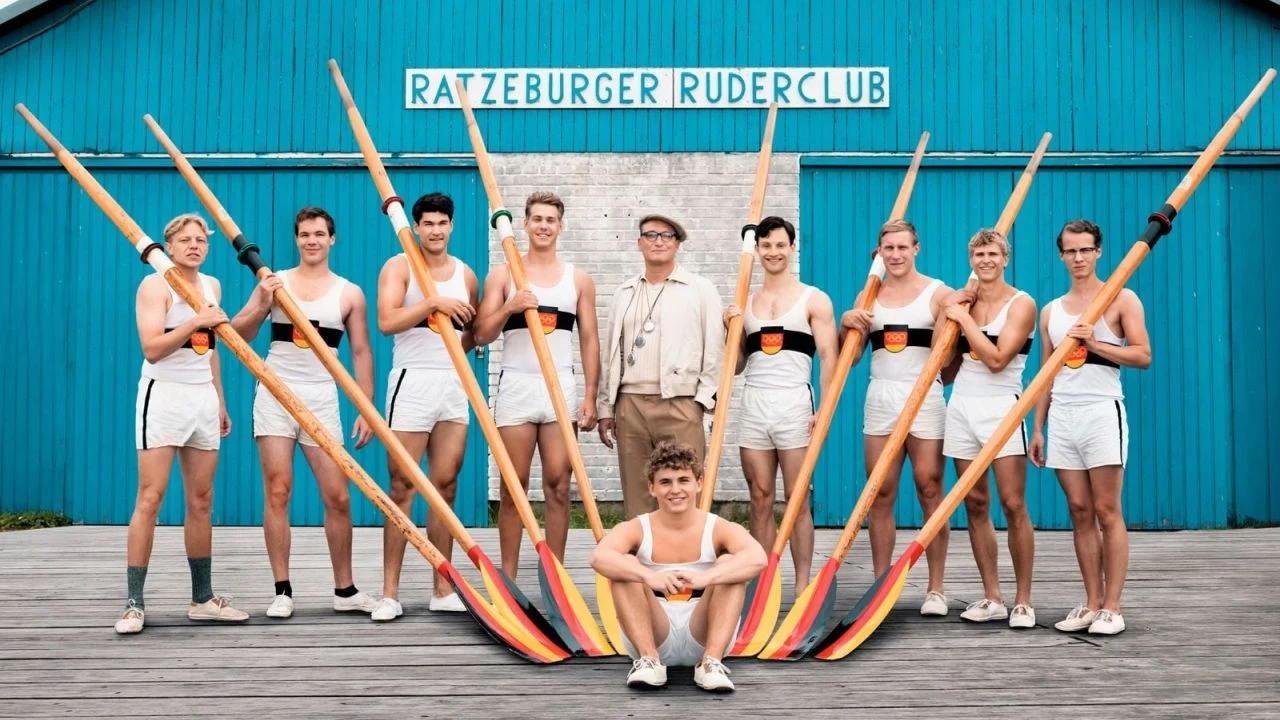
The legendary Germany eight is still one of the greatest miracles in German Olympic history!
Ratzeburg in the 1950s: Karl Adam (Oliver Masucci) works as a teacher at the local school. There he meets a generation of fatherless boys who don’t know what to do with their anger. The educator, who is constantly wrestling with the demons of his own past, tries to offer at least some of them an outlet and a perspective for their lives by getting them into rowing. Although his club can’t even afford decent boats, Adam’s innovative training methods, technical tricks and unconventional tactics quickly lead to initial success.
The officials of elite sports (including Axel Milberg and Heino Ferch), who initially smile at Adam and his protégés, soon realize that these underdogs from the provinces are Germany’s only chance of success at the 1960 Olympic Games in Rome…
Not exactly the most cinematic sport
Rowing itself isn’t a particularly screen-friendly competition – as we’ve seen recently in George Clooney’s “The Boys In The Boat”. After the start, the endurance athletes repeat the same movements over thousands of meters until they finally reach the finish line. As a rule, tension only arises shortly before the run-in. That’s why director Salonen repeatedly places close-ups of the straps in the oarlocks between the images of the struggling athletes, accompanied by crashing sound elements. In addition, there is the coach who is arguing with the heads of the association in the stands, as well as an audience that is still very hostile towards the German team at this point. In this way, it is actually possible to wrest an astonishing dynamic from the actually monotonous races – even if you know how the Olympic final in Rome ultimately turned out.
The fact that the competitions on the water seem so authentic is also due to the fact that the current offspring of the Ratzeburg rowing club actively support the actors in the boats. Restored original wooden boats were also used. In the countryside you can also feel the attention to detail in the costumes, vehicles and sets. The oppressive Cold War atmosphere in the border area at the time comes across as believable throughout, despite the lighter moments sprinkled in. The crucial weakness of the film, meanwhile, is the unsuccessful attempt to link all the storylines, each of which would already provide enough material for their own film, into a coherent whole.
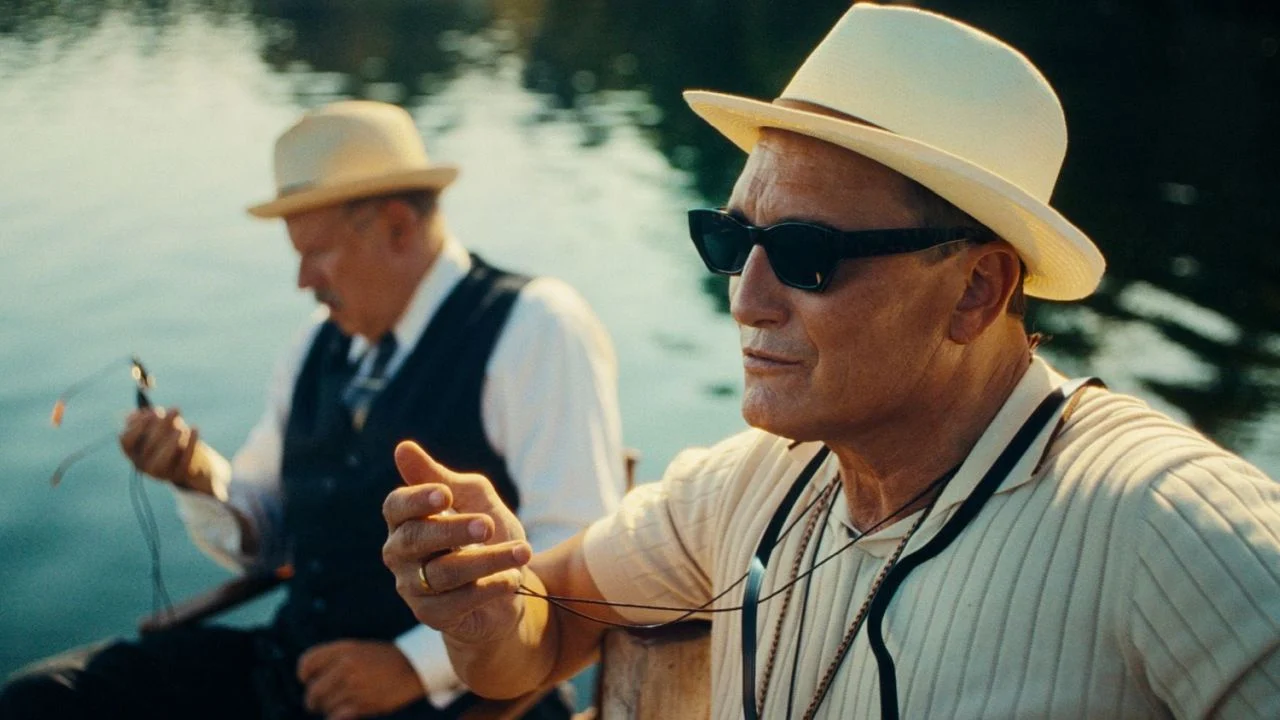
Karl Adam (Oliver Masucci) also revolutionized rowing technically!
In addition to his efforts to improve the team, the focus is on Adam’s personal struggle with his own past. However, there are facts in the trainer’s real life that the biopic deals with, but subjects them to serious smoothing over. In “Adam’s Eight,” the title character is consistently portrayed as someone who was critical or at least skeptical of the Nazi regime. The fact that in real life he joined the Nazi thug group SA in 1933 remains unmentioned – and his entry into the NSDAP just a few years later is only briefly hinted at. Already with the opening sequence some dark spots are at least lightened.
We first meet Adam, played by Oliver Masucci with a combination of charisma, cunning and melancholy, in 1947. As part of a trial before a handful of lay judges, he has to answer for his time as a teacher of mathematics, physics and physical education at an elite NSDAP boarding school. At the end of the very short hearing, Adam is issued with a clean bill of health as a safe follower. His activities at the Napola in Bensberg, Bergen, shown in retrospectives, support this, as they are limited to his work as a boxing trainer.
Glided along the surface
It is possible that the real, apparently highly intelligent man actually had a change of heart at some point due to his experiences. However, we are not shown conclusively how this could have happened, although there would have been opportunities for this in the film. Because part of Adam’s team consists of the sons of old fascists who have apparently adopted their fathers’ views. Furthermore, the SS officer who once forced Adam to personally select which of his students were sent to the front is now breathing down his neck as a high-ranking official at the German Rowing Association. Heino Ferch embodies this role, which doesn’t have much character depth, at least beautifully.
The story of Hans Lenk (Felix Kammerer from “Nothing New in the West”), who later became successful as a philosopher and university professor, deserves a film of its own. The man in love with a young mother (Svenja Jung) in the eastern zone not only works hard to be successful in the rowing boat and in his studies, but also takes on both political systems. But even this actually exciting passage remains weak due to all the other plot points that need to be told and sometimes even disrupts the flow of the sports plot. The difficult love of another rower (Leonard Kunz from “The Tiger”) for a local “superior daughter” (Stephanie Amarell), which is also pressed into “Adam’s Eight”, ultimately ensures that the film often seems hopelessly overloaded.
Conclusion: While “Adam’s Eight” is at least visually and atmospherically convincing, it tries to squeeze too many plot elements into it. A more focused – and more honest – concentration on the already sufficiently complex and multi-layered real life story of the coaching legend Karl Adam would certainly have benefited the film.