
Actually, you should stop reading the following review of “Strange Harvest” and don’t bother with anything else. Stuart Ortiz’s film could at least have the desired effect until the end credits, which are actually superfluous in the context of the concept.
Ortiz’s first solo directorial effort, best known as part of the independent filmmaker duo The Vicious Brothers (“Grave Encounters,” “It Stains The Sands Red”), which was active between 2011 and 2017, perfectly imitates the true crime format, the impact of which depends largely on the impression of authenticity. Creating this impression in today’s media age, in which the fictionality of a film can hardly be hidden permanently, is of course much more difficult. However, “Strange Harvest” makes things even more difficult for itself by undermining its own documentary credibility at crucial points. So “Strange Harvest” ultimately stumbles over its own feet. But it’s still enough for an entertaining hour and a half.

After a break of several years, the masked serial killer Mr. Shiny (Jessee J. Clarkson) is suddenly back.
The plot revolves around the nearly two-decade-long hunt for a mask-wearing serial killer named Mr. Shiny (Jessee J. Clarkson). As detectives Joe Kirby (Pete Zizzo) and Lexi Taylor (Terri Apple) discover with horror during a routine mission, it has returned after a long break: a family of three was tied up, draped under a strange symbol and slowly bled to death.
Kirby and Taylor immediately recognize the strange symbol: The killer, who doesn’t leave the slightest clue at the crime scenes, was already active 15 years ago and is now starting again – so there will soon be more opulent murder tableaus to examine. One of the highlights is likely to be a swimming pool secured with barbed wire and broken glass, where a victim was slowly being sucked dry by leeches. Only a coincidence leads the two increasingly desperate investigators, who are reaching the limits of their mental endurance, on the trail of the killer, who seems to be connected to supernatural powers…
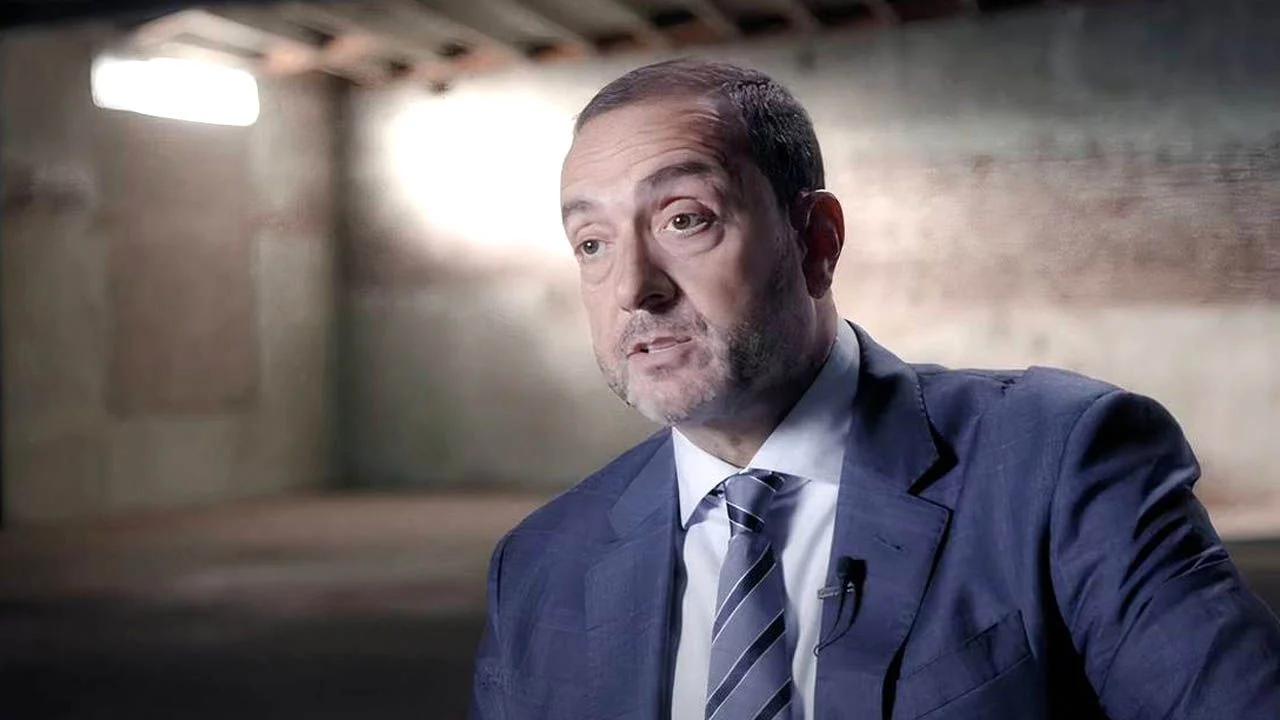
Detective Joe Kirby (Pete Zizzo) becomes increasingly desperate about the case.
When you watch the end credits of “Strange Harvest,” you can’t help but wonder how this film would have been marketed at the height of exploitation cinema and what depth of impact it could have had in this era. At a time when sophisticated distributors not only knew how to address sensationalism with sophisticated advertising campaigns, but also had no qualms about completely pulling the rug out from under their audience. Films like “Faces of Death” (1978) or “Cannibal Holocaust” (1980) also had an immense impact because the audience was consistently led to believe in advance that reality was being depicted on the screen. This type of marketing often gave rise to modern myths that would persist for many years to come.
“Strange Harvest” is unlikely to be able to pull off a comparable deception today. Formally, the film implements its play with reality remarkably consistently. The well-staged mockumentary faithfully imitates the true crime format popularized by Netflix a few years ago. The actors, whether the protagonist duo or peripheral figures such as acquaintances of the victims or eyewitnesses, always appear as if they have been taken from everyday life. The mix of interview scenes, videos from various cameras and crime scene photos, often accompanied by appropriately lurid but pointed music, captures the aesthetics of its role models to the point. Someone has definitely done their homework here, everything is almost 100 percent correct.
The film doesn’t just sabotage itself at the end
Only almost, because two points scratch the credibility of the whole thing. On the one hand, the crime scene photos and video recordings shown are very explicit and splatter film-like, even for this less squeamish genre. You’ll probably have to look for a long time to find a real true crime documentary that depicts children’s corpses. On the other hand, “Strange Harvest” suggests right at the beginning that what follows is a case that has received almost no media attention. This is hard to imagine considering the absolutely spectacular murder cases and the fact that the events in the last third have a supernatural touch à la HP Lovecraft. Anyone who still gets involved in the documentary illusion has to experience how the film lets itself out of breath at the end with a classic end credits in which all the actors are listed and which is also accompanied by inappropriate dance pop.
This seems surprisingly despondent – especially given the fact that “Strange Harvest” is otherwise relatively uncompromising (in a haunting, very hard scene, a teenager becomes the victim of a murder attempt in front of a running webcam). You could have made a conventional feature film there. But what remains is an entertaining crossover of police thriller and slasher, which is sometimes reminiscent of 90s hits like “Seven”, especially thanks to its extravagant, gruesome crime scenes.
Conclusion: The first solo work by indie filmmaker Stuart Ortiz is unabashedly detailed when it comes to violent scenes, but stumbles over minor implausibilities and doesn’t fully follow through with its well-staged true crime concept. It could have turned into something big, but it was still enough for an entertaining evening.