Every dinosaur counts! Instead of surprising his audience with the sheer number of prehistoric giants – like the recent “Jurassic World” blockbusters – “It Follows” mastermind David Robert Mitchell really came up with something for each species of his diverse dinosaur cast. This extends to two copulating longnecks, with whom the protagonists shoot a souvenir polaroid – fight for survival or not. The director came up with the idea for “The End Of Oak Street” when, while walking through the neighborhood, he suddenly imagined a dinosaur rummaging through one of the trash cans. And in fact, the giant reptiles, which have been used increasingly over the last 30 years, have a completely different impact when they appear not in a science fiction environment, but in the living room at home.
Nevertheless, there is an artificial distance from the action, after all, “The End Of Oak Street” does not take place in the present, but – certainly not by chance – in 1982, the same year in which “ET – The Extra-Terrestrial” was at the top of the cinema charts by a gigantic margin. After already filming his personal Steven Spielberg homage with “Super 8”, JJ Abrams is now upping the ante as a producer – and delivers a reminiscence of the legendary Amblin productions of that era (from “The Goonies” to “Gremlins”), shot on state-of-the-art IMAX cameras, but still looking like 80s analogue material. The result is an absolute treat for cinema fans, but it also offers enough successful dinosaur action to not disappoint a broader mainstream audience.
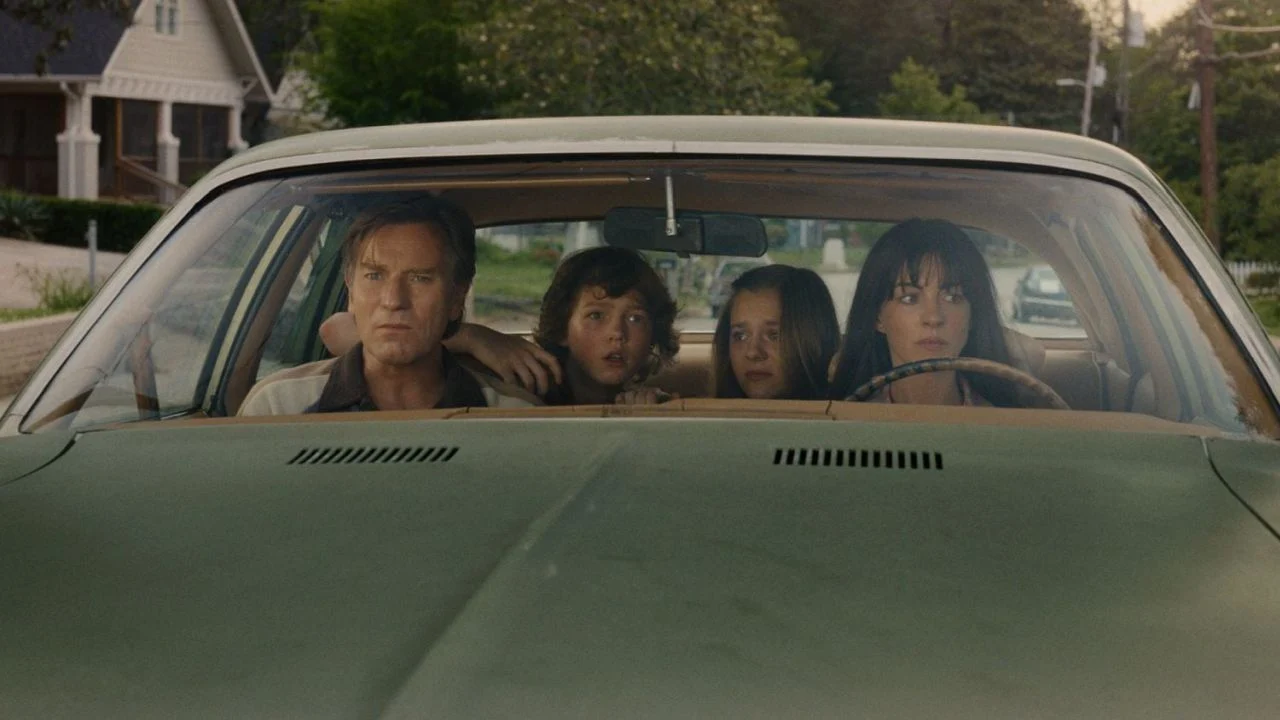
Learned from Steven Spielberg: David Robert Mitchell first shows us the astonished family before revealing why their mouths can no longer be closed.
The Platt couple, Denise (Anne Hathaway) and Greg (Ewan McGregor), are constantly in stress with their neighbor (PJ Byrne) because of their exploratory dog Starbuck – and when a 100 kilogram pile of poop suddenly appears steaming in his garden, he is immediately sure that only the Platt offspring Brian (Christian Convery) could have come up with such a prank. But even if that were the case, where did the palm-like plant suddenly come from that grew to shoulder height in just two days and, according to the library encyclopedia, has been extinct for 200 million years? Something strange is going on in this Californian middle-class single-family home development, through which the titular Oak Street also runs.
The answer to the mystery comes on the following particularly stormy night! As the Platts set out to find the cause of the sudden power and water outage, they are soon confronted with aggressive apex predators from prehistoric times. Apparently their entire neighborhood was inexplicably transported hundreds of millions of years into the past. And before the possibility of returning can even be thought of, the very acute attacks on life and limb – from land, from the air and from the water – must first be fended off…
Less budget, better dinosaurs
After “The Devil Wears Prada 2”, “Mother Mary” and “The Odyssey”, “The End Of Oak Street” marks the fourth theatrical release of a film starring Anne Hathaway in just three and a half months – and “Verity – Dark Secrets” will follow in October. But at least in this case, this also has to do with the fact that “Oak Street”, originally planned for May 2025, was postponed several times by a total of 15 months. We also don’t know whether the responsible studio, Warner Bros., had to first gain the necessary optimism with “Blood & Sinners” and “Weapons” in order to bring such a target group hybrid between broad mainstream themes and high cinephile demands into the cinemas. Or maybe it really just had to do with the fact that the special effects took a lot longer than originally estimated.
But if the official VFX version is correct, then the extra wait was definitely worth it! After the CGI dinosaurs in “Jurassic World: Rebirth” looked much better thanks to “Monsters” mastermind Gareth Edwards than the often just brown-gray pixel mud in “Jurassic World 3: A New Age,” David Robert Mitchell and his regular cameraman Mike Gioulakis (“Under The Silver Lake”) faced a special challenge: Even if they shot “Oak Street” on IMAX digital cameras, it is analog The film’s seemingly realistic look is based on Amblin productions from the 1980s – and you have to put in a little more effort so that the computer-generated giants don’t seem completely out of place. But that’s exactly what has actually been achieved here (with the exception of a prehistoric giant snake, which is used in such a drunken silence scene that, despite a certain artificial look, you hold your breath for many seconds).
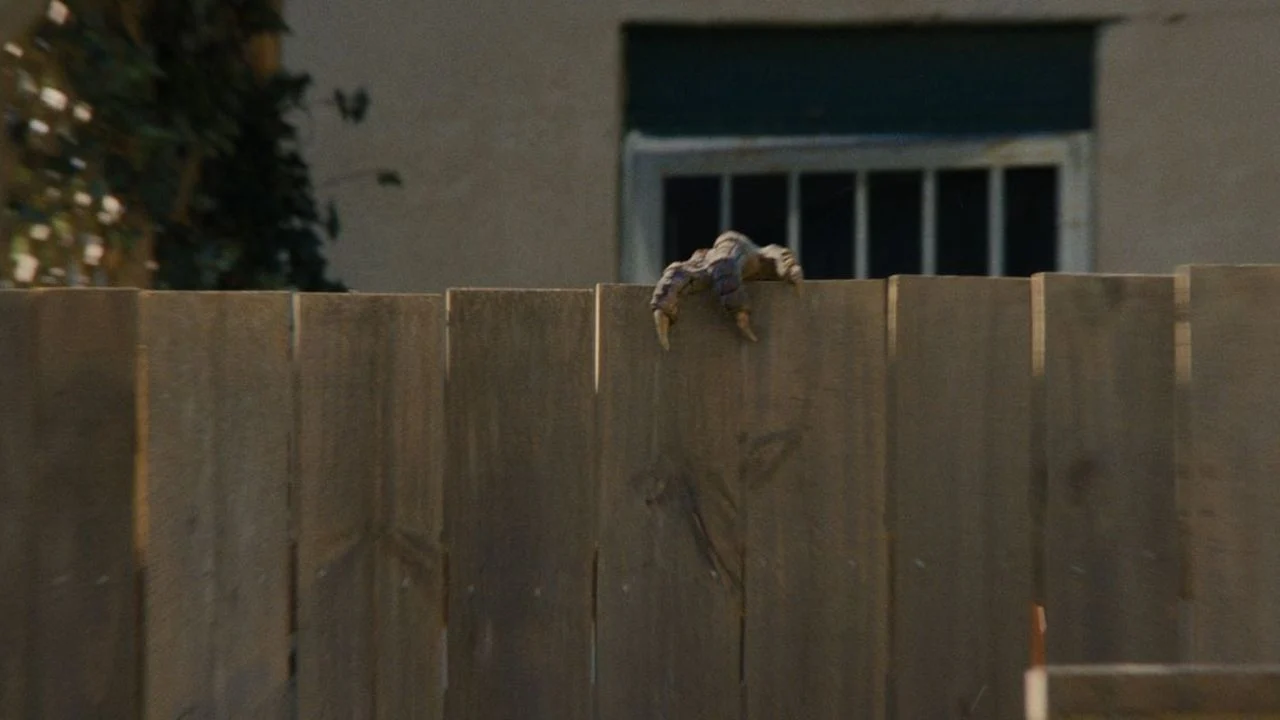
In one of the best-staged scenes in the film, you can hardly see the dinosaur behind the garden fence – but you can still see what he’s doing there!
We don’t want to spoil too many scenes, but Mitchell definitely relies on variety – right down to the turtle-dino equivalent of a bleating herd of sheep blocking the road. But he also learned from Steven Spielberg’s “Jaws,” among other things, that it can often be even more impressive not to (fully) show something – and so there are always clever sequences, especially at the beginning, in which the audience’s field of vision is played with. The highlight: a tracking shot of the garden fence, in which you can easily imagine what the excited dinosaur on the other side is up to based on the elements that protrude over the wooden planks like a rotary clothes dryer.
Anyway, despite the overall running time of just 99 minutes, Mitchell takes enough time at the beginning to introduce the family and especially the tensions between the married couple. Such a dangerous adventure as a metaphor for a family growing back together is anything but new – but a reminiscence of “ET”, in which Spielberg also dealt with the separation of his own parents, simply wouldn’t be complete without (possible) divorce. Especially since all of this comes together perfectly again in “The End Of Oak Street” in the equally clever and satisfying finale with a powerful emotional impact.
Conclusion: What would it have looked like if Steven Spielberg had filmed his “Jurassic Park” not in 1993, but eleven years earlier instead of “ET – The Extra-Terrestrial”? Quite simply: It would definitely have resulted in a masterful eighties dinosaur film like “The End Of Oak Street”!